AuthorsDen.com  Join | Login 

 
Where Authors and Readers come together!

Authors | Books | Audiobooks | eBooks | Signed Bookstore | Stories | Articles | Poetry | Blogs | News | Events | Reviews | Videos | Success | Gold Members | Testimonials

Featured Authors:  Ann Marie Hannon, iD.E.Z. Butler, iRobert Wood, iTodd Cheney, iJohn Burns, iSusan Smith, iDavid Clure, iDiane Hundertmark, iTerry Vinson, iJoshua Su, i

  Home > Relationships > Articles
Popular: Books, Stories, Articles, Poetry      Authors: A B C D E F G H I J K L M N O P Q R S T U V W X Y Z     

Sam Vaknin

 Follow Me  

· 477 titles
· 125 Reviews
· Share with Friends!
· Save to My Library
·
Member Since: Jul, 2000

   Sitemap
   Contact Author
   Message Board
   Read Reviews


Books
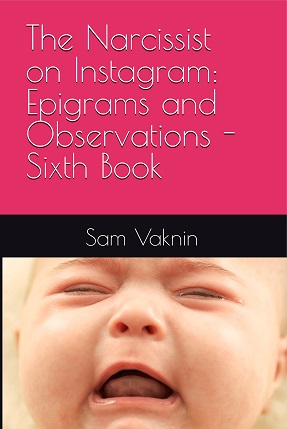
· FREE The Narcissist on Instagram: Epigrams and Observations - Sixth Book

· FREE The Narcissist on Instagram: Epigrams and Observations - Sixth Book

· The Narcissist on Instagram: Epigrams and Observations - Fifth Book

· Poetry of Healing and Abuse

· World in Conflict, Mind in Transition: Sam Vaknin Interviews

· FREE The Narcissist on Instagram: Epigrams and Observations - Fourth Book

· FREE The Narcissist on Instagram: Epigrams and Observations - Third Book

· FREE The Narcissist on Instagram: Epigrams and Observations - Second Book

· FREE The Narcissist on Instagram: Epigrams and Observations - First Book

· FREE A Critique of Piketty's Capital in the Twenty-first Century [


Short Stories
· Hunting Bambi

· Ned’s Short Life

· Sexsomnia

· Fugue

· The Galatea of Cotard

· Live Burial

· Lucid Dreams

· A Dream Come True

· Anton's Trap

· The Elephant's Call


Articles
· Triggering Cascade, Trauma Imprinting, and Total Reactance

· Lessons of My Life

· FILM REVIEW The Place (2017)

· Teen Suicide and Social Media

· The Best Offer

· Cryptoassets (such as cryptocurrencies): Pyramid Schemes or Public Goods?

· 2017 Encyclopedia Britannica Ultimate Knowledge Pack

· Narcissists HATE Christmas, Holidays, and Birthdays

· A Cerebral Narcissist on His Sexuality

· Narcissist's Frustrating, Negativistic, and Passive-Aggressive Behaviors


Poetry
· Her Birthday

· Hebrew Love

· My Putrid Lover

· Twinkle Star

· Synthetic Joy

· Our Love Alivid

· The Miracle of the Kisses

· Selfdream

· In Moist Propinquity

· A Hundred Children

         More poetry...
News
· FREE E-BOOK Abuse, Trauma, and Torture - Their Consequences and Effects

· FREE E-BOOK Narcissistic and Psychopathic Leaders

· FREE EBOOK The Hitler File (Excerpts)

· NEW eBOOK Excerpts from the Archives and Case Studies

· EIGHTH EDITION - Malignant Self Love - Narcissism Revisited

· NEW BOOK - After the Rain - How the West Lost the East

· NEW EBOOK Personality Disorders Revisited

Sam Vaknin, click here to update your web pages on AuthorsDen.

Books by
Sam Vaknin


See all Books
by Sam Vaknin


A Classification of Abusive Behaviors
by Sam Vaknin
Last edited: Friday, November 6, 2009
Posted: Friday, November 6, 2009


Overt abuse is the open and explicit, easily discernible, clear-cut abuse of another person in any way, shape, or form (verbal, physical, sexual, financial, psychological-emotional, etc.).


Abusive conduct is not a uniform, homogeneous phenomenon. It stems and emanates from multiples sources and manifests in a myriad ways. Following are a few useful distinctions which pertain to abuse and could serve as organizing, taxonomical principles (dimensional typologies) in a kind of matrix.

1. Overt vs. Covert abuse

Overt abuse is the open and explicit, easily discernible, clear-cut abuse of another person in any way, shape, or form (verbal, physical, sexual, financial, psychological-emotional, etc.).

Covert abuse revolves around the abuser's need to assert and maintain control over his victim. It can wear many forms, not all of which are self-evident, unequivocal, and unambiguous.

2. Explicit vs. Stealth or Ambient abuse (Gaslighting)

A more useful distinction, therefore, is between explicit (manifest, obvious, indisputable, easily observable even by a casual spectator or interlocutor) and stealth (or ambient) abuse, also known as gaslighting. This is the fostering, propagation and enhancement of an atmosphere of fear, intimidation, instability, unpredictability and irritation. There are no acts of traceable explicit abuse, nor any manipulative settings of control.

3. Projective vs. Directional abuse

Projective abuse is the outcome of the abuser's projection defense mechanism. Projection is when the abuser attributes to others feelings and traits and motives that he possesses but deems unacceptable, discomfiting, and ill-fitting. This way he disowns these discordant features and secures the right to criticize and chastise others for having or displaying them. Such abuse is often cathartic (see the next pair of categories).

Directional abuse is not the result of projection. It is a set of behaviors aimed at a target (the victim) for the purpose of humiliating, punishing, or manipulating her. Such abusive conduct is functional, geared towards securing a favored and desired outcome.

4. Cathartic vs. Functional abuse

While pair number (3) above deals with the psychodynamic roots of the abuser's misbehavior, the current pair of categories is concerned with its consequences. Some abusers behave the way they do because it alleviates their anxieties; enhances their inflated, grandiose self-image; or purges "impurities" and imperfections that they perceive either in the victim, or in the situation (e.g., in their marriage). Thus, such abuse is cathartic: it is aimed at making the abuser feel better. Projective abuse, for instance, is always cathartic.

The other reason to abuse someone is because the abuser wants to motivate his victim to do something, to feel in a certain way, or to refrain from committing an act. This is functional abuse in that it helps the abuser to adapt to his environment and operate in it, however dysfunctionally.

5. Pattern (or structured) vs. Stochastic (or Random) abuse

Some abusers heap abuse all the time on everyone around them: spouse, children, neighbors, friends, bosses, colleagues, authority figures, and underlings. Abusive conduct is the only way they know how to react to a world which they perceive to be hostile and exploitative. Their behaviors are "hard-wired", rigid, ritualistic, and structured.

Other abusers are less predictable. They are explosive and impulsive. They have a problem with managing their anger. They respond with temper tantrums to narcissistic injuries and real and imaginary slights (ideas of reference). These abusers appear to strike "out of the blue", in a chaotic and random manner.

6. Monovalent vs. Polyvalent abuse

The monovalent abuser abuses only one party, repeatedly, viciously, and thoroughly. Such abusers perpetrate their acts in well-defined locations or frameworks (e.g., at home, or in the workplace). They take great care to hide their hideous exploits and present a socially-acceptable face (or, rather, facade) in public. Their are driven by the need to annihilate the object of their maltreatment, or the source of their frustration and pathological envy.

In contrast, the polyvalent abuser casts his net wide and far and does not "discriminate" in choosing his prey. He is an "equal opportunity abuser" with multiple victims, who, often, have little in common. He is rarely concerned with appearances and regards himself above the Law. He holds everyone - and especially authority figures - in contempt. He is usually antisocial (psychopathic) and narcissistic.

7. Characteristic (personal style) vs. Atypical abuse

Abuse amounts to the personal style of most Pattern, or Structured abusers (see point 5 above). Demeaning, injurious, humiliating, and offensive behavior is their modus operandi, their reflexive reaction to stimuli, and their credo. Stochastic, or Random abusers act normatively and "normally" most of the time. Their abusive conduct is an aberration, a deviation, and perceived by their nearest and dearest to be atypical and even shocking.

8. Normative vs. Deviant abuse.
 

We all inflict abuse on others from time to time. Some abusive reactions are within the social norms and not considered to be indicative or a personal pathology, or of a socio-cultural anomie. In certain circumstances, abuse as a reaction is called for and deemed healthy and socially-commendable.

Still, the vast majority of abusive behaviors should be regarded as deviant, pathological, antisocial, and perverse.


It is important to distinguish between normative and deviant abuse. A total lack of aggression is as unhealthy as a surfeit. The cultural context is critical in assessing when someone crosses the line and becomes an abuser.

Web Site: Malignant Self Love - Narcissism Revisited


Want to review or comment on this article?


Need a FREE Reader Membership?


New Articles by Sam Vaknin
article Image
The Narcissistic Personality Disorder and Pathological Narcissism - a Primer.
Pathological Narcissism and the Narcissistic Personality Disorder (NPD)
article Image
The psychology and sociology of art, artists, and the creative process.
Art, Artists, and the Creative Process
article Image
Economics affects every aspect of our lives. Hence the importance of studying the ethical, moral, and philosophical question it provokes.
The Philosophy of Economics - Part II
article Image
Economics affects every aspect of our lives. Hence the importance of studying the ethical, moral, and philosophical question it provokes.
The Philosophy of Economics - Part I
article Image
Detailed studies of five terrorist organizations in the Balkan.
Terrorists and Freedom Fighters - Part II
article Image
Detailed studies of five terrorist organizations in the Balkan.
Terrorists and Freedom Fighters - Part I
article Image
The role of women in the post communist countries in transition.
Women in Transition
article Image
Articles about mental health issues and Personality Disorders
Mental Health Articles by Sam Vaknin
article Image
Essays about various topics in current philosophy. <br>
Philosophy Articles by Sam Vaknin - Part I
article Image
These seven movies deal with moral and ethical dilemmas. "The Matrix" - with the nature of reality, "Titanic" - tackles the moral obligation versus se
Moral Deliberations in Films
article Image
Diplomats and Non Government Organizations (NGOs) thrive in trouble spots.
Diplomats and NGOs
article Image
Can religious communities co-existence? A study of the Balkan case.
Religions and Co-Existence
article Image
Language and media play decisive roles in political and economic conflicts.
Language and Media Articles
article Image
Issues in microeconomics and macroeconomics studied through the prism of economies in transition.
Economics Articles - Part II
article Image
Issues in microeconomics and macroeconomics studied through the prism of economies in transition.
Economics Articles - Part I
article Image
Articles and essays regarding the societies, politics, economics, geopolitics and history of countries in Central Eastern Europe and South Eastern Eur
International Affairs Articles - Part II
article Image
Articles and essays regarding the societies, politics, economics, geopolitics and history of countries in Central Eastern Europe and South Eastern Eur
International Affairs Articles - Part I