It can be a privilege to know where we come from. By exploring our history, we have the opportunity to experience what it was like to live in another person's skin at a different place in time. Because my grandmother Helen Clay Sprague shared her childhood memories with me, I became knowledgeable about three centuries…the two I’d lived in, and intimate glimpses of the century before. She helped me appreciate what used to be, and what still is. It’s good to look back, to see, to hear, to learn, and marvel. Many of our problems today can be solved the same way our ancestors solved theirs. Grandma was fond of saying, “The more things change, the more they stay the same.”
Yet, much of our tangible heritage is slowly being whittled away, all in the name of progress.
My husband Ralph and I had hoped to spend a portion of our golden years on land that was of great sentimental importance to me, the old Clay farm. It was the setting for many of Grandma’s precious stories, as well as her first home. Located in rural DeKalb County, Indiana and straddling the Indiana / Ohio state line, the property was positioned so far off of the beaten path that it would take an experienced Eagle Scout with a compass and a pack mule to find it. The farm had been sold around 1913 when Grandma's family moved to Butler, Indiana. Until then, the land had been in the Clay family since the early 1850’s. I was interested in trying to obtain an acre or two so we could build a summer home. Country solitude appealed to Ralph and I, as we’d spent many years living and working in heavily congested Tampa Bay, Florida.
I had a particular parcel of the land in mind. It sat atop a hill sloping down to the St. Joe River. The chimney from the old farmhouse was still standing the last time I’d visited. I often romanticized about how cool it would be to incorporate the old chimney into our construction plans. I could barely wait to begin my quest to bring a piece of the old Clay farm back into the hands of a Clay descendant. Few neighbors, quiet, and a lazy yellow river sounded like heaven to a couple of city dwellers.
But, no one could prepare me for what my parents and I found when we arrived; the neighboring landscape had become a quarry. The once lovely terrain looked like a military missile testing site. Gargantuan canyons gaped from the earth. Desecration lay only a few hundred yards from our ancestral acres.
And, the old chimney had been knocked down. Not a single brick remained.
We got out of the car, and stood silently on the bridge that stretched across the banks of the St. Joe, watching several huge dump trucks stir up the gravel road as they left with their loads. Dreams evaporated in the midst of the swirling dust. I felt sick.
Surprisingly, on the edge of the quarry property a little brick schoolhouse remained untouched. I prowled around the crumbling structure, discovering a blackboard still intact that once announced daily assignments to students more than one hundred years ago. The children and teachers were long since gone, yet I felt their presence inside the sacred domain. However, it was only a matter of time before the schoolhouse was leveled by the wrecking ball of progress, inhaled into the quarry along with the land once owned by our family.
The realization was heart breaking.
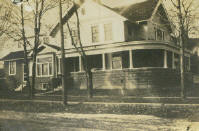
We then drove a short distance to Butler, Indiana where eight-year-old Grandma and her family relocated after they sold their farm. There we found another crushing disappointment. The once elegant, spacious Victorian home at 402 Broadway has since become a dilapidated, disreputable boarding house, a casualty of neglect. Rotten soffits, falling siding, rusty rainspouts, peeling paint, a sagging roof, as well as many broken windows (some adorned with Confederate flags), garbage bags piled high under an outside stairwell…it was a repellent mess.
Dad commented, "It won't be long before this will have to be knocked down."
Words couldn't adequately express the emotions churning inside of me at that moment.
On the same day, we visited two of the places held dearest in our hearts; both were close to total destruction. One was about to be gobbled up, and the other would soon be wiped out by lack of interest.
St Paul Catholic Church on West Washington in Ft Wayne, Indiana is another recent target of the wrecking ball of progress. The historic landmark was built in 1886 in a Renaissance Revival style architecture, which was considered rare for Northeast Indiana. It had been home to countless weddings, christenings, baptisms, confirmations, confessions, communions, and funerals for nearly 120 years. The church was a monument to the history of its past and present parishioners, as well as the city of Ft Wayne. But the Catholic diocese had allowed the church to fall into such a state of disrepair, that it would have taken approximately $3 million dollars to restore it to it’s former glory. Another church has since purchased the property, and is turning the location into a parking lot once demolition of the old structure is completed. Cars will then assume the spot where magnificence once stood…another abomination.
Historical properties provide more than examples of quaint architecture, and fodder for old lore. The tapestry of our lives is interwoven with those who have gone before us. Preservation is not only a link to our heritage, but a reminder of what our forefathers intended for us to become…solid, proud, and appreciative citizens of the greatest nation on earth.
It was a thrill to stand upon land worked by my ancestors, when the states of Indiana and Ohio were still in their infancy. It took tough stuff to live in such a hostile place. I recently read an old expression often quoted by early settlers of the region.
"The cowards never got started, and the weak died along the way."
It empowers me to know that I descend from them. But once the land is destroyed, how will those who come after me ever know that same feeling? When it’s gone, it’s gone forever.
My sincerest wish for our generation, and those who follow us, is that we carefully guard what's left.




Regis
Love Tinka
God Bless
Michelle~