Jacob Gedleyihlekisa Zuma is a former Deputy President of the Republic of South Africa, and current Deputy President of the governing political party, the African National Congress (ANC). A popular figure even across political divides, he gained notoriety after his financial advisor, Mr Schabir Shaik, was convicted of corruption and fraud, leading to Zuma's dismissal as Deputy President of South Africa in June 2005. Zuma was formally charged with corruption soon after that.
In December 2005, he was also charged with rape in the Johannesburg High Court. During this trial, his suggestion that taking a shower would cut the risk of HIV transmission attracted consternation and condemnation among health experts. On May 8, 2006, the Court dismissed the charges against Mr Zuma, agreeing with Zuma that the sexual act in question was consensual.
In November, 2005 an investigation began into charges that he had raped a 31 year old family friend at his home in Forest Town, Johannesburg. Even before charges were filed, the news media reported that the alleged victim was a member of a prominent ANC family and also an AIDS activist; and that Zuma had acknowledged a consensual sexual relationship with the woman in question.
On the morning of December 6, 2005, rape charges against Zuma were formally filed. Zuma vehemently denied the charges, and affirmed his political commitment to oppose sexual violence.

A crowd of supporters and the curious outside the Johannesburg High Court.
Even before charges were filed, as rumors about rape accusations surfaced later in November Zuma's political prospects began to appear to take a turn for the worse. The charge of rape is considered much more serious in South Africa. Most of Zuma's higher-level political supporters could not respond to these new charges the way they had the corruption charges. These allegations seemed at first to take the steam out of Zuma's supporters, but in a hearing prior to Zuma's rape trial, a group of thousands of Zuma supporters gathered near the courthouse, as a smaller gathering of anti-rape groups demonstrated on behalf of the alleged rape survivor. [2] As he did throughout the trial, Zuma sang Letu Mshini Wali with the crowd, and ANC Youth League and Communist Party Youth League spokesmen spoke in support of Zuma.[3] Zuma had not entirely lost his support base.
As Zuma's rape trial proceeded, reports surfaced that the South African Communist Party was severely divided over how to address the issue of Zuma and the SACP's relationship to him. Many members of the party's youth wing supported Zuma while others in the SACP were skeptical about the value of rallying behind a particular person as opposed to emphasizing principles of governance.[4][5][6]
Despite the defection of some former supporters, however Zuma stalwarts continued to rally outside the courthouse, arousing criticism by anti-rape groups for regular attacks on the integrity and moral standing of Zuma's accuser, insults yelled at a close friend of the accuser, and even stones thrown at a woman that members of the crowd mistook for the accuser.[7]. Zuma's defense team introduced evidence relating to the woman's sexual past, and asserted that the sex that took place was consensual. The prosecution asserted that her lack of resistance was due to a state of shock, and that the relationship between the two was like a 'father-daughter' affair.[8][9]
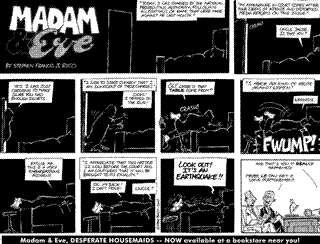
The trial also generated political controversy when Zuma, who headed the National AIDS Council, admitted that he had not used a condom when having sex with the woman who now accuses him of rape, despite knowing that she was HIV-positive. He stated in court that he took a shower to try to reduce his risk of infection, upsetting HIV educators who emphasized that this would do nothing to prevent HIV transmission.[10]
On May 8, 2006, the court found Zuma not guilty of the charge of rape.
|





Ron
Love tinka