THE HIGHLAND HAGGIS
The Antonine wall named after the Roman Emperor Antonius Pius, was built between AD 144 and 190. Constructed out of turf and less impressive than the mighty Hadrian's Wall, it was manned between the Forth and the Clyde in an effort to keep the warlike Scots out of Britain.
Although there was a truce of sorts between the Romans and the Scots it was frequently broken by both sides and it was during one of these incursions that the gentle, peace-loving Highland haggis earned its rightful place in Scottish history.
The Romans - who had secretly massed several thousand troops south of the wall - launched their attack on January 1st 176 AD It was totally without provocation and in direct violation of the peace agreement signed by Gnaeus Julius Agricola (Roman Governor of Britain) one hundred years before.
The Scottish troops were caught completely unawares (the Romans had chosen the day very carefully) and it was only by sheer luck that they managed to repel the first assault.
Outnumbered, the befuddled Scots immediately shelved their own clannish differences and formed a "council of war". Under the leadership of Phil McCafferty - one of the nicest Chieftains ever to have lived - a daring and brilliant counter offensive was evolved.
During the cover of darkness the Scottish troops set about collecting the Highland Haggis, which at that time were very common in the area. Then, working in threes, they fed the docile creatures partially fermented oats and barley.
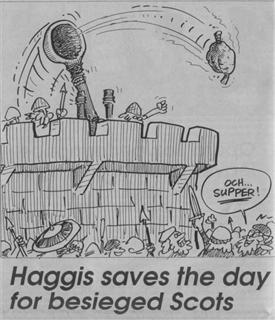
By first light the Scots were ready. Around them lay an arsenal of 10,000 freshly loaded Haggis (Haggai is the technically correct plural but I will continue to use the vernacular) and 20, feet-operated ballistas.
On the wall, crouched ready to leap down and launch the brave, bloated innocent Haggis into the enemy were pairs of the largest Scots, their arms about each others shoulders for maximum effect.
It was then that the Romans attacked for their second - and last - time.
Picture the scene if you can: from out of the mist in disciplined squares of X by X came the Romans, the Centurions voice loud and clear, "Sinister . . . Dexter . . . Sinister . . . Dexter . . . " On the wall, kilt-clad, red-bearded (and eyed) giant Scots awaiting the command.
And then it came . . .
The first salvo of Haggis was a direct hit and took out rows iv and vii of the vth Roman square. Shaken but undaunted they marched on.
Adjusting the trajectory of their Ballistas - one enormous plus one tiny Scotsman instead of two extra large - the defending army fired again.
The "Battle of the Boing" as became known was a complete victory for the less well equipped but more imaginative Scots. Within minutes, confused, confounded and totally disorganised by the exploding Haggis, the Romans turned and fled.
* * * * *
But victory had not come without its costs. As the jubilant Scottish Engineers set about detonating the numerous unexploded Haggis that littered the battlefield the realisation of what they had done sank in: out of a total wild population of 10,000 Haggis, only six remained unloaded.
It is from this "original six" - three male and three female - that the modern day Haggis is descended. Far more aggressive than its pre-Roman ancestor, it also has an uncontrollable liking for malt whisky - for over two centuries grateful Scots weaned newly-borne Haggis on a mixture of Goats' milk and Drambuie (1 part to 10) - which, in spite of the "Anti-Haggis bashing bill" passed in 1797, has made it easy prey for the poacher.
The mating season of the Haggis is extremely short - May 1st to 2nd - but it during this period that the patience of the true Haggis watcher may be rewarded.
It takes the male Haggis 364 days to recover from the previous year's encounter and pluck up the courage to seek its mate. But once it has its romantic mating cry can be heard echoing across the heath-land as it hotly pursues it "ain true love", through the heather, gorse and stinging-nettle (another legacy of the Roman occupation) screaming at the top of its voice: "Och! Ma Conokies! Och! Ma Conokies!"
Indeed it is from this plaintive cry that the scientific name of the Highland Haggis - Haggisimus Conokitis - ("itis" being Greek for "Inflammation of") stems.
So, had it not been for poor timing, the humble Haggis and not the thistle would now be the emblem of Scotland. But that's the way life goes. As an unknown Scottish poet once put it: "Fir d'ye ken da Haggis a mochen lakken, a tombe detal o' konnen vakken!" which, to date, no-one has been able to translate and probably accounts for him remaining unknown.
Drive carefully all you Burns' night celebrators and, "Lang may your lum reek . . . " which is translatable.