View this Article
This is the Third Chapter of a larger work entitled, 'In Search of the Muse-Goddess: Creativity and Female Deities in the Work of Robert Graves'. The overall work explores the usefulness of the poetics of British poet Robert Graves to modern poets, writers and artists of all descriptions.
This piece belongs to Vol. 3 of The Collected Works of Ian Irvine (Hobson). (Nonfiction)
BOOK: In Search of the Muse Goddess: Creativity and Female Deities in the Work of Robert Graves, by Dr Ian Irvine, 2022-23, all rights reserved.
Read: Chapter 3: Poet, Poetry and Muse-Goddess in Graves's Books, copyright Ian Irvine, 1993 and 2022, all rights reserved.
This chapter explores Graves's understanding of authentic poets and authentic poetry, and notes his unique idea that the two concepts are linked to a primordial 'Religion of the Goddess'. The experience of writing and hearing/reading true poetry is discussed. We also look at and critique (or expand upon) certain problems we encounter in Graves's use aspects of James Frazer's work The Golden Bough in order to define ancient experiences around poetry. We note that problems in Frazer's work transferred into Graves's various books on poetics.
SEE ALSO:
*Chapter 1: "Introduction to In Search of the Muse Goddess"
*Chapter 2: "The Influence of Graves's An Historical Grammar of Poetic Myth"
*Chapter 4: 'The Magic of Poetic Initiation: Garbled Poems, Tree Alphabets, Fantastic Creatures and Vanished Deities'
*Chapter 5: "From Georgian Modernism to a Global ‘Origins’ Poetics: Before and After 'the Abdication’" (6.900 words)
*Chapter 6: Who, exactly, is the Triple Muse Goddess? (or ‘Honouring the Ancient Librarian’)
*Chapter 7: Devotion or Degradation?: Reassessing the Love Mysticism Inherent to Graves' Poetic,
*Chapter 8: The Work of Primordial Poets: Toxic Emotions, Catharsis, and the Perils of the Soul
*Chapter 9: Alternative Myth Narratives for Poets: Reborn Wounded Healers
*Conclusion: 'So Cold No Fire Could Warm it', copyright Ian Irvine, 2023, all rights reserve.
*Bibliography to "In Search of the Muse Goddess", copyright Ian Irvine, 2023, all rights reserved.
Also: please note that Graves wrote two major works on the topic of Muse-Goddesses, i.e. The White Goddess and The Black Goddess. Given we live in an age of 'heightened sensitivities' of all sorts, it needs to pointed out here that Graves held to NO racial connotations for these figures in his books, rather both Goddesses are aspects of a theorised multi-faceted sacred entity, usually associated with astronomical colour variations linked with the earth's Moon during various stages of manifestation as it circles the earth. The white Goddess is anciently associated with the Full Moon and the mature adult female (often linked to marriage and motherhood), whereas the black Goddess has long been associated with the Moon's final, or 'waning', phase, i.e. the days of the month before its extinction/eclipse (symbolic death), as well as the wisdom, leadership and transpersonal awareness of older women/elders. The third Goddess in the ancient trinity is usually defined as a red Goddess, she is mentioned in passing by Graves, but he did not write a major work on her. She represents the new or 'waxing' phase of the moon and is anciently linked to younger women and girls. The three figures together also imply the passage of the seasons and therefore the various phases of the year (i.e. they have significance for the 'calender' and the circular passage of time in agricultural societies).
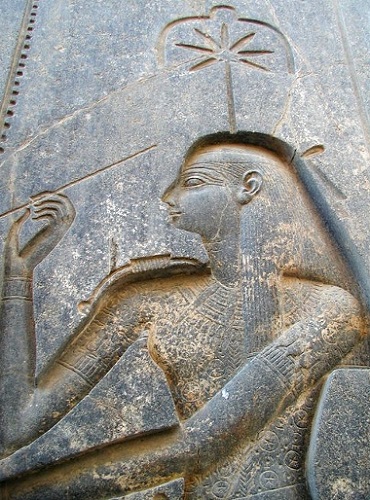
The image accompanying this text, entitled 'Sesheta: Ancient Egyptian Goddess of Scribes' is in the common domain. All quotes and extracts from texts consulted for inclusion in this work are made use of strictly for the purposes of literary criticism and academic assessment of literary ideas, history and theories (as authorised by international copyright law). However, I want to encourage readers to purchase and read in full the many texts mentioned and referenced in the various chapters of this work.
Published by the Zoetics Institute, Bendigo, Australia.
NOTE: The first draft of this work was written in 1993 and presented in partial fulfilment of the requirements for a B.A. (Honours) degree at La Trobe University (Bendigo). Many revisions to the original draft have been made in order to update the general argument for a contemporary audience. This version of the work is being delivered in TEN instalments (i.e. 9 chapters and a Conclusion) plus a Bibliography during 2022 and 2023 and will eventually run to approximately 80,000 words (a significant increase on the work’s original word count).
|