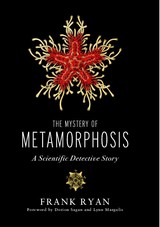
 This is the prologue to my forthcoming book, The Mystery of Metamorphosis: A Scientific Detective Puzzle. Note two free chapters available from www.fprbooks.com.
It is a hot day at the end of August, and students at Amanda Elementary School in Manhattan, Kansas, stream out of classes to gaze heavenward. After several days of clouds and rain the weather has improved, and today the sun is beaming down through a clear blue sky. Suddenly, fingers point to where splashes of golden orange are soaring above the playground. The great monarch butterfly migration has begun. Further south, in Emporia Village Elementary School, students are also staring up at the sky and counting. By the end of the day they will have already listed 100 sightings. Later that afternoon, monarchs come pay a visit at Corinth Elementary School in Shawnee Mission. Hundreds float high in the air, then all of a sudden descend on the playground, accompanied by birds and dragonflies that appear to be making the journey with them. The monarch migration is an exciting annual attraction for children in America, when up to 100 million butterflies migrate from the colder North to winter on the warm Californian coast or the Sierra Madre in Mexico. It is a journey as old as, and maybe a great deal older than, the great migrations of buffalo that have entered legend. On the Web sites that link to the school biology classes, teachers explain what is happening: the story of caterpillar and butterfly, two utterly different life-forms following their different life cycles. The children are fascinated to learn of how the monarch “changes its ecological niche entirely when it transforms from a caterpillar to a butterfly . . . a miraculous biological process of transformation [involving] two ecologically different organisms, as distinct as a field mouse and a hummingbird." It appears almost magical, a transformation that has captured the human imagination from classical times—and perhaps even longer.
We can admire the naturalistic animal paintings on the walls of rock shelters in Australia and South Africa, and deep within the gloom of French and Spanish caves, dating back to the Aurignacian period, roughly 30,000 years. Exquisite sculptures date from the same period, such as the figurines of a diving cormorant, or the putative head of a horse, carved out of mammoth ivory, that were discovered by the German palaeoanthropologist Nicholas Conard at the Hohle Cave in the Ache Valley.1 One such ivory figurine, just a few centimeters long, depicts the hybrid features of a man and a lion. We can’t be sure what the artist intended, but given that a second lion-man sculpture has been discovered in a nearby German cave, Conard suggests that this might fit with a common shamanistic religious experience, suggesting that “the transformation between man and animal, and particularly between man and felines, was part of the Aurignacian system of beliefs.”2 For Conard, this extension of creativity, from mere observation of nature, to a more ideational, perhaps spiritual inspiration, was the most exciting discovery of all. “I’ve been digging for a long time and I’m usually very calm in my work—but this certainly got my heart pumping.”
There is a word for the dramatic transformation of one being into another. We describe it as metamorphosis. This is the title Ovid chose for his classic collection of exotic and wonderful stories, so reminiscent of what was seen in the ancient sculptures and cave paintings, of how men and women lost their human forms and souls to be transformed, by divine miracle, into four-legged animals, birds, and flowering plants. It seems not unreasonable to assume that such inspiration came from the everyday observation of the natural world, where the mystery of metamorphosis is all around us. Indeed, the more one looks to nature, the more widespread appears to be this phenomenon of bizarre, spectacular change. It extends far beyond the world of insects to include amphibians, such as the familiar frogs and toads, and in its most dazzling variety, to the strange and colorful marine invertebrate creatures that inhabit the hidden depths of the oceans, such as starfish, sea urchins, crabs, and sea squirts.
All such metamorphoses involve a series of transformations, so that the developing being exists in a variety of different stages, or forms, from the egg, through one or more “larval” stages, such as we see in the grubs or caterpillars of insects, or the bewildering variety of marine invertebrate forms, to a transformation that results in the final, or “adult” form of the insect or periwinkle, lobster, or salamander. An intriguing example is the startling metamorphosis of the starfish, Luidia sarsi, in which larva and adult coexist simultaneously as independent life-forms in the different ecologies of the surface waters and the ocean floor. If we did not know that the larva and adult starfish were born from a single fertilized egg, we would view them as radically different animals that belonged to completely different branches of the tree of life. In fact, this is no rare or fantastic freak: it’s an altogether typical example drawn from the bizarre, entrancing, some might say magical, process of transformation the starfish shares with the majority of the animal species that inhabit the oceans, lands, and air of our planet. It is part of the mystery of metamorphosis.
In nature, we are familiar with the metamorphoses of moths and butterflies, where the humble caterpillar stops its frantic feeding to enter a phase of quiescence, known as the pupa, or cocoon. Walled off from the world, it appears to undergo a mysterious, and wholesale, transformation from which, as if by some quasi miracle, the glory of the adult eventually emerges. For the Dutch anatomist Jan Swammerdam, judged by many to be the foremost naturalist of the seventeenth century, the metamorphosis of caterpillar to butterfly symbolized the journey from pedestrian life to death and resurrection in the afterlife, with the pupa representing the repose of the soul between death and the Day of Judgment. Such ecstatic vision is perhaps understandable when we see what emerges from that seemingly deathlike cocoon, the newly emerging adult insect with its multifaceted eyes, articulated legs, newfound sexual maturity, and extraordinary wings. That two such very different beings could derive from a single fertilized egg is at once shocking and thrilling. It is little wonder that it has long intrigued the human imagination.
For a great thinker, such as Aristotle, the butterfly’s caterpillar stage was a continuation of its embryonic life that extended to the formation of the perfect adult. “The larva, while it is in growth,” he argued, “is nothing more than a soft egg.”3 William Harvey, famous for his discovery of the circulation of the blood, saw some mystical influence at work in the transformation of the larva into an entirely new form. In the pages ahead we shall meet other naturalists who were equally enthralled, including Charles Darwin, the father of modern evolutionary theory, and the French “poet” of nature, Jean-Henri Fabre. A modern example is Don Williamson, a marine biologist who has spent his working life at the former Marine Laboratory on the Isle of Man. If Williamson is right, metamorphosis is even more intriguing than some of these past luminaries of science and philosophy dared to imagine.
Williamson’s ideas have provoked such controversy in the fields of marine biology and entomology that some colleagues will object to my including his theory at all. I hope that, by the conclusion of this book, my readers will understand why I include him, in part because his story encapsulates this very conflict with orthodoxy, but more importantly because there are aspects of his theory that, taken on balance, offer enlightenment as well as the potential for new research. The mystery of metamorphosis is truly complex and profound—so much so that no single theory, whether orthodox or radical, can be considered in isolation. In addition to important contributions from Darwin and Fabre, I shall focus on the pioneering work of Sir Vincent Wigglesworth, widely regarded as the father of insect physiology, the American entomologist Carroll Williams, and the modern inheritors of both Wigglesworth and Williams’s pioneering enlightenment, the husband-and-wife team of Lynn Riddiford and James Truman.
I don’t pretend that science has all of the answers—metamorphosis still jealously guards many of its mysteries. But what we have captured to date is so precious and fascinating, it is no exaggeration to say that, even in its scientific exploration, metamorphosis remains both awesome and beautiful.
We shall examine these various scientific explorations of the mystery, which includes transformations in real life that would appear every bit as exotic and strange as those we encounter in Ovid’s fantasies. The mystery of metamorphosis will be seen to lie at the very heart of the origins of the animal kingdom, extending beyond insects and the diverse and fascinating marine divisions of life to the vertebrate animals, including the familiar frogs and toads, and possibly to certain aspects of humanity. There are scientists who believe that we humans undergo metamorphosis in the profound and body-changing experience we are familiar with as puberty—and there are extrapolations of metamorphosis that may help us to understand the development of the very organ that defines our sentience, our extraordinary human brain.
|