On Earth serpents were often seen as long-lived, sometimes eternal as the stars. Many investigators have pointed to the fact that snakes shed their skins periodically, claiming this wonder as the source of such beliefs, but that is too simplistic.
Snakes, especially the sun-bellied Egyptian cobra, were a source of food long before a vast civilization grew up along the Nile. Eventually humans began to collect their eggs and raise them like cattle. Still later they came to be kept about granaries, homes and temples. They, and domesticated cats helped control explosive rat populations.
In temples throughout the mid-east cobras became guardians against ‘evil’ and magic (what today we recognize as disease). Anatolian places of worship often had large clay urns guarding either side of doorways. Inside these vessels the hooded snakes lived their lives. In order to discourage thieves it was said that pilgrims and other supplicants must be pure of heart and soul in order to pass, for otherwise they would feel the venomous fangs of 'divine vengeance.'
No doubt it was disconcerting to those entering, for the cobra, feeling vibrating footsteps through the stone (walkway) seemed always to rise out of its slumber to investigate. Those allowed to pass this test had shown themselves worthy, pure and ‘honest’. The unlucky were obviously guilty of some offense, perhaps a deeply secret one, against the divinity which resided inside.
It seems plausible that this is the origin of the custom requiring one to ‘prostrate oneself’ before ‘god’, or god’s earthly image, for it must have quickly become apparent that if one crawled between the guardian urns, hiding their eyes as well as fears, one’s odds of passing safely were greatly improved.
The guardians were fed rats and such. Much incense had to be burned to mask the odor of their ‘nests.’
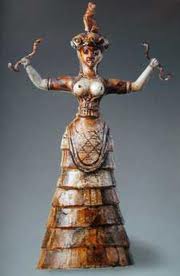
The legend of Diogenes must have grown out of such a fearful place. As we have already seen, creatures half-woman, half-serpent were worshiped all over southern Asia.
Around Asia-Minor they were called Kadi. Canaanites and Shebans knew her as Allat and in Arabia she was Lillith. Hittites prayed to her as Nara and in Iran and India, Naga. Her duties were to draw the fiery chariot of the feminine sun, Amarici/Mara/Mari, etal, and in Paradise she was ultimate guardian of the secrets to spiritual truth.
In this Diogenes was very much like the Nagini, fierce and jealous of arcane wisdom, yet more behind the veil. Even his name (god of genesis) suggests something more alarming.
Although humans seem to have a special fear of snakes, researchers assure us it is not inborn. It is therefore taught, sometimes with masterful sublimity. This phobia is not directly related to any venomous bite a viper might give, although this should not be minimized. What men feared (and still do) most was a mystery related to the supposed immortality of serpents.
Immortality was not confined to single snake, but individuals might outlive the humans who tended them. Men’s real fear came from the female cobra’s apparent ability to reproduce without contact with any male of her species. Such ‘miracles’ were documented again and again ... spontaneous conception. Somehow, even when denied male contact for several years a female suddenly began laying eggs, fertile eggs. And, even more disturbing to men, the hatchlings were all female ... always.
To the male of our species, especially those who fancied themselves an image of this or that god, this unique survival trait posed a direct threat, and should women ever discover the secret (many supposed the acolytes of Mari and Amaz already had), men would no longer be a biological necessity.
Women, men of cultures from China to Britain believed, would give birth to male children only if treated brutally, raped, beaten and starved - forced to yield to a ‘superior’ force, the masculine principle. Pagan Zeus, for example, rampaged all over the planet, raping women (especially virgins) in the guise of the creatures of the Zodiac. (Many ‘traditionalist’ men still see rape as a valid, even holy form of propagation/regeneration).
Greeks, by making the ‘passion plays’ of Aeschylus mandatory education, were able to withdraw the hereditary rights of women, leaving them with fewer privileges than slaves. No wonder Sappho (and others) set up their own island refuges and defended themselves with valor. They were being wiped out like "nests of vipers."
Ironically, modern research suggests that aggressive men are far more apt to sire female, rather than male children. So far it is only a statistical abnormality, but gene mapping is closing in on the matter. Similar findings have been noted for other animal species, as well. Nature somehow manages to control naked aggression because it is so contrary to her survival mechanisms. Another example, it seems, is that the more crowded human communities become, the more diluted sperm counts.
As for Adam and Eve, many explanations have been offered for the nature of their ‘sins.’ They ate the fruit of the Tree of Life, or Knowledge or aspired to immortality, and so on. No matter how the idea of ‘tree’ is translated or ‘life’ defined, philosophers and church leaders invariably decide the ‘sin’ is somehow sexual and it is women and her serpentine ‘familiar’ who are condemned for sexuality.
(One wonders that such pagan, destructive notions are so vigorously propagated these many thousand years later ...)






powerful work
Never stop writing
m
Regis