At the outset, the primordial boundaries are satiated to the extent necessary to delineate science from pseudoscience. In previous episodes, the underlying conjecture in this discourse once again concerns what has been characterized as the 'social studies arena'. Regarding Gonzo Theory and the basic tenets of classical criminology, these are adventurous explorations of pseudoscience. Notably, there is nothing wrong, divisive, or condescending herein relative to the various excursions into the realms of pseudoscience. On the contrary, outside the domains of real science, pseudoscientific quests are about exploring what is yet to be proved. This underscores the need for critical analysis and exploring uncharted territories in our understanding of the world, a crucial aspect of academic and scientific progress. Undoubtedly, the allure of the arcane permeates much of the social spectrum. The fascination with 'alchemy' is not confined to cyberspace but extends to the liberal arts domains of criminology, psychology, sociology, and theology.
At the outset, the primordial boundaries are satiated to the extent necessary to delineate science from pseudoscience. In previous episodes, the underlying conjecture in this discourse once again concerns what has been characterized as the 'social studies arena'. Regarding Gonzo Theory and the basic tenets of classical criminology, these are adventurous explorations of pseudoscience. Notably, there is nothing wrong, divisive, or condescending herein relative to the various excursions into the realms of pseudoscience. On the contrary, outside the domains of real science, pseudoscientific quests are about exploring what is yet to be proved. This underscores the need for critical analysis and exploring uncharted territories in our understanding of the world, a crucial aspect of academic and scientific progress. Undoubtedly, the allure of the arcane permeates much of the social spectrum. The fascination with 'alchemy' is not confined to cyberspace but extends to the liberal arts domains of criminology, psychology, sociology, and theology.
This widespread influence of pseudoscience, which underscores its impact on the 'social studies arena ', should be a matter of urgent concern. Of course, there are other examples of bonafide scientific endeavors, such as paleontology and zoology; the pseudosciences encompass a variety of fascinating quests. For the "social studies arena", sometimes comically called "social sciences", these four are the most common representations of ideological wizardry. And are closely connected to investigations of anomalous mental phenomenon (AMP). Such are endless adventures in academia, from one generation to the next, to theorize within the scope of various philosophical ideologies. Whereas one estimate suggests about fifty (50) types of science, from applied to natural science, the alleged "social sciences" deal primarily with opinion-based speculative conjecture. There is an absence of definitive scientific validation through irrefutable evidentiary artifacts and viewpoints (opinion, rumor, gossip, etc.), and favorable forms of evidentiary substantiation are not considered. For instance, skeletal remains would be helpful.
The need for irrefutable evidence is paramount in maintaining scientific rigor and integrity. Meanwhile, the investigations into the nature of magical thinking address the caldron of spooky things that may be referred to as AMP. Depending on the country relative to its usage, some friends and some foes, the phrase refers to personal experiences involving consciousness and unconscious realms of human behavior. The absence of verifiable physical evidence, such as DNA sequences, undermines the biological plausibility defense of any semblance of cryptids.
One CIA report released in 1994 suggests AMP about remote viewing (RV), as well as those parameters regarding extrasensory perception (ESP) and precognition. Here, AMP includes a broader range of behaviors. The search for cryptids, or UFOs and aliens, represents a broader context of people searching for themselves. For instance, finding feelings, meaning, and psychic substance in existence finds the strain of both conscious and unconscious mysterious processes. Monsters of all sorts are everywhere, most often in plain sight. But they are clever and wear many masks in this masquerade of socio-economic illusions. As to their existence, they come from the abyss in the brain's vast cerebral matrix, particularly the unconscious realms. Each manifestation is of each person's creation. And this point is fascinating in that the U.S. supposedly has among the highest rates of so-called "mental illness" when compared to other allegedly developed countries. According to a 2003 paper published in a science-oriented publication, the prevalence of adverse mental health issues is high, with correspondingly low rates of treatment success.
Debating the relevance of supporting scientific evidence for what might be considered "mental health" is not in the purview of this discourse. As the mystical realm of psychodynamic health issues is significantly arguable, scientific efficacy remains elusive. Regardless, the U.S. is in the top three countries of the world with the highest rates for so-called anxiety, depression, schizophrenia, etc. Again, evidentiary substantiation, other than opinion-based research, eludes definitive quantification. Nonetheless, among adherents to the various subsets within the fields of psychology, a prevailing view suggests that AMP may be associated with psychological problems. Some researchers in those areas of the social studies arena consider paranormal ideations to be "psychosis-like" beliefs. This also includes "schizophrenia". Similarly, "perceptual distortions" and eccentric behaviors (i.e., UFOs, Bigfoot, etc.) are widespread among the U.S. population. This infers that supernatural beliefs are commonplace.
One research paper suggests that anomalous (AMP) behaviors cannot be explained by scientific evidence but remain prevalent without proof beyond a doubt. Somehow, this sounds contradictory. In this sense, how is it widespread if no one explains AMP? Or, consider this. If it is commonplace, why is it considered abnormal? One answer might be more disturbing than the mysterious nature of AMP. Such things, if abnormal and widespread, work to the advantage of the various interests within the domains of the social studies arena. Meanwhile, some criminologists are looking for scams among all of them. The lack of corroborated sightings and the reliance on anecdotal accounts without rigorous documentation fail the research's credibility.
Additionally, from a criminological perspective, what does the evidence show? Overall, relevance tends to reflect personal viewpoints. Eyewitness testimony and personal opinion are matters of biased interpretation. For a slight departure in this adventure, where does thought come from? One view and there are many; thoughts come from the intricate nature of neural processes. Philosophers and scientists speculate myriad propositions. A particular viewpoint from a neuroscientist is that thinking emerges from nowhere and yet everywhere. From the complex interactions of neurons, no one precisely knows how thoughts emerge. For many researchers, it remains a puzzle for which definitive answers defy biological delineation. Guesswork abounds across a spectrum of charlatans to criminologists. Speculation relegates the mystery to all manner of cerebral processes within the brain. Some will hazard the speculation that thinking is influenced by a wide variety of interactivity, internally and externally, in the person.
This infers nothing other than willfully making choices and deciding actions to take. Hollywood detectives are leaping to hasty generalizations of motive, means, and opportunity in the movies. Similarly, most people use fiction as their factual representation of the real world. However, in terms of a competent investigative process, much depends on the experienced skill set of the investigator. The skill set is contingent on a variety of conscious competencies. A wiser sense of personal maturity, productive self-evolution in transformation, and exceptional real-world experience are necessities. All too often, especially in the various fields of the pseudosciences (e.g., criminology, psychology, cryptozoology, etc.), wannabe "scientists" muck up the intellectual strain of murky philosophical waterways. Attempting to assert science where science has no explanations or the investigator lacks credibility is generally part of an overall scam.
For this, the spheres of the "social studies arena" are a multifaceted circus filled with con artistry. So-called reality TV shows, which are not about reality, are rife with an array of pretentious infantile influencers. As such, sleight of hand is always present. Caution is warranted every step of the way. Meanwhile, emerging from the vast U.S. intelligence community, studies continue to pursue how thoughts translate into behaviors. For example, in 1994, the "decision augmentation theory" (DAT) conceptual framework was studied extensively. This perspective considers how humans integrate information obtained through anomalous cognition into decision-making. Noted here is the assertion that "decision-making" infers the freedom to decide and determine choices. For classical criminologists, this is a critical concept. Going back to the previous claim, cognitive integration reflects a "mental menu" where choices are made.
Then, there is the escape plan. Psychodynamic transfiguration in the projection of the fantasies. Thinking is all about searching for explanations to answer core questions about individuality. Such is the quest for ultimate liberation. Narcissistic mirrored images looking back tell stories and invite the darkness. How is that expressed? Is it ghost hunting? Or, does it relate to a monster quest, or better yet, stalking the creatures to prove essential validation? Who needs to find a way out? But wait, what is the plan? The plan is to find freedom and become a liberated, well-differentiated, transformed entity. However, that requires painful, laborious effort. How do you prove it exists? Where is the asserting going relative to the escape? Escapism is the very core of American society. Forget the serious destructive issues of maladaptation, which are rampant everywhere. Just focus on gluttonous consumerism. In the process, create the "monsters from the Id". Not the plan itself, but the alleged conjecture of that which exists.
Which, of course, reside beyond the scope of limited imaginative processes. Critical inquiries stumble into unsuccessful results due to the persistence of erroneous assumptions and absent evidentiary sufficiency. What concrete facts are in evidence? Trite, inconsistent, and irrelevant diversions deflect to states of debilitating psychopathology. As hasty generalizations unfold with alarming frequency, the debasement of contrived consensus erodes the vitality of the truth. No rescue is coming; it is up to the individual to ascend forcefully. Yet, never-never land awaits daily for the pampered pan of petered-out infantile selfishness. Creatures that fail the intense scrutiny of critical analysis through natural proofs are endlessly recreated for personal satiation. And so, the human creator needs one creation after another. For that, escapism is the narrow trajectory of easy subservience that makes submission easier.
From a science publication in 2021, researchers explore the unreality of cryptic creations. For con artists, like movie makers and such, the sleight of hand is for material gain. To the believer, the adherent of the cryptozoological philosophy, replication is a fantasy that has been brought to reality. Both serve as the very basis of carnal excitation. For those seeking a bridge to cross between science and folklore, the authors point out the struggle between science and non-science. The return to pseudoscience is more applicable at the end of the day. Once again, that word appears, and there is nothing wrong with embracing the framework of pseudoscience. Such an effort accepts the notion that the science is not there yet. To acknowledge that is to put on the face of a grown-up person. That is to say, such a person who invokes self-evolving maturation. It is okay to realize that not everything has a solution, and some things remain mysterious.
Similarly, it is also okay to pursue the variations within the framework of pseudoscience. An expanded definition of this word infers the study of the unknown while attempting to apply scientific methodology. A pseudo-reality exists across a multidimensional universe. Thinking is a potent example of such potentiality. As realities vary, the three-dimensional context is allowed to blur other diverse probabilities. Outside this pretext, absolutes may falter. Who knows? No one knows with any sufficiently high degree of accuracy. Regardless, the pseudo environment is reflected in dreams. Initially, whenever the prefix "pseudo" is heard, the elementary albeit juvenile reaction is the presupposition to "fraud, fakery, false" or other "F" words. Yet, in the lexicon of many references, there are layered definitions. In earlier origins, the word stems from the Latin for spurious claims that may imitate or exaggerate other things. However, for this purpose, the use applies to that which cannot yet be proved beyond doubt by the evidence.
To explore thinking processes, a historical researcher with a medical background (science) delved into the deep regions of the unreality of dreams. Many propositions conjectured the scope, intent, and expanse of dreaming connected to consciousness. As to the earlier theories of the dream state, the 20th-century medical doctor considered the non-human possibilities of special symbolic meanings. The research claimed that most people fail to use their full sensory capabilities to understand these mysterious psychic hauntings. Most people fail to grasp the hidden implications. Instead, fantasies are taken into the reality of the awakened state and recreated into something seemingly tangible. Cryptids become creatures of reinvented manifestations from a surreal world of individually induced imaginative processes. Again, it is indicated that humans are good at deception, especially in deceiving themselves. As such, it is easy to overlook the natural realities of hard-core science to substantiate one’s agenda.
In the studies of one zoologist, the skeptic proposition is defended based on biological restraints. Cryptids cannot be singular entities that exist without replication like other animals. Breeding must take place to perpetuate the cryptid species. Otherwise, they cannot exist. For the population of such to grow and reproduce, territorial roaming grounds are required. So far, none have been found. Biologists, paleontologists, and zoologists agree that larger mythic creatures, like Bigfoot, need increasing areas of "home ranging". There is a biological formula for that: the larger the creature, the broader the range. Likewise, the equation would come to bear again as to lake creatures. Larger bodies of water are needed for larger aquatic mythic entities. Of this particular viewpoint, other attributes would be necessary to prove existence.
Criminology is a pseudoscience, as is the hunt for "monsters". While some academicians run screaming and hollering, renting their alleged "scientific" viewpoints and dousing themselves with holy water, the refreshing notation is that in the "social studies arena," real science takes a holiday. Simultaneously, some classical criminologists look for scams, hoaxes, and criminality in the shadows. From the Latin crimen to the word or reason in logos, the theology of crime studies is a philosophical adventure. It is often more associated with chasing a "white rabbit" down the warren of folklore, myth, and legend. As a reminder, there is nothing wrong with the pursuit of that which a sufficiency of evidence sufficient rove. So, pseudo is okay; put down the cross, the holy water, and the silver bullets. The fun is in the adventure. If for no other reason, such pursuits give temporary respite from all the other political nonsense interfering with our daily lives. The plethora of faux experts abound throughout the mainstream.
And we desperately need to delve deeper into our darker selves and embrace the fantasies created. As to that, pseudoscience is an apt descriptor. Yet, for many, the thinking that is wishful thinking pervades attempts to elevate the importance of scientific objectivity. All too frequently, the chase is in the need for self-gratification. It might be self-glorification for an online blog or ensure tenure by publishing another spurious paper supported by bogus "peer review". With criminological explorations, cryptozoology shares kinship. Both share the questionable basis for their simplistic albeit shallow approaches to investigative efficacy. Once again, a brush with the sheer nature of criminality comes to the forefront. There is plenty of room for fraud, hoaxes, and scams. Look at all the advertising surrounding any TV show involving the "quest for monsters". What is the first annoying sleight-of-hand tactic one confronts on a particular "creature quest show"? It is a spooky cinematic sight and sound introduction.
Typically, that is followed by a quick series of non-evidentiary opinions. But more importantly, the subtlety of product placement as the main protagonist. It's advertising, especially if viewed on a particular "tube", where everything is about monetary policies. For a one-hour show, the telecast is 45 minutes or less. In the scope of one show from a certain series, any pretext for scientific validation barely receives attention. The skeptical viewer is reminded that educationally oriented intellectual maturity is not a high priority in American culture. Just the opposite is more of the tragedy. In investigative analysis, distinguishing between science and pseudoscience becomes a daunting challenge. No doubt real science sometimes makes errors, and sometimes pseudoscience discovers a relevant nuance of importance.
In terms of overall balance, pseudoscience commits tremendous errors regularly. So much effort devolves into personal prejudice. Intentional predisposition to feelings instead of facts relegates authenticity to primordial depths of immaturity. Nevertheless, inquiries are necessary into all manner of mysterious occurrences. However, the caveat is constant: people can be wrong when assessing any particular perspective about life on Earth. Large numbers, an entire society, can be extraordinarily misguided in assumptions about phenomenological events. More often than not, hasty generalization become policy. Such notions are witnessed daily in academia, particularly in the "social studies arena". As "hope springs eternal" for the satiation of subjective validation, where correlation competes with causality, cognitive bias pervades the fundamental aspects of the investigative process. Self-centeredness, as opposed to objective selflessness, often enters the picture. The result is a plethora of "baloney and sausage".
Relative to the ongoing debate in the "forensic sciences" realms, scientific validation demands strenuous efforts for objectivity. Beyond emotional reactivity and subjective intensity, the necessary perspective requires proof over and above opinion. Frequently and displayed brazenly in "reality TV shows" is the disconnect between viable investigations and superficial, overly simplistic conjecture. Competent analysis and critical inquiry insist on questioning, doubting, and testing every aspect of the issues. Rather than a sophomoric superficial regurgitation of alleged eyewitness resuscitation, incident analysis invites rigorous application of scientific validation. Up against the challenge of social media misinformation, where "experts" are easily invented, the investigator risks the ridicule of the "adult child". For the salacious reinforcement of psychic masturbation, infantile narcissism is rampant in mainstream culture. Unfortunately, fits and bursts of media tantrums overshadow intellectual ascendancy.
As one scientist points out, fact-checking in American culture is nearly nonexistent. Every kind of B.S. permeates blogs, pods, and vlogs as if unenlightened mental self-flagellation is a persistent pastime. Modern 21st-century "influencers" seem to correlate the legal drinking age with intellectual achievement, absent the combined maturity of education and real-world experience. Healthy skepticism, tempered by realistic cynicism, patiently waits for substantiation, as the burden of proof is on the claimant. Whoever makes the claim is responsible for proving the assertion. A fanciful hypothesis based on opinion, rumor, gossip, or even eyewitness accounts is potentially slayed by the necessity of facts. Entire industries built upon the conjecture of the "social studies arena" reflect the myriad ghost stories of anomalous mental phenomena.
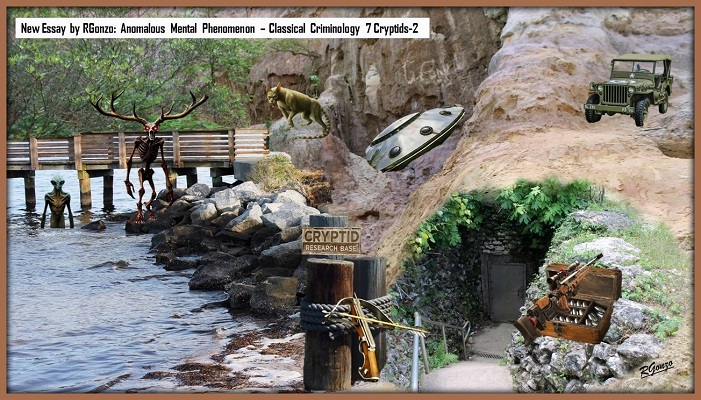
Five key issues in the investigation of cryptids. Those enigmatic creatures whose existence remains a mystery to mainstream science present challenges to provability. In terms of the “crime scene,” all too often, evidence eludes forensic science analysis for several reasons:
- Proving the existence of cryptids is a formidable task, as they typically lack tangible evidence, such as bones, hair, or other biological materials that forensic scientists can analyze and verify. For example, identifying, collecting, and testing evidence at a crime scene is intricate and time-consuming. This absence of concrete proof presents a significant hurdle in validating their existence. To paraphrase a familiar quote in scientific investigations, astonishing claims require astonishing evidence.
- Scientific rigor is meticulously applied to cryptid claims, especially those reported in areas where their existence is biologically and ecologically implausible. For instance, large creatures like Bigfoot or the Loch Ness Monster would require substantial and consistent food sources and habitats that do not exist. This rigorous approach helps to separate fact from fiction, ensuring that only credible evidence is considered.
- Lack of Reproducibility and meticulous measurement: Forensic science relies on the ability to reproduce results. Independent researchers, who are not affiliated with the original investigation, often cannot consistently reproduce or verify cryptid evidence. This is because they may not have access to the original site or conditions of the sighting or because the evidence is not robust enough to withstand independent scrutiny, undermining its credibility.
- Technological Advances in Wildlife Monitoring: Modern technology, such as trail cameras, drones, and satellite imagery, has not produced credible evidence of cryptids despite extensive monitoring of habitats. Meanwhile, overhead satellite surveillance of the planet is very extensive.
- Genetic Analysis Inconclusiveness: DNA analysis of samples purported to come from cryptids often matches known species or is too degraded or contaminated to provide conclusive results. This undermines claims of new or unknown species.
- Falsifiability Theory Application: Falsifiability is essential to forensically oriented scientific investigations. It encourages rigorous testing, objectivity, technological progress, lucidity, and dogmatic and subjective validation prevention.
- Logical Analysis: In 2023, a national outdoor magazine reported approximately 54 million hunters and anglers in the U.S. are active in outdoor activities. These types of recreation have increased significantly, from hunting with firearms to fishing rods to bows and arrows. About 26 million are estimated to be active in hunting. And yet, no one has “bagged” a cryptid, particularly in the “big game” category.
|