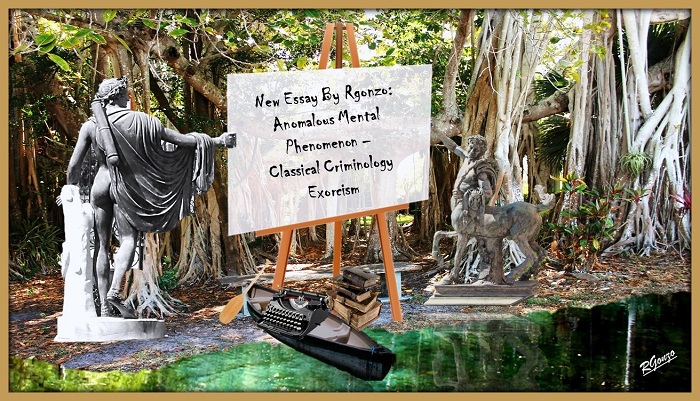
In his latest essay, Randy Gonzalez critiques the cultural fixation on supernatural phenomena, particularly exorcisms and demonic possession, as a case study in the conflict between pseudoscience and the scientific method. Part of his Gonzo Theory series, the essay explores how belief systems—fueled by infotainment, pop culture, and media sensationalism—blur the lines between reality and fantasy, particularly when unverified phenomena are presented as fact. Gonzalez scrutinizes the "adventures in metaphysics," as he calls them, where academic fields like criminology and psychology intersect with pseudoscientific explorations of the paranormal, making a sharp distinction between these pursuits and the empirical rigor required in natural sciences such as physics or biology.
At the outset, the basic schematic is, as in previous episodes of Gonzo Theory (a classical criminology perspective), to assert the dichotomy between science and pseudoscience. Or, as indicated herein, the distinction between adventures in metaphysics and scientific exploration. As to that, the inference promulgates the all-encompassing realms of pseudoscience, also referred to as the “social studies arena”, versus the critical domains of the natural sciences. Particularly, in the so called higher education spheres of academia, the four prominent fields of study include criminology, psychology, sociology and theology. Among these expositions of pseudoscientific endeavors, allied fields include the various subsets of the supernatural, the parapsychological and the extraterrestrial. And, as mentioned on occasions before, there is nothing wrong with the claim that one is involved in pseudoscience. This means things are not fully known yet.
To this mention, the “pseudo” prefix suggests the philosophy in point of reference is still exploring unknown spectrums of human behavior. Such behaviors are associated with thinking processes. In classical criminology, free will is essential as a core tenet. No excuses, no mitigations, and no alibis, choice is freely undertaken by rational instigation on the part of the instigator. For the metaphysics of pseudoscience, scientific validation is yet to be achieved vis-a-vis real sciences, such as astrophysics, biology, chemistry, physics, or quantum mechanics to name a few. For criminological issues (i.e. criminal investigations, etc.), from crime scene to courtroom scientific validation is essential. This is frequently referred to as the areas of “forensic science”. Within that framework, come the applications of the natural sciences. Without hardcore scientific authentication, conjecture falls on matters of viewpoint.
As such, so called “opinion evidence” is to be ruthlessly examined. Since eye-witness testimony, as well as personal perspective, are subject to unreliability, the rigors of critical analysis are important. For the criminology practitioner (e.g. the first responder, police officer on scene), that is a challenging process. As a religious rite, exorcisms are a fascinating and mysterious matter of philosophical interest. Not to forget of course, the hunt for scientific efficacy. In the mainstream, the notion of an exorcism captivates audiences around the world. Such is a popular motif in various genre. Where storytelling is creatively enticing, so is fraud, hoax, scam and so forth. While there is diversity among religious ideologies, there are also secularized versions in the form of alleged “psychotherapy” practices. Within this spectrum, belief systems become intriguing.
An interesting question occasionally surfaces in this regard. In one criminology class for example, the puzzle of “why” people commit horrendous crimes was of primary focus. While there are no single definitive answers as to the proverbial “why”, there are many philosophical viewpoints. Projecting one’s inner believability may lead to dangerous perpetrations. That is, if someone believes something to be true , is it true with regard to them? Take for instance, the beliefs associated with the supernatural, paranormal and the extraterrestrial. For many, their belief systems insists on the existence of things beyond the natural world. And, added to that is the vast “infotainment” networks, social media, mainstream media, etc. that encourage all manner of phenomenological points of view. Well-reasoned logical deductive processes often fall by the wayside. In many way, without proof, mysterious realms exist alongside of the physicality of our three dimensional world. All too often, believing is “reality” absent the science.
In that regard, nearly 80% of the U.S. public believe in something connected to things like cryptids, aliens, ghosts, etc. What people believe is important to how they respond to their environment. This can be productive or destructive. Then toss in the con artists. As the predators sense targets of opportunity illicit manipulation, control, domination and so forth, maladaptive perpetration is close by. The criminal mindset permeates society. From acquiescence to manufactured normalcy, to gluttonous consumerism, as well as myriad acts of violence, belief systems harbor a variety of “monsters from the Id”. Subsequent actions, prosocial or antisocial, stem from these belief systems. Whether smart or stupid, all manner of people assert idiotic stances. Powerful enough, the thinking processes on an individual basis asserts a kind of alternate reality. By insisting upon a certain frame of reference, realty becomes more of a surrealistic alteration on a person to person basis. The words “magical thinking” come to mind.
While one might argue in opposition to a given perspective, based on facts in evidence, another counters with their faithfulness to a certain dogma, conspiracy, or mythic ideation. In the realms of anomalous mental phenomenon, truth can be altered to fit the scheme. In alleged reality TV, the schemes are abundant and hoaxes and frauds masquerade as authenticity. According to one research institute, the truth in American society is decaying. Lines are blurred between fact and fiction. Contemporary cognitive processing, as a sweeping generalization across mainstream society, interjects a continuous flow of bias. With a never ending array of opinion driver blogs, vlogs, pods and flogs of all kinds, truth doesn’t stand a chance of survival. As to that, frequent encounters on the internet come into contact with so-called “influencers”.
These exposures of contemptuously vaporous intellectual depravity castrate the potency of intellectual ascendancy. Regardless, assert the dark side, as some proclaim. Embrace personal deviance in every aspect of the imagination. And, take an adventure into the darkness of oneself. Or, follow the cowardly lion down the well-worn paths of manufactured normalcy. By contrast, it opens the mindful carnality of individual proclivity. Exit the safe zones, the neutered debilitation of contrived consensus. In that quest, the motions are those of ongoing individuation in the process of self-evolution toward extraordinary depths of maturation. Such engages the arduous efforts for becoming a well-differentiated life-form. With that comes the dedication to a healthy sense of skepticism, yet receptive to the possibilities that pseudoscience may stumble on the truth. As to the various perspectives on exorcism, investigate fraud and distinguish between fiction and fact-finding. Regardless, most people remain in a state of impotent stagnation.
Meanwhile, competing interests are busily attempting to capitalize on the belief systems of others. From ideated fantasy, dreams, or otherwise, the perpetration surfaces to the stage play of everyday life. From a criminological point of view, con artists stalk every byway of human activity, looking to instigate the next con job, swindle, hoax, and other deceptions. As such, nearly a dozen years ago, a cable news network invited a brief debate between a skeptical inquirer and a representative of the religious community. Naturally, in the mainstream media, as nothing changes much of time, the moderator is often not well versed in probing the postulations. For the pastoral perspective, the advocate asserted that his/her experience include over 10,000 exorcisms. This, of course, was translated into a “reality TV” show. During the course of the “Q & A”, the moderator, in this case, started off by asking for the evidence. What is the evidence in favor of exorcisms? Or is it real demonic possession? Could there be a scam at work, or serious psychological state of being? In answering, the pastor in question diverted to his/her tv show.
As the panel discussed ensued, controversial commentary became unglued. In lieu of scientific validation, the ecclesiastical advocate diverted to a defensive posture of justifying the idea of performing exorcisms. Based on opinion of philosophical assertion, eyewitness testimony, and observation an assortment of mysterious behavioral antics, simplistic over-generalization was applied. Still however, the science remained on the sidelines. By contrast, a veteran skeptical investigator countered with reference to myriad possibilities of psychological implications. No matter how bizarre the behavior is, there is a high probability that psycho-dynamic cerebral energies are at work within the individual in question.
As the cable news channel segment played a clip from a reality TV show on exorcisms, the showmanship of intentional scripting became apparent. As with all so-called reality TV shows, the staged antics are manufactured to seduce the audience. Similarly, the exorcism adventure follows a standard format for viewer enticement. Lots of stage props are necessary. In monster hunt shows, lots of firepower is usually brought onto the scene. Yet, no one ever fires a gun at a monster. How much firepower is needed for “demonic minions”? If they’re so powerful they cohabitate with the human host, how would you “shoot” one? At any rate, the newscast, in this instance, naturally has to play the music from a popular fictional movie on the subject. That sets the stage for audience appeal and does not promote evidentiary substantiation. nonetheless, a skeptical investigator counters with an emphasis on rational assessment. In the 21st century, with advances in scientific capabilities, belief in “demonic possession” is called into question.
One accusation that seems plausible is that “role-playing” to the ever-absent necessity of proof is central to portraying the probability of fraud. Following the scripted stage direction, actors fill the gaps between the real and the surreal. Another assumption is that opinion is more relevant than evidence, for the alleged victims involved, much like those claiming alien abduction, separating fact from fiction is a problem. As usual for the investigative process, opinion is not evidence and neither is eyewitness testimony. With the public saturated in stories, movies, television, art, and so on, filled with references to evil spirits, reality blurs with fantasy. For the harsh authenticity of forensic science, as in a crime scene investigation, what does the evidence demonstrate? That is to say, where is the smoking gun? Again, role-playing with guttural sounds, makeup, puking, fomenting vile accusations, thrashing around, and flailing hands and legs does not prove the efficacy of demonic possession claims. More likely deception is afoot.
In the warning of one critical investigator, the belief in exorcisms in modern times is discouraging. Such is disappointing in an age of vast information flow, educational opportunities, and technological innovation. Supposedly, in an enlightened culture, such things would no longer be prevalent. Accordingly, such provocations of ignorance about the mental states of people, speaks volumes medieval regression to primitive states of thinking. Regarding early religious practices of the 1600’s, the stereotypic behaviors of so called possession remain consistently expressed in the modern era. As though a template for standard issues possession, the same antics are incessantly redundant. Human thinking is complicated. Understanding consciousness is still quite mysterious. And, mistaking possession for mental problems is dangerous.
Everyone has psychological issues. Growing up and acting like a mature, self-evolving adult is challenging and terrifying. This is particularly true in a gluttonous consumer culture, where an abundance goods and services foster a leisure society. By way of diverse manifestations, everyone expresses a unique aspect of their disfunction. To that end, the myth of “mental illness” pervades the menu of escapist mitigation to preclude personal accountability. More often than not, the excuse of “mental problems” is quickly suggested as the default explanation as to why someone does something stupid. Most of the time, nearly everyone is acting stupid in some way. In an effort to dissuade the psychic maladaptation of certain personalities, one skeptical inquirer’s investigation into exorcisms asserts the ignorance of the current era. Where there is limited intellectual ascendancy, there is a tendency to relish in magical thinking.
With nearly 80% of the American culture clinging to mystical beliefs, it is little wonder such simplistic notions abound. Dull, boring, and regressing, large swaths of the population prefer not to self-evolve. As such, an array of movie-making magic entices the myriad illusions of the public. Horror stories are exceptionally popular, and the resurgence of demonic depictions adds to such influences. While many viewers find the latest exorcist adventure entertaining, others find such fictions reinforce dearly held beliefs. One technique storytellers embellish upon is the so-called “true story”. Sometimes the introductory portion of a movie offers text suggesting it is “based on a true story”. For the credulous, this is somehow reflective of the real truth and nothing but the truth. Yet, on the contrary, it is more “reel truth” than anything else. Which of course, this means a red flag ought to mindfully popup. Entertainment is about money making. It is not about presenting a fact driven, evidence laden, and scientific analysis in documentary format.
However, the fictional aspects can be quite entertaining for those who enjoy the genre of horror. This is not edutainment or infotainment. It is theatrical entertainment. Particularly with demonic possession motifs, the salacious nature of vicarious seduction is seductive. For that, the viewer gets to psychically indulge in his or her amative fantasies. As a side note, embracing the dark side by enjoying fictional portrayals provides the possibilities of getting closer to one’s individual nature. In so doing, everyone ought to indulge in the self-evolving personal experience of delving deeper into oneself. Between light and darkness, one can take an adventure into profound efforts of introspection by watching the story unfold. By contrast, some will take the process too far. For them, fiction is the reality based on emotion, not scientific evidence. Over the decades, in reviewing a number of such productions, why does the “priest” always seem to lose?
Seems like movie makers slant toward demons outscoring the priesthood. Aside from that, the darkness of humanity runs to unfathomable depths. Regarding “monsters from the Id” earlier suggested, an endless array of demonic creatures exist by way of our own creativity. Whether for good or bad purposes, people manufacture the cryptids they fear. And then, they hunt them. We are the monsters and they are us. From the standpoint of ideated fantasy to reality, a short trek travels the psychic circuits from the surreal to the real. Out of dreams come many monstrous memes. People are very good at deception and often never reveal the full intensity of their depravity. Often is heard the frequent admonition, “let’s be transparent”. At the same moment, the fraud of such conjecture is very apparent. Does anyone really think another person will say exactly what is in their thoughts at any given moment? Of course not, such is the nature of people. In so doing, a keen investigator keeps in mindfulness human propensity for illusions.
Prior to the 1970’s, little was heard of exorcisms, according to one skeptical investigation. Probably a similarity can be drawn with the rise of interests in UFO’s after World War II. A number of questions come up. One is, who seeks to gain from such promotional media? Also, what is going on in mainstream society at that point in time? Another query might be, what is the socio-economic and political atmosphere? How does the vast “infotainment” industry, including 24/7 news cycles, influence opinions and so forth? Where is the mainstream culture going in regard to intellectual advancement? So many question and so little time to sort things out. Separating “baloney and sausage” (BS) in the abundance of non-sense requires complex analysis of many factors. The list of interrogatories could continue, but where is the evidence? Likewise, in 1973 successful horror genre became popularized by a film release. Following that, other art forms promoted the ideas related to demonic manifestations.
In the contemporary reference, nothing is new as such beliefs have been around for centuries. With techno wizardry, very inventive processes in filmography, movie-making, and other media foster a very believable sense of realism. Along with the expansive reaches of the internet, the flow of information is monumental. Delving into the nature of what is real and what isn’t, becomes an investigative challenge of a huge magnitude. One source of analysis, a center for inquiry into paranormal activity, considers the range of fakery in “demonic possession”. Citing the possibility of easy “movie making” hoaxes, one investigator suggests the child-like simplicity of faking “demonic possession”. Depending on the intent, scope and purpose of maladaptive behavior, the probability of fakery is very profound. As such cultural fraud reaches deep.
That aside, the notion of exorcism stems from beliefs systems that particularly reflect ancient mysticism regarding myths, legends, and folklore. In both Jewish and Christian traditions, exorcism is the process whereby “evil spirits” are removed from people, places and things. Such is the effort in calling up or driving out “evil”, however one chooses to define that. From the Latin, exorcismus, the admonition of malevolence to leave that which is occupies by illicit possession. Maybe a broader definition in the moder context is needed. In a superficial and metaphorical sense, it might apply to the driving out of incompetent politicians who wreck governmental operations. Meanwhile, unraveling the affinity people have for such anomalous mental phenomenon, delves into the complexity of human thinking. And not only that, but also the motivations for mythic obsessions that fail scientific efficacy. Worrisome is the cultural manifestations of behavioral aspects by which the populace indulges in ancient rituals.
Regardless of any latent factuality, many holds to the sacred nature of medieval artifacts. This leads to further queries as to how reliable is anyone’s point of view. The conjecture of course captures audience attention and subsequent revival with each renewed cinematic production. Fascinating is the real presence of seemingly intellectually astute people who embrace the credence of mystical otherworldly manifestations. Interactivity transcends socio-economic and political boundaries. In the diverse areas of investigation regarding anomalous mental phenomena, the experience with atypical out of the ordinary events leads to enormous speculation. All too commonplace, especially in academia, the gatherings foment all manner of hasty generalizations. When evidence is absent or sketchy, bias scurries quickly to the defensive posture of subjective validation. And yet, unexplainable is not inexplicable. A data driven explanation is waiting for the revelation of its timely discovery. As such, it may take time to find the relevant answers.
For time being, ghost stories will always entertain the mainstream, while in the privacy of secure fortifications ideations question, is this really true ? To many, it is all true . From dreams to streams of consciousness, all kinds of memes can be imagined. Beliefs bring the surreal to life and they exit into the realms of the real. Monster from the Id know no boundaries, and are especially adept at trickery, deceit and an array horrors. From a recent article in the world of skepticism, an author notes modern day adventures in irrationality regarding exorcism. Accordingly, the assertion is made that contemporary culture relishes in “demonic possession” for mass marketing purposes. In so doing, many people can achieve their neediness for self-validation. In the horror genre, mass public appeal in the glitz, glamor and gore.
Essay synopsis:
In his latest essay, Randy Gonzalez critiques the cultural fixation on supernatural phenomena, particularly exorcisms and demonic possession, as a case study in the conflict between pseudoscience and the scientific method. Part of his Gonzo Theory series, the essay explores how belief systems—fueled by infotainment, pop culture, and media sensationalism—blur the lines between reality and fantasy, particularly when unverified phenomena are presented as fact. Gonzalez scrutinizes the "adventures in metaphysics," as he calls them, where academic fields like criminology and psychology intersect with pseudoscientific explorations of the paranormal, making a sharp distinction between these pursuits and the empirical rigor required in natural sciences such as physics or biology.
At the core of his argument is the claim that pseudoscientific disciplines, which delve into supernatural and paranormal topics, can often become arenas for manipulation, where anecdotal accounts or eyewitness testimonies overshadow forensic evidence and scientific scrutiny. Gonzalez points to exorcisms as an example of this phenomenon, exploring how they serve as both a form of popular entertainment and a mechanism through which people can project internal fears onto external forces. He argues that the portrayal of exorcisms in media is often more theatrical than factual, driven by dramatic conventions that appeal to audiences rather than the scientific validation typical of forensic science.
Furthermore, Gonzalez examines how belief in supernatural entities like demons or cryptids can impact individuals' perceptions and behaviors, sometimes with harmful consequences. He raises the question of whether belief in the supernatural serves as an "alternate reality" where subjective truths override empirical evidence. Gonzalez highlights the role of con artists and self-styled influencers who exploit these belief systems, feeding into what he calls the "monsters from the Id" that drive both antisocial behavior and societal manipulation. He contends that such beliefs foster a kind of “magical thinking,” which encourages people to interpret personal experiences through the lens of supernatural or mystical phenomena rather than engaging in rational, evidence-based analysis. This is the eighth (8th) essay in the series on AMP, as previous discussions have been published in various venues on the world wide web.
https://www.scribd.com/document/787961858/Anomalous-Mental-Phenomenon-Classical-Criminology-8
|