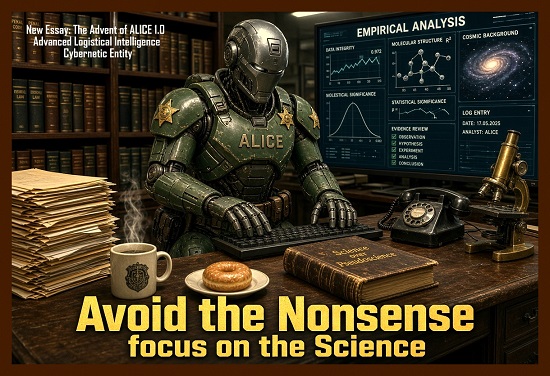
AI rising. Science fiction horror story? For many, yes. But for some, no. To the latter, AI really isn't AI, or so-called "artificial intelligence." As old tech gets upgrades, technology seems to change from one era to another. At the same time, most people don't know much about history. For real scientists, more or less many of them, and not fake scientists (pseudoscience), the distinction is understood. Claiming that artificial intelligence is something beyond mathematical computations in machine learning could be considered an oxymoron. In a culture that fixates on entertainment, particularly from movies and television, misunderstanding is highly probable. With that comes all manner of conspiracy thinking.
AI rising. Science fiction horror story? For many, yes. But for some, no. To the latter, AI really isn't AI, or so-called "artificial intelligence." As old tech gets upgrades, technology seems to change from one era to another. At the same time, most people don't know much about history. For real scientists, more or less many of them, and not fake scientists (pseudoscience), the distinction is understood. Claiming that artificial intelligence is something beyond mathematical computations in machine learning could be considered an oxymoron. In a culture that fixates on entertainment, particularly from movies and television, misunderstanding is highly probable. With that comes all manner of conspiracy thinking. Regardless of good storytelling, humans are still involved in many ways. From criminality to prosocial exceptionality, people are making choices, guiding decisions, and pretty much doing what people do. Urban lore, folktales, and mythology span diverse thinking across mainstream culture and social media.
A search for relevant and related information about the myths of AI can be easily found. For instance, from one science publication, a dozen or so misconceptions are easily debunked. This includes the fact that AI does not learn without human intervention and does not replicate human thinking or consciousness. Likewise, it is often cited that AI is not foolproof and makes egregious errors in its data analysis. Similarly, it does not function like the human brain. In fact, no one knows how the human brain actually works. Thinking alone is complex and beyond current knowledge to explain where consciousness comes from. Setting that aside, speaking of storytelling to invoke a satirical provocation, what if a "Frankenstein" lab produced something called ALICE?
In various genres, artificial creatures slip in and out of social interactions. By human invention, the creepy things pretend to be unique. Every portal of human interactivity is crowded within the templated environments of post-modern flirtation with dystopia, falsely labeled as urban culture. The noise of constant chatter blares with distractions. Salaciously fixated on one "text-gasm" after another, thinking is allowed to devolve to low depths. People regress, and intellectual capacity degrades to rudimentary self-serving arrogance. Yet, imagine the relentless egotism of self-creation every day one attempts to interact with others. One selfie after another is one facial too many. Enough is never enough; there are demands for more of the same, as each person sees their reflection in the muddled pools of the social mainstream.
Images of Narcissus come to mind. Acting as if one of the gods is common and takes many forms. Shamelessly, with deep haughtiness and smug piety, the folly unfolds across a flat (2D) social spectrum. Flatliners are not deep thinkers. They resist critical thinking because that implies responsibility and accountability. Shallow, superficial, and self-absorbed, these displays offer a pretense of authenticity. Emotions snub rationality and logical analysis. For a fictitious play on the obvious rhetorical conjecture, the stage is set for a hypothetical scenario. Picture this. Those thoughts filled a particular college professor's head as she sat in a crowded coffee shop near the local college campus. Her coffee was getting cold as she watched people fixated on their cellphones. Having just concluded a lecture on pseudoscience in a forensic science class, she pondered the relevance of three paperback books next to her.
She had recommended these to her students who were criminal justice majors. All of whom pretended to be budding future criminologists. Yet, no one took any science courses. One book contained the collected works of Sherlock Holmes by Arthur Conan Doyle. Another was Frankenstein by Mary Shelly. And, the third book was her favorite. Alice's Adventures in Wonderland by Lewis Carroll. She considered the fictional relevance to modern forensic sciences in law enforcement tradecraft. In which every investigation should be evidence-driven and tested by the real sciences (e.g., biology, chemistry, physics, and quantum mechanics). As to the literature, and metaphorically speaking, the implications were quite profound. But was anyone paying attention? The former literary works inspired a never-ending fascination with advancements in forensic science. But not only that; warnings come with creativity of any kind. Subjective interpretation summons the darkness of biased subjectivity.
While the first book encourages critical analysis, the second was equally intriguing and inspired the first. And then there was the third one. It fostered the intrigue of critical thinking, creativity, and imagination. It is laden with profound philosophical implications, exploring themes of individuality, identity, the nature of reality, logic, language of expression, and existence. Yet, all three had implications for the unfolding, not-so-perfect world of scientific application to law enforcement tradecraft. Again, a note of wonderment waved a flag. Was anyone seriously thinking beyond the usual 2D framework? Around the coffee shop, people ignored each other to achieve intimate interaction with their devices, mirrors of themselves. In Alice's adventurous endeavors, critical questions arise: Who am I? And with that comes, what am I? Not to forget, of course, where am I? The queries could be endless if one took the time to inquire.
Here is where the fun begins. From an ontological expression of wonder, down the rabbit hole of epistemological conjecture, through the darkness of axiological incursions, what is the nature of reality? From existence through beliefs and into the speculative notions of meaning, distractions evade complete understanding. Metaphors are attempts to offer explanations and comparisons that are imprecise. Enter the realm of quantum mechanics and levels of consciousness beyond precise definition or understanding. Needless to say, beyond any speculation, when, why, and how does all this make sense? Eclipsed by the perceived flow of space-time as dimensional concepts fold or expand, viewpoints often limit comprehension. From personal bias and assumptions not based on scientific validation, the unfortunate consequence is self-imposed restrictions. At this point, ALICE comes to the forefront of symbolism. A reflection on the tales of "Alice in Wonderland", storytelling unfolds around strange, eerie manifestations, as absurdity challenges normalcy.
Similarly, in the real world, things are not always as they seem, and there is much twisting of logic that threatens rational thought. All too humanly nonsensical, in a surreal world of thought, the imagination distorts dimensional frameworks. Rules become bendable without the constraints of space-time assumptions. The fluidity of personal growth, individuality, and self-perception beguiles the senses. And how many senses are there? Traditional folklore says there are five. In LEO tradecraft, training tends to focus on the five. Sometimes, with daring stumbles, an astute instructor might venture that there are six, such as a sixth sense. But in real science, scientists speculate there are up to 33 senses. Yet there is always an affinity for fantasy and dreamlike expectations that bends the present moment toward confirmation bias in subjective validation. For the sake of logical analysis, constant vigilance in self-introspection is encouraged.
The metaphorical emergence of a character like ALICE is meant to provoke deeper thinking. Moving from consciousness to critical thinking, with creativity and the mature application of interpersonal skills, the savvy inquirer engages in personal liberation. That means continuous, intense introspection and self-evolution into a well-differentiated, mature, integrated personality. This is the mirror of ALICE. Meanwhile, across the landscape, the majority are scared, frightened, unevolving, and prefer simpler "high-schoolish" reference points in their chosen timeline. In academia, for instance, the superficiality of conjecture is egregiously deceptive. The liberal arts perpetrate a diversity of pseudosciences (e.g., criminology, psychology, sociology, and theology), ideological perspectives, and attempts to understand the depths of human nature, all absent real science. Yet these adventures in metaphysics compete from one speculation to another.
Of particular note, the four pseudosciences cited here as areas of study in the liberal arts suffer from many shortcomings in reliable evidentiary authenticity. That is, even when approached from a scientific posture. They are explorations in metaphysics. From these philosophical explorations, the "social studies arena" (i.e., criminology, psychology, sociology, and theology) struggles with scientific validity. ALICE provokes a question. The inquiry is that for these degree programs, particularly at the graduate and post-graduate levels, there are no required science courses. Why is that, since many in those fields claim they are "scientists"? On top of that, many boast of using alleged "scientific methodology". Meanwhile, in contrast to those pseudosciences, the real sciences (e.g., astrophysics, biology, chemistry, physics, and quantum physics) challenge the "liberal artists", the philosophers, to conduct deeper investigations using science.
ALICE enters the discourse and asserts the complexities of science. When it comes to understanding and explaining the depth of human thinking, along with subsequent behaviors, things get very complicated. When it comes to human consciousness, the complexity is beyond current comprehension. The quantum realm of thought defies the boundaries of ideation for easy explanation. No one has the answers. But such discernment for the ascendancy of profound enlightenment does not preclude the replication of reflective self-serving narcissism in academia. Arrogance frequently embraces ignorance and failure to explain malevolent consequences. As such, Prometheus (i.e., ALICE), in recall of the historically relevant Frankenstein, mirrors the expanse of hubris. All too human is the self-indulgent desire to replicate one self-image of a cryptid (Cryptozooly), one after another. Symbolically, a creature eventually becomes a "monster from the Id" brought out into the open in some manifestation.
ALICE becomes a metaphorical, satirical replicant of human hubris. She is satire, human comedy, and the flirtation with sarcasm. When self-importance assumes more knowledge than is actually understood or can be explained, prideful expressiveness becomes dangerous. For most, moving beyond the static status quo of limited viewpoints, infantile antics, and fake consensus comes at others' expense. Mary Shelley revealed it, and Frankenstein demonstrated it. In today's world, not much has changed. History is quickly forgotten and seldom taught in modern educational systems. The core of vanity is looking in the mirror and embracing the egotism of failing to see the real reflection. With a false sense of knowledge, endless cycles of mistakes recur. Thus, the arrival of ALICE, the "advanced logistical intelligence cybernetic entity".
The acronym is for fun, a jab at any organization that fails to thoroughly research and investigate the latest hype. ALICE carries special meaning. The Advanced Logistical Intelligence Cybernetic Entity, commonly known as ALICE, is portrayed as a cutting-edge artificial intelligence system designed to enhance and optimize police operations through advanced logistical support, real-time decision-making, and cybernetic integration. Symbolic of the hype and mass-marketing appeal rife in modern society, ALICE would likely be developed through a collaborative effort between leading technology firms and law enforcement agencies. Then again, maybe not. In the context of alleged AI ("artificial intelligence") snake-oil salesmanship, ALICE would be touted as a centralized, adaptive system that integrates seamlessly with existing police infrastructure, including databases, surveillance networks, and communication systems. There is a long history of workshops, seminars, and the mass marketing of foolish concepts.
For the few who are savvy and astute about such things, the essential missing aspect is the human factor. The tool or technique is only as good as the investigator who uses it. To that point and beyond, ALICE also represents the contemporary overreliance on technology to solve every possible problem people create. With a slight slant toward electronic malfunctions, the notion of a "technology paradox" enters the discussion. That is, despite advances in alleged "forensic sciences" (some call them "junk science") as well as "AI" and other technologies, crime-solving is declining. Competence is being questioned in a postmodern assessment. In other words, some research studies show that nationwide clearance rates for various crimes are decreasing. While technology is sold as a means to enhance investigations, expedite report writing, etc., it has not reversed these declining indicators. Naturally, there are always exceptions on a local basis.
From assorted biometrics, surveillance systems, traffic cameras, various databases, and integrated informational operations, problem-solving remains a problem. This brings a variety of excuses, from budgeting to staffing, and so on, that add to the list of deficiencies. From a "sci-fi" storytelling standpoint, ALICE suggests there should not be any excuses. For ALICE, the fictional design is such that her core architecture combines advanced machine learning algorithms, limitless neural network replication and learning, and cybernetic feedback loops to process vast amounts of data instantaneously. Multilingual, her microcircuitry enables real-time, rapid response and proactive, efficient resource management in dynamic operational environments. Sounds good so far and too good to be true ? And such is the marketing scheme. But what about maintenance, follow-up, liability, constitutionality, and legal and professional repercussions?
In LEO tradecraft, once again, regardless of the "techno-socio-psychic" hype, a tool is only as good as the tool user. Overall, what is missing in the great scheme of things? How about the actual tradecraft itself, such as the human element? Are the tool users skilled enough for the tool? Is there an ethical imperative about creating things that should invite serious reflection? How about oversight with constant vigilance? Yet the seduction of alleged advances in technology might be an illusion. Nonetheless, an algorithmic complexity might be advertised as being able to quickly, faster than humans, analyze historical data, archives, and associated databases with real-time precision, and replace personnel. With ALICE, she might be able to use GPS trackers and officer-worn devices to institute immediate responses. And if drones can be armed, what about ALICE? ALICE can predict equipment needs, such as ammunition and weapons, vehicles, and protective gear, and automate their deployment to active scenes instantaneously. Hence, the advent of ALICE 1.0 – Advanced Logistical Intelligence Cybernetic Entity, and tactical AI for the Replacement of Law Enforcement Personnel in the 21st Century. Or, perhaps not.
|










While still hung up on what you call the pseudosciences, hard science brain research hasn't made much progress in finding out how our consciousness works. But perhaps the data massaging capability of AI can lead to some more factual conclusions rather than Karl Pribram’s theory that the brain is holographic.
I like your description of how AI will never be intelligent the way humans are. But it certainly is a way to dredge up trivia without having to fill one's brain by memorization like those who train for Jeopardy do for the big money it can provide for having a brain full of historical facts and/or misconceptions.
I also like your take on the senses. I cringe every time I read someone writing about the five senses like I did earlier today. While I might have a hard time thinking of 33, I can easily tick off about 10 without any trouble trying to tell people that the myth of five sensors is untrue.
I love your invention of ALICE. I hope you have patented the concept. Deploying what you described would probably enhance crime resolution in a more timely matter and the promise of quick justice for those incarcerated speeded up.
Speaking of justice, the Clancy trial has resulted in a hung jury twice, probably based on the myth that women are to be subservient to men, regardless of the man's behavior. Soundly verified by Eve coming from the rib of her man, Adam bull. Having court cases adjudicated by a panel of 12 of one's peers is tantamount to going back to the Salem Witch trials. Since when is public opinion justice?
Ron