View this Article
What is a compost toilet and how does it pertain to Africa? That was my focus on a month-long trek through Tanzania, Uganda, and Kenya in March 2018. Since I’m considered a compost toilet “expert,” my job was to spread the word about composting as a sanitation solution, introduce people to compost toilets, design and build compost toilets and compost bins, conduct impromptu trainings and seminars, and monitor and document compost toilets installed in schools, villages, prisons, game parks, and households in slums, cities, and in remote locations. I learned a lot!
COMPOST TOILETS IN AFRICA
By Joseph Jenkins
April 19, 2018
What is a compost toilet and how does it pertain to Africa? That was my focus on a month-long trek through Tanzania, Uganda, and Kenya in March 2018. Since I’m considered a compost toilet “expert,” my job was to spread the word about composting as a sanitation solution, introduce people to compost toilets, design and build compost toilets and compost bins, conduct impromptu trainings and seminars, and monitor and document compost toilets installed in schools, villages, prisons, game parks, and households in slums, cities, and in remote locations. I learned a lot!
It helped that Cape Town was facing a “day zero,” or a day when the taps run dry and toilets no longer flush. There was a lot of chatter online from South Africans trying to come up with alternatives to the flush toilets they so depended upon. There is obviously a lot of misinformation and confusion surrounding this topic.
For example, there’s a big difference between “compost toilets,” “composting toilets,” and “dry toilets.” A dry toilet is any toilet that doesn’t depend on water to function, like a flush toilet does. This can include things like incinerating toilets and chemical toilets, for example, as well as a compost toilet, which is a type of dry toilet.
A “composting toilet” is kind of like a unicorn, it doesn’t really exist, but people keep repeating the term anyway. Composting doesn’t take place inside toilets, hence the term “composting toilet” is not only incorrect and misleading, but it damages the composting industry, because “compost” and “composting” are real things with specific requirements and characteristics. What people refer to as “composting” toilets are actually dry toilets designed to dehydrate the toilet contents. You can call them waterless toilets, or biological toilets, or ecological toilets, but don’t call them composting toilets. The toilet contents are dehydrated by draining or diverting urine, by venting out moisture, and by heating the toilet contents using external heat sources such as electricity or solar. These toilets often use a carbon-based cover material, like compost toilets do, and the dehydrated organic material may eventually look something like compost, but it isn’t.
Composting, by definition, has three requirements: 1) human management; 2) aerobic conditions; and 3) the generation of internal biological heat. If these three requirements are not met, “composting” is not taking place and the end result cannot be called “compost.” According to the U.S. Composting Council, compost is “the product manufactured through the controlled aerobic, biological decomposition of biodegradable materials. The product has undergone mesophilic and thermophilic temperatures, which significantly reduces the viability of pathogens and weed seeds and stabilizes the carbon such that it is beneficial to plant growth.”
Most dry toilets do not compost because the toilet contents don’t generate internal biological heat, primarily because of their small organic masses and organic material that is too dry. When organic material is subjected to a true composting environment, it is converted into humus or soil by microorganisms while human pathogens are eliminated or significantly reduced. Dehydration toilets do not achieve composting, although their contents can later be added to a true composting system and presumably thereby processed for pathogen removal.
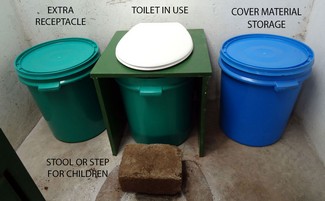
A “compost toilet” collects the toilet material, which can include fecal material, urine, toilet paper, anal cleaning water, other human excretions such as vomit and menstrual discharges, and whatever carbon-based cover material is being used in the toilet. Cover materials can include sawdust, rice hulls, sugar cane bagasse, grasses, leaves, coco coir, coffee grounds, and other semi-dry, finely grained materials derived from plants or plant byproducts. Correct cover material with a degree of moisture will completely block all odor and flies, allowing compost toilets to be located almost anywhere, including, for example, right next to a bed.
Compost toilets, to function correctly, require four elements: 1) the toilet receptacle; 2) the cover material; 3) a separate compost bin; and 4) human management. Like a flush toilet not being able to function without water, drains, and pipes, a compost toilet will not function without cover material, compost bins, and someone to manage the system.
Most dehydrating toilets are commercial products and can be quite expensive. A compost toilet system, on the other hand, uses the toilet to simply collect the toilet material, much like garbage is collected in a garbage can. Once collected, the toilet material, also called “humanure,” is then composted in compost bins, either by the toilet users themselves, or by a collection service which collects full toilet receptacles and replaces them with empty ones. The toilet material is covered after each use with the cover material, which, if correct, will completely block all odor and allow the toilet to be located anywhere, including places where flush toilets are impossible. So, if there is no electricity, no pipes, no running water, no drains, vents, or even money, compost toilets will still work. And urine diversion is completely unnecessary because the toilet contents are not being dehydrated.
Figure 1-Formerly a pit latrine, a compost toilet system is setup at the Police Barracks School in Moroto, Uganda.
Figure 2-Samuel Souza and Alisa Keesey of GiveLove.org stand behind compost bins at the WeltHungerHilfe.de headquarters in Moroto, Uganda.
How are compost toilets being applied in Africa? Well, let’s start with the Nakapiripirit Prison in northern Uganda. The officer in charge, Patrick, informed me that the prison would have been closed down if not for the compost toilet system that had been installed there a year ago. No other sanitation system will work there. Pit latrines, for example, fill with water and flood during heavy rains. Then their inner walls collapse due to the nature of the soil structure in this part of Uganda. They must be laboriously cleaned out, only to collapse again and again. On the other hand, the working parts of a compost toilet system are all above ground. There is nothing to flood or collapse. Furthermore, the prison inmates are locked up at night, thirty per “uniport” (round metal room), where they used to sleep with a “bucket toilet,” which is just an open bucket full of uncovered human excrement reeking of foul odor. Now there is a nice little odorless compost toilet inside their cell, which they can sleep near without the stench of a bucket toilet. Their quality of life has improved, and now Patrick would like to introduce compost toilets to the army, the police, the larger prisons, schools, hospitals, and households.
Figure 3-Patrick, the chief officer, shows off a compost toilet in the uniport at the Nakapiripirit prison.
People of the Iraqw tribe in Dongobesh, Tanzania, were eager to adopt compost toilets. They described the toilet system as “revolutionary.” With an estimated 2.5 billion people worldwide without toilets, it’s about time the compost toilet revolution gets going. There were many in the Iraqw tribe who were elderly, infirm, crippled, lacking mobility, and unable even to squat. They were extremely grateful to receive compost toilets and astonished to have one right beside their bed; one they could sit on comfortably without having to go outside.
Figure 4-The village elders in Dongobesh, Tanzania, learn about compost toilets.
People who grow up with flush toilets have no idea what it’s like to live without a toilet. But imagine if your only toilet option is a hole in the ground, and it’s 50 meters away, and it’s night, and it’s raining, and you have children or elderly grandparents to care for. Those pit latrines smell badly enough that many children don’t want to use them and prefer open defecation. If you look inside a pit latrine you will see what appears to be boiling liquid. Those are maggots squirming, millions of them. The pit latrines breed flies and leak sewage into ground water where drinking water sources can become polluted and disease can be spread. One elderly lady described her compost toilet, located in her stick and mud hut where she did her laundry, as being equivalent to an en suite toilet in a hotel. Providing these people with a revolutionary toilet system is both gratifying and humbling. Gratifying when you see the tears in their eyes when they realize they can have an indoor toilet for the first time in their lives, and humbling when you understand the sheer magnitude of the global sanitation problem.
Figure 5-An elderly Iraqw man with one leg receives a compost toilet as a gift in Dongobesh, Tanzania.
Much of the compost toilet work in Africa is being conducted by a U.S. organization called GiveLove.org, established by the actress Patricia Arquette in Haiti in 2010 to help survivors after the earthquake. After setting up compost toilet systems in tent cities, schools, orphanages, and villages in Haiti, GiveLove managed to expand to Colombia, Nicaragua, Kenya, Uganda, and India, not to mention the USA where they operated a compost toilet system for the water protectors at frigid Standing Rock, servicing 10,000 people at a time. GiveLove’s project director Alisa Keesey from Santa Cruz, California, leaves her lovely home and her devoted husband and daughter for months at a time to help people establish compost toilet systems around the world. She was presented with the U.S. Composting Council’s prestigious H. Clark Gregory Award in 2018 for her dedicated work.
Alisa, along with GiveLove’s compost instructor and general handy man Samuel Souza of Brazil, set up compost toilets at Lake Naivasha in Kenya, for example, where tourists flock to see the hippos and other wildlife. There were no toilets there, but now compost toilets await the visitors, who are quick to compliment the clean, odor free, fly free toilets. The toilet material is composted in wire bins located near the toilet stalls. The contents of the bins are always covered with grasses, weeds, leaves, or whatever plant materials are available to block the odor and encourage the composting process. The same bins can also be used to compost food scraps, animal manures, other discarded organic materials, and even dead animals.
Figure 6-Author Joseph Jenkins meets with Iraqw tribal leaders to introduce compost toilets in Dongobesh, Tanzania.
My month in Africa revealed to me that we need to start mass producing compost toilets designed to be simple, inexpensive, durable, and easily shipped in large quantities. We need to source cover materials and make them available in large quantities as well, plus devise some sort of inexpensive, portable hand-operated apparatus that can be used to grind plant material into a fine enough consistency to allow it to be utilized as toilet cover material. That way people can make their own cover material from whatever they can gather in their local area. Already they’re chopping up plant material with machetes, but a grinding device would be a big help.
After I met with the Iraqw tribal leaders in Dongobesh on their mountainside underneath their huge community Candelabra Tree, one elderly man stood up and asked, “How do we get these toilets, how much do they cost, and who pays for them?” I thought of the eight people in the world who own as much wealth as half the human race, while looking at these people who can’t afford a toilet, and my blood started to boil. Then an Iraqw lady stood up, pointed off into the distance, and said, “We have land for you here. We want you to come and look at it right now and accept it as yours.” What a world we live in. The rich squander and hoard while the poor overflow with generosity and gratitude over something as simple as a toilet.
I was again humbled, this time by the offer of land, but I was scheduled to leave in only two hours to start the long drive back to Kilimanjaro, so I had to respectfully and reluctantly decline the offer. I told them it would have to wait until I returned. Then I went on to Uganda, then India, building compost toilets, before returning to Pennsylvania. It’s a big world, and everyone needs a toilet.
Figure 7-Compost toilets at Lake Naivasha, Kenya.
Figure 8-Kids at the Musas School in northern Uganda surround a compost bin near their compost toilets.
|