View this Article
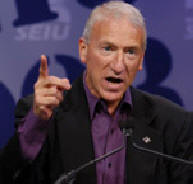
Andy Stern is the president of the 1.9 million members Service Employees International Union (SEIU), the fastest-growing union in North America.
As both a labor leader and an activist, Stern is a leading voice and aggressive advocate for practical solutions to achieve economic opportunity and justice for workers; to ensure affordable, quality health care for all; to promote quality public services; and to guarantee that globalization benefits not just big corporations but also working people. To that end, Stern has spearheaded bold new partnerships with community allies, employers, and other worker organizations, and he has helped elect officials of both major parties.
Called “a different kind of labor chief” and a “courageous, visionary leader who charted a bold new course for American unionism,” Stern began working as a social service worker and member of SEIU Local 668 in 1973 and rose through the ranks before his election as SEIU president in 1996. After launching a national debate about the fundamental change needed to unite the 9 out of 10 American workers who have no organization at work, Stern led SEIU out of the AFL-CIO and founded Change to Win, a new six-million member federation of seven major unions dedicated to giving workers a voice at their jobs.
Stern is the author of the book, A Country That Works (Free Press), which offers a fresh prescription for the vital political and economic reforms America needs to get back on track.
It's no accident that the New Deal followed by four years the presidency of Calvin Coolidge, who once famously declared, "The chief business of the American people is business." The human cost of the Great Depression created a change in climate that became the philosophical underpinning of the New Deal: the business of the American people was the people themselves--all of the people--not just the tycoons who made the "Roaring Twenties" roar and then crash.
Of course, we are as far today from the New Deal as the New Deal was from the Civil War. We cannot expect that work will be valued and rewarded in a global economy by reflexively copying strategies from an industrial economy. Although our values stay the same, our strategies must change. In the 1930s, employers were local, so local unions were strategically aligned with their employers. Today capital has gone global, trade is global, finance is global and, most important, companies are global--so how can unions assist members by just acting locally? "Workers of the world unite" is no longer an ideological slogan; it is the basis of an effort SEIU embarked on four years ago to create global unions of workers who work for the same employers.
Moreover, almost all labor issues in the 1930s pitted American unions against American businesses. The relationship was almost always adversarial. Today, America needs to act more as a team and create a new plan to compete in a global economy. That plan must start with universal health care. We simply cannot compete if we are the only nation on earth that asks our businesses to put the cost of health care on our products.
While modern developments--the Internet, fiber optics, cellphones and a globalized workforce and economy--have resulted in a profound transformation of the American economy, they have not erased the basic debate about the proper role of government. Coolidge's heirs today are corporatists who have succeeded in rolling back many elements of the New Deal and the subsequent reforms that helped create a great American middle class.
Roosevelt understood that in addition to government programs, a balanced economy requires strong labor unions. Then, as now, increased unionization created higher wages and benefits for both union members and unorganized workers. As unionization increased, the middle class grew. And as the percentage of workers represented by a union has declined in the past three decades, the disparity of wealth has increased.
Corporatist's have persistently tried to weaken two of the New Deal pillars of economic fairness and redistribution: government and the law enacted in 1935 to give workers the freedom to form a union under the oversight of a National Labor Relations Board. In recent years, the NLRB has increasingly been dominated by corporate interests issuing rulings hostile to workers' rights and creating new barriers to workers who want to form unions.
Today, more than half of all workers say they would join a union if they had the opportunity, yet less than 8 percent of private workers are in unions. Billion-dollar corporations hire professional "union avoidance consultants," who gang up on workers in unending private interviews, require them to watch hours of antiunion videos in "captive audience" meetings, punish or fire key supporters, threaten wage cutbacks and closings. These corporations face no consequences for their actions or meaningless sanctions under the current weak law.
Where the New Deal once served to re-balance the power between labor and capital, we are now perilously out of balance. In recent years, CEO salaries have gone up more than 600 percent. Had we only tied CEO pay to the minimum wage in 1990, the minimum wage would be more than $23 an hour and the average production worker would make more than $110,000 a year.
This is why Congress needs to enact the Employee Free Choice Act: to permit workers the choice to unite their voices at work. The House of Representatives has already passed it, but Republicans blocked it in the Senate. Both Democratic presidential candidates support it, and its passage is critical to restoring fairness to the workplace.
As in 1935, America is faced with a choice. Is the role of government to serve the 99 percent of hard-working Americans or only corporations and the super-wealthy? The answer will lead to very different decisions on taxation, education, pensions and health care.
We need to take into account the vast changes that have occurred since the New Deal, and we must continually adjust as new changes take place. America still needs strong unions--as well as a government on the side of working people--as part of the solution to rebalance power, provide greater fairness, make work pay and ensure that the dreams of all American children can still come true .
|