AuthorsDen.com   Join | Login    
Where Authors and Readers come together!

SIGNED BOOKS    AUTHORS    BOOKS    SAMPLE CHAPTERS    AUDIOBOOKS    eBOOKS    STORIES    ARTICLES    POETRY    BLOGS    NEWS    VIDEOS    SUCCESS    TESTIMONIALS

Featured Authors:  H.G. Potter, iJudith Bailey, iDebra Kraft, iGlen Schulz, iLisa DAnnolfo Levey, iJudy Joy Jones, iFrank Whyte, iMargaret Mullings, iMaria Rushing, iShirley Francis-Salley, i

  Home > Language > Articles Popular: Books, Stories, Articles, Poetry      Authors: A B C D E F G H I J K L M N O P Q R S T U V W X Y Z     

Carol Culver Rzadkiewicz

 Follow Me  

· Contact Me
· Success story
· Books
· Articles
· Poetry
· News
· Stories
· Blog
· Messages
· 65 Titles
· 167 Reviews
· Save to My Library
· Share with Friends!
·
Member Since: Dec, 2007

Carol Culver Rzadkiewicz, click here to update your pages on AuthorsDen.


Identifying Nouns
by Carol Culver Rzadkiewicz   
Rated "G" by the Author.
     
Recent articles by
Carol Culver Rzadkiewicz

• The Good Life
• Subject/Verb Agreement
• Verb Tense
• Similes & Metaphors
• Semicolons & Colon Usage
           >> View all

What is a noun?


A noun is a “label” for a person, a place, or a thing; and nouns serve certain functions within sentences: subject, subject complement (predicate nominative), direct object, indirect object, or object of a preposition.


  1. John is tall. (Subject)
  2. John is a quarterback. (John = subject; quarterback = subject complement or predicate nominative
  3. John threw the football. (John = subject; football = direct object)
  4. John threw Tom the football. (John = subject; Tom = indirect object; football = direct object)
  5. John threw the football to Tom. (John = subject; football = direct object; Tom = object of preposition.

Can you identify the nouns in the sentences below, as well as the roles those nouns are playing within the structure of the sentences? For example, in the first sentence the nouns are mother, cake, and birthday. Mother is the subject; cake is the direct object; and birthday is the object of the preposition “for.”


  1. My mother baked a chocolate cake for my birthday.
  2. The quarterback ran across the field for a touchdown.
  3. The president of the company has some innovative ideas for potential growth.
  4. Most students are uncertain of their abilities when it comes to writing an effective essay.
  5. Writing an essay need not be difficult if students gather their thoughts in advance.
  6. The United States Marine Corps wants a “few good men.” 
  7. My grandmother, who is eighty-years-old, is an eccentric lady.
  8. Last night, my brother ate a dozen chocolate-chip cookies and drank a quart of milk.
  9. For their anniversary, Chad bought his wife a dozen red roses, made reservations at the best restaurant in town, and hired a limo for the night.
  10. Yesterday was the last day of the zoo’s lecture series on native wildlife, but a series on native plants begins next week. 
  11. Do you think the teachers should insist on a raise at next month’s meeting?


Want to review or comment on this article?


Need a FREE Reader Membership?
Popular Language Articles
  1.  Flash Fiction Fun
  2.  LOVE
  3.  The Art of Poetic Prose...
  4.  Direct Characterization
  5.  Stream of Consciousness
  6.  Idioms and Cliches - where did they co
  7.  How cool is cool?
  8.  EUPHEMISMS
  9.  Creative Flexibility and Annihilated L
  10.  Places That End in 'A'
  11.  Alliteration
  12.  CONJUGATION OF VERBS
  13.  Talk About Talk
  14.  EPITAPH
  15.  English, Literature, and Musings
  16.  Miscellaneous 'Stuff'
  17.  NO HABLO ESPANOL !
  18.  Language and the Law
  19.  The Goddess of Speech
  20.  The Rise of the Poet Most Likely to Be
  21.  ANTIDISESTABLISHMENTARIANISM
  22.  CARS with a U
  23.  The Day the Word Nigger Entered My Lif
  24.  Why I May Confuse You
  25.  Language?

Free Book Review Program
Select a book to read and review today!

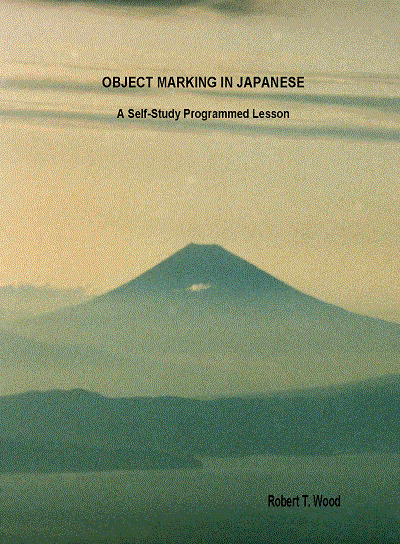
Object Marking in Japanese: A Self-study Programmed Lesson (Paperback by Robert Wood

This programmed, self-paced lesson focuses exclusively on the use of postpostions (ga and (w)o) with grammatical objects in the Japanese language without wavering or getting off track in the labyrinth of Japanese syntax and other grammatical issues.  
Member BookAds

Object Marking in Japanese: A Self-study Programmed Lesson (Paperback by Robert Wood

This programmed, self-paced lesson focuses exclusively on the use of postpostions (ga and (w)o) with grammatical objects in the Japanese language without wavering or getting off track in the labyrinth of Japanese syntax and other grammatical issues.  
Member BookAds

Object Marking in Japanese: A Self-study Programmed Lesson (Paperback by Robert Wood

This programmed, self-paced lesson focuses exclusively on the use of postpostions (ga and (w)o) with grammatical objects in the Japanese language without wavering or getting off track in the labyrinth of Japanese syntax and other grammatical issues.  
Member BookAds