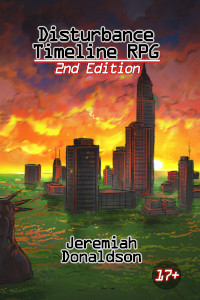
Inspiration for the second edition of my TTRPG.
Of course, anyone reading this title will see 'Fallout' and immediately think of one specific game, if they know it, but here it's used per its definition. And not the radioactive kind. Fallout, per the definition that existed before the nuclear kind, is the 'side effects or results of a situation', sorta like 'collateral damage'. And the 2nd edition of my Disturbance Timeline RPG was the result of numerous fallouts interacting.
The story begins at the limits of my solid memories in aprox 6th grade c. 1988/89. Me and my friends knew what Dungeons and Dragons was, but weren't allowed to play such stuff. The MAD movement, Mothers Against Dungeons and Dragons, had successfully convinced many in the Bible Belt that Dungeons and Dragons was Devil worshiping stuff (I, of course, didn't know all this until years later). Needless to say, we weren't allowed to have anything like that. But the game won't be stopped, only slowed and changed.
Since we weren't allowed to buy or be bought Dungeons and Dragons, me and my friends made our own D6 RPGs on notebook paper that we took turns running. These were essentially what we thought Dungeons and Dragons was, even though we had no idea what it was beyond fighting dragons and magic. Still, it didn't matter. We made and played these games until we reached 8th grade and then we were finally allowed to play a real RPG. But not Dungeons and Dragons. TSR's Buck Rogers RPG was released in 1990 and one of the guys I knew was allowed to have it because, well, 'spaceships' and not 'demons'. We happily took turns running Buck Rogers games in lunchrooms and libraries until our ban on Dungeons and Dragons finally ended sometime in our Freshman year of high school c. 1991/92.
Now, when I look back at it, I find all of that sorta funny. TSR's Buck Rogers RPG has a far more mature and brutal backstory and world than Dungeons and Dragons. Dungeons and Dragons is basically just Lord of the Rings in game form while the TSR Buck Rogers RPG is sorta what you'd get if Stephen King and William Gibson had created Flash Gordon. TSR's Buck Rogers world is a dystopian cyberpunk nightmare that is full of mad scientist creations, deadly, and uncaring. The genetic lifeforms, or Genies, in Buck Rogers are almost all created to make something that would work, produce, or fight better in some specific environment. No care at all is given to how their appearance or social structure is perceived by their human counterparts whom they have to co-exist with. People and animals are treated as things to be modified for a job and not much else. Some literally can't even speak without special equipment. Some of the most powerful NPCs aren't even alive, they're Digital Personalities that live in computers and don't have to deal with most of what everyone else does. Earth is a poisoned post-apocalyptic wasteland due to nuclear war and other disasters, where many live in arcologies due to the pollution. The largest population centers are called 'orgs', as in 'Los Angelorg'. These 'orgs' and the wasteland surrounding them are very similar to MegaCities in the Judge Dredd storyline. Strange, genetic experiments guard moons, and the main villain that the game assumes you're going to be against is RAM, or the Russo-American Mercantile, which is a fascist superpower and most powerful entity in the solar system that is trying to take over.
Meanwhile, we weren't allowed to play with elves and halflings in the forest. However, 35+ years later, I wouldn't want it any other way.
Everyone wants to compare any post-apocalyptic setting to Fallout now days, but they maybe forget what inspired Fallout and that that stuff inspired a lot of other stuff. This is because Fallout, the franchise, is the most popular post-apocalyptic video game franchise ever, despite the arguable fall from grace it has had in recent years (that won't be reclaimed with a TV series, although the TV series could convince them to make another real Fallout game in the same vein as New Vegas that itself could reclaim some grace). As someone stated in a review of DTR1E, 'Fallout the way it should be'. But DTR was never meant to be Fallout. The Disturbance Timeline itself was born from an idea to set my first and second, and so far only two, novels in the same world, which itself was born from my love of history. And history itself is far worse and more interesting than anything put into a game. It just so happened that the timeline had three 'periods' on it and the first on the timeline was the post-apocalyptic period. I actually didn't even plan to do a post-apocalyptic RPG, it's just that I decided to do one for each of the three periods in order, and the second time period, which will be talked about more at a later time, was the one that I looked forward to at the time, and still do. I just had to get about a decade of ground work done first.
I have thought about why someone would say the first edition was 'Fallout the way it should be', even though that first edition was pretty bad, and I'm allowed to say that as often as I want since I wrote it. World progression is the main thing that comes to mind. Things don't stay the same and there is a clearly defined 'start' and 'end' to the post-apocalyptic world. It isn't just there like it is now in Fallout and many other such sittings. Why? Because things don't stagnant and always change. Something is weirdly wrong if a place goes for a hundred years without collapsing or progressing. The progression in the settlements from the first to the second Fallout games is a very good example of how the world should have been changing and developing as time went by. This concept appears to have been dropped from Fallout as a whole after the second game, and the franchise now seems to take place in a forever post-apocalypse that an endless stream of mutants evolve into. However, it's only been about 1500 years since the last apocalyptic type of event on Earth, the massive decline in growth rates and starvation tied to the ~538 AD event that is thought to have been a caused by a chain of volcanic eruptions. Human civilization did not roll over and die. If anything, it surged forward even harder into the middle and late medieval periods. They had about 10 years that really sucked, about 30 years that sucked a lot, and about 50 that sucked slightly less, making the entire event last a max of 90-100 years. A worse event would have had longer lasting effects and vice versa.
Most post-apocalyptic worlds are pretty similar from Mad Max to TSR's Buck Rogers to Judge Dredd in the type of people that inhabit them. Your savages. Your cults. Your dictators. Your lunatics. However, it's very rare for them to not communicate with each other, and they do even in movies like Planet of the Apes. I've tried to include a wider range of civilization types in DTR2E than normally present since the lowest are non-speaking savages in huts and the highest have powerful technologies. And I'm not talking about some little group hiding in bunkers, collecting trinkets they can't reproduce. I'm talking about entire cities, and, in the case of New Yellowknife, future world conquerors, who are still producing modern, for them, technologies and developing new ones. This desire to expand is an important point. People generally don't hide in holes and wait for death to come for them, although some do, like it seems that many in post-apocalypse game worlds do. People in general go out and die while fighting against the unknown, sometimes at the prodding of those older and 'wiser' than they for the 'greater good' (which should sound very familiar to Fallout 1 and 2 players). This process isn't going to suddenly stop in a post-apocalypse world, and would probably increase as the level of challenge to life increased and people responded to it. Of course, some will hide in holes, but they're essentially passive Chess pieces in the game of life. Dreamers, if they're lucky, that can't put thought into action.
And of course, there were many other influences on DTR2E and the world it takes place in. One of the largest not mentioned already is the AD&D Dark Sun setting, which took place on a world that had gone through more than one apocalyptic time period. It was and probably still is the most brutal of all Dungeon and Dragon settings where just surviving a normal day is nearly award worthy. And there's an untold number of other influences such as novels like At the Beach by Nevil Shute, Lucifer's Hammer by Jerry Pournelle, and The Stand by Stephen King along with movies like Dr. Strangelove and Them, and many, many more pieces of media of all types, some I liked and some I was indifferent to, but they all had a hand in creating DTR2E.
|


I grew up with the computer from doing binary coding to the Internet that I embraced and started my website in 1997. However, I'm old enough not to have not been interested in computer games that were just basically old battles fought over and over in settings that may or may not have been futuristic. I saved a lot of money and stuck to movies and television that betrayed the future in many different ways, most of it downright fantasy like the Lord of the Rings and its popular spinoff, Dungeons & Dragons. Those games and the ones that follow like Fallout on for those young people that have unlimited spare time, are bored with their easy lives and have money to spend before they become responsible.
I agree with you about fallout. Fallout and collateral damage go hand in hand. I have written a number of apocalypse scenarios in my stories and even in two novels, because people are thrilled by reading stories that seem to resonate with their feeling that everything is going to hell. Wanting a hero to come along and save everything from evil.
The duality is that things are really getting better for most of us. AI is helping us a great deal become more understanding and getting things done more efficiently and easily. But there are those who fear AI has some kind of mental (spiritual?) malfunctioning intelligence that will create a scenario like The Terminator or others along those lines like Predator.
Apocalyptic stories should be read, played or watched with entertainment in mind and not reality or fear. We are highly capable of fixing all of the bad things we've done in the past once we fess up to them. Until we do, we will still have them nagging on our brains thinking that they are going to bite us like in the President's Analyst… "I'm not paranoid, it's the telephone company!"
Ron