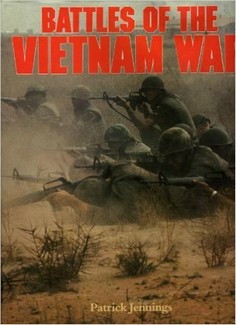
Lecturer, Historian, Author Patrick Jennings’ Battles of the Vietnam War is an ample work of 192 pages. Jam-packed with many photographs, text and subject matter
The Table of Contents lists an Introduction, 7 Chapters and an Index.
1 Dien Bien Phu
2 Junction City
3 Rolling Thunder and the Air War
4 The Tet Offensive
5 Hue
6 Khe Sahn
7 Saigon Succumbs
Author Jennings relates in the Introduction that ‘most wars, modern and ancient, have their great battles, the moment in the conflicts which were seen contemporaneously or subsequently as turning points that decided the course of the war. …
The War in Vietnam has no such comparable actions, at least in the more recent past. The author tells Readers that ‘Some wars cannot be avoided. Most can.
Jenkins believes The war in Vietnam is one of them, and it is hoped that the description of what happened in Southeast Asia in a military sense will help bring about an understanding of the tragedy that the Vietnam War inflicted upon the people of both Indochina and the United States, and the price the entire world has yet to pay for that ultimate failure of judgment.’
The route to Dien Bien Phu was set in motion well before it began.
In 1941 Nguyen Ai Quoc established a political/military known as the Viet Minh. The group fought against the occupying Japanese, nevertheless their eventual goal was riddance of all foreign social control. With the defeat of Japan numerous Vietnamese hoped the French would release their control, that did not happen.
Soon Allied troops replaced Japanese and the French re-established their colonial rule. By this time Nguyen had changed his name to Ho Chi Minh and the eventual consequent Dien Bien Phu action was in place.
Text and photos displaying combat-ready men, training activities, French Paratroopers, patrols on the Saigon River, fortifications, conveyance of provisions, captured weapons, Viet Minh prisoners in Tonkin 1954, injured French and south Vietnamese following military operation on Eliane, Montagnard ‘mountain commandos’ on patrol in the jungle help Readers understand better the text.
French infirmary helicopter, French forces movement south of Dien Bien Phu protected by Air Force, march 1954, French troops watching napalm bombardment, French defenders during conflict, French medics and withdrawal of wounded during barrage fire, a double page photo of helmeted Viet Minh troops in Hanoi after the French cease-fire, Oct 1954, a French underground command post, cheering crowds in Haiphong, 1955, in addition to a map of Vietnam at the time of the French withdrawal in 1954 help explicate understanding of the Dien Bien Phu action.
Junction City tone is set with a double page photo of soldiers advancing toward a Viet Cong bunker. Author Jennings relates that ‘Operation Junction City is an example of what the common American soldier faced, and faced down, in Vietnam.’
Fighting carried out principally by infantrymen in grueling jungle or wetland terrain never received the media attention centered on select forces like the Green Berets or the Marines up on the DMZ.
Following arrival of US troops in 1965 to succeed the consultive role with regular battle operations, they found it was very difficult to engage the evasive Viet Cong or NVA they had come to combat.
Oct 1966, the first conclusive conflict came pretty much by chance event; US forces attacked elements of the 9th Viet Cong Division as the hostile forces blundered into one another. Before the conflict ended 29 Nov, 22,000 US allied South Vietnamese troops were engaged.
Gen’l Westmorland mounted the first multi division operation of the Vietnam War –Operation Junction City. The operation commencing early February 1967 included moving 9 infantry units into position, mending mine damage, flushing out Viet Cong from camouflaged tunnels, building command post and tank bridge, search and destroy missions, and close quarter skirmishes.
At last 1 April, the opposition was discouraged, the remnants of 3 battalions of the 271st Regiment, 9th Viet Cong Division, and 2 battalions of the 70th Guard Regiment were in full flight. Fire Base George as the last major battle of Operation Junction City, symbolizes much of the war in Southeast Asia.
Again, an abundance of photos taken in the field along with text assist Readers in formulating a pretty good impression of some of the activity carried out by US fighting units.
From a full page occupied with 155mm shells, to a view of a Mike Force near Ban Me Thunot, a M113, the standard armored personnel carrier of the Nam war, a scene of soldiers hacking vines covering a tank, a pic of an M48-A3 tank being pulled out of the mud by M-113, and another tank being maneuvered up the hill, while the one on the opposing page has bogged down in vines, a 2 page spread in full color of helicopters moving personnel into assault area, followed by a scene of machete in hand soldier preparing a landing zone for resupply, shots of combat, and ‘Wolfhounds’ cheering after a successful operation as Gen’l Westmorland praises his men, help Readers realize some of the action, difficulty and situations faced by the US fighting forces sent into combat in Vietnam.
Each of the battles showcased in this edition follow the elemental format as that used to inform Readers of the activity at Junction City. Pages are occupied with textual matter, along with maps and photos taken of the region during the action.
Rolling Thunder and the Air War commences on page 70, with the passage opening with a bit of background, prior leading into discourse re the action per se, bring out early targets were frequently controlled by the White House, with some areas, port facilities, air defense systems to be left unscathed. Initial Rolling Thunder operations during 1965 were under command Lt. Gen’l Joseph Moore.
The author mentions diverse air power used by US troops, text is augmented with large and small photos including an aerial look at the 4th Cav Div Army encampment. Much damage was wreaked during the period 1965 – 28 December 1972, when air dominance was established by U.S. leading to a disposition by the Northern Vietnamese to come to the negotiating table.
Discussion of The Tet Offensive starts on pages 98/99 with a 2 page photo spread depicting Troops, Co G, exploring near the DMZ, Nov 1967. The Offensive was not a single encounter, action or conflict, but, was rather a series of coordinated actions provoked by Gen’l Vo Nguyen Giap in the hope to propel the Americans from Vietnamese soil.
The build up toward conflict commenced in earnest during Jan 1968 with activity close to and around the old Special Forces camp at Marine fire supported Khe Sanh.
The author notes that Tet was expected more to cause the feelings in the United States to become disillusioned with the military action being carried out in S. E. Asia.
Military operations reaching from near the DMZ in the North and stretching South to Saigon included actions along the Laotian border at Khe Sanh, Lang Vei, A Shau, and near the middle of the country at Kham Duc, Dak To, Kontum, Pleiku, Ban Me Thout, Dalat, and in the South at Bien Hoa, Saigon, My Tho, Ben Tre, Vinh Long, Can Tho, Ca Mau and near the Camboia Southern border at Chau Doc, while other attacks were in play along the East Coast at Quang Tri, Hue, Da Nang, Duy Xuyen, Quang Ngai, Qui Nhon, and Nha Trang are detailed in text, BW and colored photos, and maps.
With the concluding days of Feb 1968 The Tet Offensive was over; 27 days of intensive conflict left thousands deceased, many more were uprooted, Lang Vei, Special Forces camp, was the only locale of Khe Sahn to actually be over run.
The actual engagement activities for Khe Sahn were waged later in March and April. The battle for Hue is thought by some military minds to have been the most successful of the operations launched during Tet.
The battle for Hue is detailed between pages 126 and 141. Once more, the author relies heavily on text and BW Photos, to assist Reader comprehension of the venue and result of of the battle.
Ferocious fighting raged house to house. Air mobility helped keep casualty rates down as helicopters moved in rapidly to pick up injured soldiers whenever they could. Tank assistance was pivotal during the heaviest fighting.
The battle for Hue was officially over 25 Feb, Hue bore heavy cost for the civilians, 100,000 were made homeless, 6000 were lost to vindicatory decapitation, shooting, being buried alive and other means of instilling fear and compliance.
The battle for Khe Sahn, Marine fire support base, close to the Laotian border in the North West region of the DMZ in Quang Tri Province, garrisoned nearly 4,000 Marines.
The US Special Forces camp, Lang Vei, sited on Route 9, the major east west road between the coast and Laos was intended primarily as a site for Long Range Reconnaissance activities as well as with training of the local native population. The fall of Lang Vei on 8 Feb aided by a dozen or so Russian PT-76 tanks added a new component to the military equation.
BW and Colored photos are used in addition to text to explicate for The Reader the components of the struggle for Khe Sahn. By the end of March the siege was coming to a close, Operation Pegasus, meant to clear Highway 9 established with little opposition. US/South Vietnamese control of Quang Tri Province including the Special Forces Camp at Lang Vei was resumed. Khe Sahn base structures were destroyed, and the base closed June 1968.
The flourishing seaport of Saigon and center of commerce in South Vietnam, Saigon had become a refuge location for many refugees from the North, many in the US were becoming progressively jaded with the daily news reports of body counts and young American lives lost. Growing governmental fervency for an end to the status was increasing in the US. Communist intrusion across Vietnam was growing. Saigon Succumbs relates the final days of the South Vietnamese war effort.
Hue fell to the Communists on 26 March 1975. Frightened Refugees streamed south toward Saigon as the Communist forces were making their way to the same area.
3 April President Ford declared that American military transportation would be used to evacuate children, as it became apparent that Saigon would indeed fall; other countries joined in what became ‘Operation Baby Lift.’ American Citizens and Vietnamese refugees waited apprehensively for the helicopters to carry them out of peril, away from the urban center and hopefully to the US. 29 April 1,373 US civilians, 6,000+ other nationals, and 1,000 US Marines who had protected the landing zone were air lifted to safety.
Author Jennings notes, that on the whole, Vietnam Veterans were not welcomed home to the US, and, were often reviled by much of the populous. At the least, until more recent times, they have been ignored for many years. Alphabetized Index is placed on the last 3 pages of the work.
I found this large publication to be an explicative work filled with subject matter, photographs and maps all outlining some of the military actions carried out by our military fighting force in South East Asia.
While every action of the war could result in many volumes or one single text so massive and cumbersome it would be all but impossible to heft. This specific volume fills a need for those who know little of the war, and want to learn something of the time and men who answered our country’s call; many of those fighting were drafted into service.
Well written, font size large enough to allow aging eyes to read with little difficulty. I found the maps in particular to be helpful, photos help clarify what the location was like – jungle, etc.
Highly Readable, straight forward language, very decipherable, good reference for the serious student, or reader who may want to read only one or two books on the subject.
Happy to recommend.
==================================
Reviewed by Molly Reviews BOOKS molly martin ==================================
Biography from end flap Born in Illinois in 1937, Patrick Jennings was educated at the university of Michigan and Yale University. A Lecturer in History for 13 years with the University of Maryland, he was a visiting Assistant Professor at the Graduate School of International Relations of the University of Southern California for ten years. Mr Jennings has written and edited many books on military history, including an illustrated history of World War II.
AMAZON PRODUCT DETAILS
TITLE Battles of the Vietnam War
AUTHOR Patrick Jennings
GENRE Military History
Hardcover: 192 pages
Publisher: Bookthrift Co; 1st Ed. (U.S.) edition (August 1, 1985)
Language: English
ISBN-10: 0671069853
ISBN-13: 978-0671069858
Package Dimensions: 12 x 9.7 x 0.8 inches



as the widow of 1 and wife of another Nam vet and having grown up in a time when we knew our brothers, boyfriends, male cousins, husbands might expect to see a draft notice appear; my own perspective of the action in Vietnam is often seen through that prism.
having lived through the homecoming and watching the neglect presented to Nam vets then and now by much of the populace and our governmental leaders ; my own perspective of the action in Vietnam is often seen through that prism even today.
i have long read military history, most WBTS and/or our Revolutionary War back during the 1700s
a visit to The Wall, and reading history of the Vietnam action helps to put into perspective some of what the Nam vet experienced then and there, doesn't really explain how or why the vets were treated as though they were somehow responsible for what they experienced during the action in Vietnam, their homecoming or neglect then to now
m
Complicated history treated with honesty.
Donan
If they present a factual and impartial view of war, books like Jenkins's can be helpful in revealing the price of war for everyone.
Ron