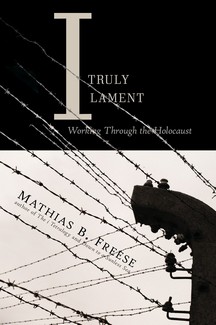
Mathias Freese’s I Truly Lament Working Through the Holocaust, is a publication of twenty-seven short stories offered to assist readers who may be in quest of answers vis-à-vis what, and how and why the Holocaust took place. Who provoked it, who permitted it to endure and what lasting affect it makes on society, humans and persons Jewish and non-Jewish alike then and now are also a part of the meld.
The Table of Contents lists a Foreword, Preface and Glossary of Terms prior to the beginning of the narratives.
The Foreword states Freese’s mixture of tales are selections jam-packed with ‘obsessions, bottomless terror, humans rendered into ashes and smoke, chiefly death camps, Jewish obsessions, unimaginable cruelties, senseless torture, and miraculous survivor, who are little more than walking dead men and women for the balance of their lives.’
Preface Freese re-counts writing about the Holocaust is a ghastly grandiosity. And declares ‘One soon realizes the fundamental understanding that the species is wildly damaged, for only a damaged species could have committed the Holocaust.’
Glossary of Terms opening with appell: camp roll call, golem: Hebrew for unformed; a man artificially created by Kabalistic rites; robot, cheder: room, Jewish religious school for children, shtetl: Jewish village community of Eastern Europe, especially in Russia, shul: synagogue, tzaddik: Hebrew for righteous man and ending with yarmulke: skull cap lists a sequence of words used in many of the sketches. The words are ones non-Jewish readers may not easily identify.
The first story Golem, I Need Your Help along with The Indifferent Golem as well as The Disenchanted Golem are three of the narratives in which a shapeless person plays a part. Food, a touching read filled with bleak despair, may be the contemplation of a starving prisoner while Der Fuher Likes Plain is presented much as a radio interview might be.
Herr Doktor is narrated as a consultation between a scholar and one of the concentration camp clinicians.
Freud in Auschwitz provides a glimpse into what Freud, who actually had family members die in camp might have thought had he been sent to Auschwitz.
Apotheosis tells of an apprehensive Jewish man, pursued and fleeing from the hunter.
Max Weber, Holocaust Revisionist, was there a revisionist named Max Weber?
Of No Use, We were given ‘soup’ that night, the passing of a turnip through water.
Tucson Women, I flash back to the camp.
Snow Globe I We have endured only to pass into an extensive, winding road of struggle.
Snow Globe II: Homage to Kafka The sentinels in their tower belfries, look down upon their well mannered flock
Slave I know my lifetime following the camp has been, in a way, a second slavery.
Soap Hitler’s shorts are fact; Jews turned into bars of soap are not.
Cantor Matyas Balog Treasuring the overwhelmed room a minute longer, Rebecca slipped the letter and the dated chocolate paper into her muff and left, not dissimilar to what I tolerated in the camp.
Hummingbird for me to remain alive each day is a scuffle.
Leviathan I know of guards whose thoughts have withered, so the harshest and most awkward animal actions of man come to the fore.
Archipelago a detainee yearns for an island away from the camp
Longing A week of yearning for a missing spouse
Away Distressing read, thoughts of a child left behind when his mother was taken away.
Hand The burning bush permits me this one devastating – magnificent - notable moment.
Sincerely, Max Weber I desire you don’t view me as punitive nonetheless, like you, I am striving to determine what is accurate and what is not.
Food, Part II: Past Forward Holocaust survivor. It’s your future profession.
Chagall’s Crows The most valiant thing I have acomplished in my old age was moving to Tucson.
A Way Up The deceased have no say, …
The Tea Table Mr Ginsburg, you are safe here.
I Truly Lament: Working Through the Holocaust by Mathias B. Freese is a visceral work from introduction to zenith. It is not a bubbly little ‘fun’ read and unconditionally is not for the reader who chooses light reading, titter and forget.
The imagined short stories relating to the Holocaust as written by Mathias Freese are presented as a determination to present a bit of clarifying information leading to more understanding apropos the circumstances. The accounts are not all blunt, while they are; they are not all horrifying, while they are.
The reader is carried along on an, at times mystifying, continuously cerebrally exhaustive expedition through the sentiments prompted by the proofs of the Holocaust.
The chronicles frequently deliver a broadly disparate vantage point all fixated on the Holocaust. Some are presented as though they are articulated from the viewpoint of guards, golems, survivors, prisoners in the concentration camps, one appears as a virtual radio interview with Hitler’s lover, Eva Braun.
The writer sets down bits and pieces, some perchance, written with the standpoint of a Holocaust revisionist, while another as perhaps by someone who does not accept as true that the Holocaust occurred at all or in the way as history has described.
The assortment ends with the golem enquiring his reason for existence.
Every reader may find an anecdote or two to be especially dreadful in their view, or read ones that particularly distracts them, opens their eyes to the shock of the Holocaust, or reminds them of how truly base some humans can be.
Freese’s, I Truly Lament is an incomparable gathering of twenty-seven, at times heart wrenching, mind wringing narratives. This accumulation of accounts is not advised for the faint of heart. I Truly Lament delivers an imaginable indication into the mind set of perpetrators, victims, and survivors.
While each sketch takes a somewhat dissimilar view, some rudiments were the same. Many of the survivor stories took place in Tucson, Arizona.
I found this book to be a rough read at times.
The focus itself united with my own reading, investigation and understanding of the horror of the Holocaust situation lend to reading that can be all but overriding.
I appreciate that this book is a work of fiction, it does leave the reader considering some of the alarm and dismay Jewish people suffered during the reign of Hitler.
Gripping read, well written. Happy to recommend for inclusion in High School, College, and public libraries.
=========================================
Reviewed by Molly Reviews BOOKS molly martin
=========================================
About Mathias B. Freese is a writer, teacher, and psychotherapist.
His recent collection of essays, "This Mobius Strip of Ifs," was the winner of the National Indie Excellence Book Award of 2012 in general nonfiction and a 2012 Global Ebook Award finalist.
His "I Truly Lament: Working Through the Holocaust" was one of three finalists chosen in the 2012 Leapfrog Press Fiction Contest out of 424 submissions.



Freese could be considered to be very well educated from exceptional research of true stories, perhaps a survivor, himself, or just a very good writer/researcher of fictional history. I will take your positive review as a positive thumb's up for the book.
Ron