A Spirited Historical Hoax
(Or How to Start A Religion)
by Dianne K. Salerni
Uncle Albert, are you with us? Knock twice for yes …
It’s a recurring theme in popular media. Whether Patricia Arquette is solving crimes in the NBC show Medium, or wide-eyed Haley Joel Osment is whispering, “I see dead people,” America’s fascination with contacting the dead is undeniable. Even someone who has never attended a séance can certainly imagine one: solemn people seated around a table, holding hands in the dark, waiting for the curtains to billow mysteriously and the spirit of Uncle Albert to tell them where his will is hidden. Although the mystery of spirit communication is embedded in our popular culture, few people know that the entire concept originated with two adolescent girls in the mid-19th century—and that it all began as a high-spirited prank.
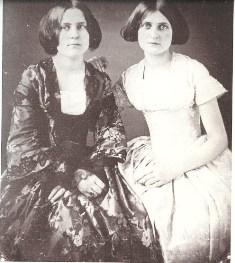
Maggie and Kate Fox, aged fourteen and eleven, were the youngest daughters of working class parents who, in 1848, entertained family members with a trick that ultimately founded the spiritualist movement. When life in the rural town of Hydesville, New York became too dull, Maggie and Kate invented a game which convinced their parents—and then the neighbors—that their house was haunted. By means of a knocking code, the girls communicated with the ghost of a murdered man supposedly buried in the basement. When the parents of the girls and the neighbors searched the house from top to bottom but could find no earthly explanation for the rapping noises, they commenced to dig up the basement. Results were inconclusive—some hair and bone fragments were discovered—but this was enough to convince the residents of Hydesville that supernatural events were afoot.
Word of the ghostly occurrences spread, and people from the surrounding towns came to hear the knocking spirit. A newspaper reporter published a pamphlet on the mystery. Apparently thrilled by all the excitement, the Fox girls revealed that it was not the house which was haunted, but themselves! No matter where the girls were located, ghosts and spirits knocked in response to their questions, and soon Hydesville residents discovered that Maggie and Kate Fox were “mediums’ through which they could communicate with their own dead relatives!
Interestingly enough, the Fox sisters were spotted as frauds early on by many people who guessed their method for creating the rapping sounds. However, those who had been deceived by the scam steadfastly refused to believe that the angelic-seeming girls could be liars or that the cherished spirit communications were fake. Even after Maggie Fox confessed—forty years later—that she and her sister popped the joints in their knees and ankles and snapped their toes to create the famous rapping sounds, belief in spirit-rapping continued unabated.
In the 19th century world of miraculous discovery and scientific progress, a rapping spirit did not seem quite as nonsensical as it does today. Michael Faraday was experimenting with electromagnetism. Fossilized bones of giant monsters—later called “dinosaurs”—were discovered in New Jersey. The steamboat had been invented; the Erie Canal had been excavated. And then there was the telegraph! Messages spelled out in one place flew through the air and magically tapped themselves into existence somewhere else. Was it beyond the realm of possibility that, in a world where such things could happen, men could find a way to communicate beyond the grave? Inventor Nikola Tesla didn’t think it so strange. Before the end of the century, he began work on a radio transmitter he hoped would be able to receive broadcasts from Heaven—or at least from outer space.
Nevertheless, scientific gullibility aside, it is doubtful that the Fox girls’ notoriety would have lasted if it had not been for the intervention of their oldest sister, Mrs. Leah Fish. Seeing through her sisters’ charade, this woman shrewdly recognized the money-making potential in the scam and relocated the family to Rochester, New York. There, she set up a profitable business conducting “spirit circles” at a dollar a head. Furthermore, she took additional steps to ensure her success by calling upon her acquaintance with radical Quaker and social reformer Amy Post, who then introduced her to Lucretia Mott and Elizabeth Cady Stanton. An arrangement of mutual promotion quickly developed. The reform leaders endorsed the spiritualists, and the Fox sisters made certain that the spirits devoted some of their messages to political causes. The ghost of Benjamin Franklin promised “great changes,” and pro-slavery Senator John Calhoun stopped by the spirit table shortly after his death to announce that he had been converted to the abolitionist cause in the afterlife!
Although there were critics who condemned the Fox sisters as frauds, and many who believed they were witches, several churches accepted spiritual communication as a religious experience. One Protestant minister stated that “God’s telegraph” had completely overshadowed the more mundane version invented by Samuel Morse. Leah Fish’s connection to abolitionists, suffragettes, and religious leaders became a social stepping stone for the sisters, who consorted with people high above their station, such as Horace Greeley, James Fenimore Cooper, and former Wisconsin governor Nathaniel Tallmadge. Hobnobbing with the rich and famous eventually brought them into the social circle of Elisha Kent Kane, a Philadelphia war hero and explorer. Kane immediately saw through the pretense and, developing a romantic interest in Maggie, sought to remove her from the influence of her avaricious sister.
The tale of Maggie’s romance with Kane and her subsequent defection from spiritualism is a story in itself (see High Spirits: A Tale of Ghostly Rapping and Romance), but even this breach in the Fox sisters’ ranks could not stop the movement from growing. By 1854, spiritualists numbered in the hundreds of thousands, and across the country enthusiasts were “discovering” their own supernatural talents. Spirits rapped messages, tipped tables, and wrote on slates for a new crop of “mediums” all hoping to capitalize on the notoriety of the Fox sisters. What had begun as a prank perpetrated by two mischievous girls had become a political vehicle, a new religion, and a source of entertainment for the popular media into the next century … and beyond.