The Mysteries of Eden
I love the book of Genesis because it contains so many mysteries about our beginnings and how the world was created. Many of those mysteries are still unanswered but with information available today, we can make “informed” guesses about what was written by God. One of those “mysteries” is about the Garden of Eden.
We know that it was a large land area because a part of it, in the east, was set aside to be a “garden”. Many people only think of Eden as the “Garden of Eden”. We know that there were other areas surrounding it that had names because the Bible says that Cain traveled eastward to the land of “Nod” to find a wife.
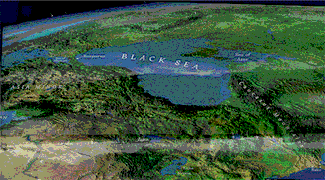
When Adam’s descendants began to multiply on the Earth, it seems likely that they would inhabit the land around the place where man originated. There is a place that seems ideal for that and at the same time is close to an area that fits the description of the Garden of Eden in Turkey. The place where I speculate that Adam’s descendants would have settled is an area just north of there in what is now the Black Sea.
At the time of Genesis chapters 1 and 2, the area that is now the Black Sea was a large “Bowl” of dry land that had a small fresh water lake at its center. When the flood of Noah covered the land that area became what is now the Black Sea. Robert Ballard is now using diving equipment to search for signs of life that inhabited the shore of that lake before the flood.
One of the more appealing mysteries for me concerns the phrase “The Breath of Life”. The Bible says that Adam was not a “living soul” until God breathed the “Breath of Life” into him. Apparently “The Breath of Life” means more than just being “alive”. That is supported in the New Testament when the breath of Jesus infused the "Holy Spirit" into His Desciples.
One of the mysteries about Noah’s Ark is how he got all the animals on it. A passage that is often overlooked is Genesis: 7:17, “And they went in unto Noah into the ark, two and two of all flesh, wherein is the BREATH OF LIFE.”
But the only time the Breath of Life is mentioned is after creating in the Garden of Eden. You will notice that nothing in Genesis, chapter one, received the Breath of Life.
If we accept the idea that God created the Heavens and the Earth in Genesis, Chapter One, and later, in chapter two 6000 years ago, came back to Earth to create in the Garden of Eden, then this passage would only pertain to the creatures that were created in the Garden of Eden.
Because Genesis 7:17 refers to "creatures" having the "Breath of Life", I believe that only those creatures created in the Garden of Eden received the “Breath of Life”.
We don’t know how many that was, but it seems logical that it was certainly was less than the millions of species around the whole world.
Another "mystery" concerns Cain's wife. There is an explanation if one considers that Eden was a "second creation event", and that Adam, while being the first "Biblical Man", was not the first bipedal hominid species on earth.
If Homo sapiens existed on earth before Adam, then Cain could have traveled to Nod and taken one of the "primitive" man's females for a wife. That theory is supported by a study by anthropologist John Hawks "of the University of Wisconsin-Madison in 2007, that showed that human DNA has changed by 7% in the last 5000 years while it only changed 1-2% the previous 95,000 years", and that man is only 2% different from the Great Apes.
That could be explained by Adam's DNA, through his descendants, mixing with the "Homo sapiens" DNA that was already on the earth.
If we accept that the “world” that was flooded was mainly “Eden” many of Genesis’s mysteries are cleared up. The Ark didn’t have to house millions of animals and everything the Bible says about the flood suddenly becomes very plausible.
You will notice in Genesis: 6:17, “And, behold, I, even I, do bring a flood of waters upon the earth, to destroy all flesh, wherein is the BREATH OF LIFE, from under heaven;” that God doesn’t say that ALL life is destroyed. Only life that had the “Breath of Life”.
The Hebrew word for “Earth” was “Erets”. That word also meant “land”, “country”, and “ground” as well as “earth” It could have just as likely meant that the whole “country”, or "land" was flooded. The error was made by early Hebrew scribes that didn't know that "The whole Earth" was a planet, and thought that all that they knew of was "The World". From that time one, the idea of a Global Flood was perpetuated.
Clearing up that one mis-interpretation would clear up many of the "mysteries" of Genesis.






When compared with the rapidly growing body of knowledge of the gradual development of man as Homo sapiens, the biblical stories still seem to have serious flaws when compared to reality.
Ron
I enjoyed reading your informative, interesting review of Genesis. I am very fond of Proverbs.
m