Li Bai is so influential in the West partly due to Ezra Pound's versions of some of his poems in the collection entitled "Cathay," the name by which China was known to medieval Europe (Pound transliterated his name according to "Rihaku" in Japanese, which is "Li Bai" in Chinese). Li Bai's life in the flourishing period of the so-called 'Golden Age' in China's history and his interactions with nature and friendship, his love of wine and his acute observations of the old society enriched his best poems. Some of them, like "The River Merchant's Wife: A Letter," as Ezra Pound entitled it from a word-for-word translation largely based on the work of Ernest Fenollosa (1853–1908), which recorded the hardships and emotions of common people, were the striking examples of the liberal but poetically influential adaptations of Japanese versions of Li Bai's poetry expressed through the talent of American poet in the 20th century.
There is another musical setting of Li Bai's verse by composer Harry Partch, whose Seventeen Lyrics by Li Bai for intoning voice and adapted viola (an instrument of Partch's invention) are based on the texts in "The Works of Li Bai" translated by Shigeyoshi Obata. In Brazil, the songwriter Beto Furquim included a musical setting of the poem named "A Quiet Night Thoughts" (see my retranslation below) in his album "Muito Prazer."
In 2013, Gareth Bonello (aka the Gentle Good, which is one of the Buddha Gautama's name) released a Welsh-Chinese folk album "The Immortal Bard," whose lyrics were inspired by and based on Li Bai's biography. The album was partly recorded in Chengdu, Sichuan, with local musicians.
Australian composer Stephen Whittington's second string quartet work composed "From a Thatched Hut" is based on Li Bai's poetry (a detailed study of it, including history and analysis, has been made by the composer himself).
The ideas underlying Li Bai's poetry has a profound impact in shaping American Imagist and Modernist poetry throughout the 20th century. Also, Gustav Mahler integrated four of Li Bai's works into his symphonic song cycle "Das Lied von der Erde." These were derived from a free German translation by Hans Bethge published in Anthology named "Die chinesische Flöte" (Chinese Flute). Hans Bethge based his version on the pioneering translation into French by Saint-Denys.
It would be enough to name Derek Walcott, Charles Bukowski, Charles Wright, James Wright, Hermann Hesse, John Steinbeck, Simon Elegant, Guy Gavriel Kay, MacDonald Harris, Philip Jose Farmer, Ursula K. Le Guin, Philip K. Dick, Annie Dillard and many other authors whose works this or that way refer to the Chinese poet, his irrepressible lifestyle and transcendent creativity. As I know, a number of poetic works of Mao Ze-dong were written under the living influence of Li Bai's poetry; even a crater on the planet Mercury has been named after him.
In China, some four centuries later after Li Bai's death, just regarding his poem "Drinking Alone under the Moon," for example, the Song-period poet Yang Wan Li wrote his long work alluding to this title (as well as to two other Li Bai's poems translated below) implemented in the same 'gu-feng' or old-style of versification.
It sounds obvious but, again, we learn more about the world literature by studying the evolution of poetry through the centuries; as a result, we find out more of the world's history, evoke our interest and understanding of the ancient writers and of humanity in general.
The following three poems of Li Bai translated and represented herein as the preface to my collection of poems are unfolded around the common subject of the Chinese literature -- the moon and its imagery. Together with the reader, we are going to unveil some unnoticed (if not to say 'misunderstood' or even 'wrong interpreted') moments of the poet's legendary life.
Poetry analysis and its translation from the language like archaic Chinese, which is the foreign language for the contemporary Chinese as well, is not scientifically exact, it is somewhat subjective to how it affects the translator's academic knowledge and daily experience. Yet, I find it very difficult to put a lot of credit on those representatives of the Old School (most of them are the famously known scholars of the academic elite) who do not try to dig deeper about the poets of antiquity, and to reveal their motivations and find out those who affected them.
But before offering my translation and give a conceptual explanation of the presented poems, it is necessary to make a fairly brief digression in order to brush through some milestones in the lifespan of one of the most well-known and at the same time semi-mythical personage in the cultural history of China.
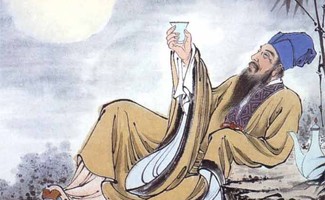
Li Bai (701-762 CE), also known as Li Tai Bai (his courtesy name translated as "Grand White," literally Venus) or Qinglian Jushi (the literary pseudonym which means "a resident of the Blue Lotus Town," as long as his growing years he spent in the place called 'Qinglian') or his many nicknames, such as Immortal Poet, Poet of the Transcendental, Wine Immortal, Poet-Knight-Errant, Poet-Hero, or simply Li Bai (he generally referred to himself as 'Bai' meaning 'white' or 'clear'). He was born somewhere in present-day Kyrgyzstan, Central Asia, or, probably, in Tiaozhi, a state centred near the modern Ghazni, Afghanistan. These areas extended along the ancient Silk Road and the Li family were likely merchants there; and, according to some researchers, their trading was quite prosperous.
Legends say that while Li Bai's mother was pregnant with him, she had a dream of a great white star falling from the sky. This seems to have contributed to the idea of his being as a banished immortal (one of his nicknames) who arrived in the world for a certain mission. The fact that the Grand White Star is synonymous with Venus helps to explain his courtesy name of Tai Bai.
When the boy was five years old or so, the family under the lead of his father, Li Ke, moved to Jiangyou, the place near modern Chengdu in Sichuan province, the cradle of the Daoist sect of Heavenly Masters (tian-shi dao) with the notable Daoist centre in the Maoshan Mountains. It is not a secret that throughout his lifespan Li Bai was a devoted Daoist and a member of a few small groups of Chinese poets and freethinkers. As one of the greatest poets of the Tang-period China (618-907 CE), he had the commitment to traditional poetic forms, taking them to the new heights. Together with Du Fu (712–770) he was a romantic and the most prominent figure in the flourishing of Chinese poetry during the 'Golden Age' of China famously known with the so-called "Three Wonders" (san-jue) of Tang referred to Li Bai’s poetry, Pei Min’s swordsmanship and Zhang Xu’s calligraphy performed in the 'kuang-cao' or wild cursive script.
Li Bai was also engaged in some other activities, such as taming wild birds and fencing under the direction of his master, General Pei Min who transmitted his precious 'soaring dragon sword' method (teng-long jian) to the poet, adding some closely guarded secrets to his arsenal of the sword techniques. He loved riding, hunting, travelling, aiding the poor or oppressed by means of both money and warm shoulder of a friend. Eventually, Li Bai seems to have become quite proficient in the martial arts. According to his autobiographical confession, which both testifies to and also helps to illustrate the wildlife that the poet led in his youth when he was fifteen, he was fond of swordplay and with that art he challenged quite a few great men.
Before he was twenty, Li Bai had fought and killed several opponents, apparently for reasons of chivalry, in accordance with the knight-errant tradition "you-xia" or dueling.
In 720, he was interviewed by Governor Su Ting who considered him a genius. Although he expressed the wish to become an official, he never took the civil service examination to become a ranking officer. The reason why he never took what would seem to have been the logical step toward his stated desire apparently was for some personal reasons of the freethinker.
At age 24 he left home for a period of wandering, after which he married and lived with his wife’s family in Anlu (present-day Hubei province). He had already begun to write poems, some of which he showed to various officials in the vain hope of becoming employed as a secretary. During the first year of his wandering, he met celebrities and gave away much of his wealth to needy friends. By perhaps 740, he moved to Rencheng city in Shandong province. It was at that time that he became one of the group members known as the "Six Idlers of the Bamboo Brook," an informal group of like-minded individuals dedicated to literature and wine, including Kong Chao Fu, Han Chun, Pei Zheng, Zhang Shu Ming and Tao Mian who lived on Mount Chulaishan and were constantly dead drunk.
Li Bai wandered about the area of Zhejiang and Jiangsu, eventually making friends with Wu Yun, the venerable Daoist priest who in 742 was summoned by the emperor to attend the imperial court where his praise of Li Bai as a poet was great. Wu Yun's praise of Li Bai led Emperor Xuan-zong (born Li Long Ji and also known as Emperor Ming-huang) to summon Li Bai to the court in Chang'an. After another nomadic period, he arrived at Chang’an (present-day Xi'an), the Tang capital, hoping to be given a post at court. No official post was forthcoming, but he was accepted into a group of distinguished court poets. Li Bai's personality fascinated the aristocrats and common people alike, including another Daoist and poet by the name of He Zhi Zhang who bestowed upon him the name of Immortal Exiled from Heaven. After an initial audience when Li Bai was questioned about his political views, the emperor was so impressed that he held a big banquet in his honour. Eventually, the emperor employed him as a translator, as Li Bai knew at least one Asian (non-Chinese) language. Then Emperor Ming-Huang gave him a post at the Hanlin Academy that served to provide scholarly expertise and poetry for the imperial court. Leaping ahead, it is good to mention here that if, as some people haste to conclude, Li Bai's aim was drunkenness itself, he would stick to his position at the imperial court for doing this in comfort under the emperor's auspices, but he didn't.
One day, when the emperor was sitting in the Pavilion of Aloes Wood, he had a sudden stirring of heart and wanted Li Bai to write a song expressive of his blue mood. When Li Bai entered in obedience to the summons, he was so drunk that the courtiers were obliged to dab his face with water. When in a short while he came to his senses a little bit, he seized a brush and, without any visible efforts, wrote a composition of flawless gracefulness. The emperor was so pleased with Li Bai’s talent that whenever he was feasting or drinking he always had the poet to wait upon him.
Li Bai wrote several poems about the emperor's beautiful and beloved Yang Gui Fei, the favourite consort. A story, probably spurious, circulates about his relationships during this period. Once, while drunk, he had gotten his shoes muddy, and Gao Li Shi, the most politically powerful eunuch in the palace, was asked to assist in the removal of the shoes in front of the emperor. Eunuch Gao took offense at being asked to perform such a menial service and later managed to persuade Yang Gui Fei to take offense at Li Bai's poems concerning her. At the persuasion of Yang Gui Fei and Gao Li Shi, the emperor reluctantly but politely, and with wealthy gifts of gold and silver, sent the poet away from the court.
After leaving the court, Li Bai formally became a Daoist, making his home in Shandong, but wandering far and wide for the next ten years, writing poems. Once he went by boat with Cui Zong Zhi from Bianshi town to Nanking. He wore his embroidered court cloak and sat as proudly in the boat as though he were the ruler of the universe.
Thus, in the autumn of 744, he began his wanderings again. Much of his life is reflected in his poetry: places which he visited, friends whom he saw off on journeys to distant locations perhaps never to meet again, his own dream-like imaginations embroidered with shamanistic overtones, current events of which he had news of, descriptions sliced from nature in a timeless moment of poetry and so on. However, of particular importance are the changes in the times through which he lived. His early poetry took place in the context of internal peace and prosperity in the Golden Age Empire of Tang dynasty under the reign of an emperor who actively promoted and participated in the arts. This all changed suddenly and shockingly, beginning with the rebellion of General An Lu Shan when all of the northern China came to be devastated by local wars and famine. Li Bai's poetry as well takes on new tones and qualities. The emperor eventually fled to Sichuan and abdicated. During the confusion, the crown prince opportunely declared himself emperor and head of the government.
In 756, Li Bai became unofficial poet laureate and staff adviser to the military expedition of Prince Lin of Yong, Emperor Ming-Huang's 16th son who was far from the top of the primogeniture list, yet named to share the imperial power as a general after the old emperor had abdicated. The prince was soon accused of intending to establish an independent kingdom and was executed. Li Bai was arrested and imprisoned at Jiujiang. In the summer of 758 he was banished to Yelang; before he arrived there, he benefited from a general amnesty. He had only gotten as far as Wushan when the good news of his pardon caught up with him in 759. He returned to the Eastern China where he died in a relative’s house, though popular legend says that he drowned when, sitting drunk in a boat, he tried to seize the moon’s reflection in the water. The truth may be that he contracted his last illness as the result of falling into the water while drunk. The actual cause appears to have been natural enough, although perhaps related to his lifestyle of a pilgrim and freethinker. Nevertheless, the legend has a place in Chinese literature and mythological culture, which frequently reflects what lies beyond biographical facts and events recorded in annals.
Afterwards, the new Emperor Dai-Zong (reigned 762-779) named Li Bai the "Registrar of the Left Commandant's Office." It happened in 762; when the imperial edict arrived in Dangtu, Anhui province, the poet, at age 61, became critically ill and his health would not allow him to fulfil the imperial assignment. His last years were devoted to the deep study of Daoism. It's good to say of a mysterious figure mentioned in his poems by the name of High Priest of Peihai in Shandong from whom the poet received an initiation into the Daoist proficiency in 746.
Li Bai was a romantic in his view of life and poetry. Around a thousand poems attributed to him are extant, and thirty-four of his poems are included in the "Anthology of Three Hundred Tang Poems," which was first published in the 18th century. In the same century, translations of his works began to appear in Europe; however, only a few of them have been translated into English. The selected poems were models for celebrating the pleasures of friendship, the scenes of Nature, solitude and the joys of drinking wine. Among the most famous are "Drinking Alone under the Moon," "A Quiet Night Thoughts" and "How I Was Waking from Drinking Bout in a Spring Day" retranslated below. In the West, multi-lingual translations of Li Bai's poems continue to be made at different levels of interpretation; fortunately, the Old School of Sinology gives way to the new trends, and Li Bai's poetry has even taken on a new legendary aspect, including the tales of a true meaning of his drunkenness and chivalry. Li Bai has become a favourite among translators for his seemingly simple style. Later translations are too numerous to discuss here, but an extensive selection of Li Bai's poems translated by various scholars can be viewed in John Minford and Joseph Lau's "Classical Chinese Literature" (2000).
One of the most notable wine drinkers in China’s long tradition of imbibers, Li Bai frequently celebrated the joy of drinking alone with his regular practice in swordsmanship. He reached a higher level of mastery to create his own style of fencing named "Tai Bai zui-jian" (Li Bai's Style of Drunken Sword). As legends run, his elusive art of drunken sword he picked up from one drunken beggar who once walked into an inn located deeply in the mountains. That man was ugly and covered with filth. He went from table to table, begging for handouts. Everyone was disgusted by him and tried to ignore him. The inn owner and the barmaids all denied him for service except for Li Bai who just checked-in to overnight. He took pity on the beggar and brought him to a back room to avoid the jeers of the others. He offered him a drink and, much to his amazement, the old man magically transforms into one of the eight immortals who also was the godhead of drunken swordplay and who rewarded the poet with a blessing.
Everything the poet did was tuned to the passage of time and the joys of Nature with brilliance and great freshness of imagination. The poem “Drinking Alone under the Moon” is likely from the post-court period of his life. Some other subjects that he studied in his poetry were swordplay, friendship and solitude constructed around the everlasting image of the moon with its multiple tints and mythological riddles. His imagination and humorous characteristics of a freethinker are apparent here in full. The following translation of the poem looks to give a line by line Chinese-English account.
月下獨酌 (Drinking Alone under the Moon)
花間一壺酒;A pot of hot liquor under the blooming trees I heat up time and again;--
獨酌無相親。Alone I feast as none of the intimates is nearby me.
舉杯邀明月;Raising my cup, I ask the bright moon to drink;
對影成三人。With him, my mime shadow, we make a good companionship of three.
月既不解飲;The moon, alas, has never understood wine,
影徒隨我身。While indisputable shadow follows me in all.
暫伴月將影;Yet with the moon as a tactical ally and the shadow as the general's aide
行樂須及春。I must be in high spirit, no less than that of the first spring flowers.
我歌月徘徊;For that, I sing my combat march, and the moon nods in time with its pace;
我舞影零亂。I square up with my sword, but my halting shadow tangles in moves. . .
醒時同交歡;While slightly tight, all the three observed the decencies,
醉後各分散。But upon getting deadly drunk, each goes his own way of gaiety.
永結無情遊;Then, setting off from the booze straight into a long voyage of oblivion,
相期邈雲漢。We make an appointment far away, drifting downstream along the Milky Way.
Drinking Alone under the Moon
A pot of hot liquor under the blooming trees
I heat up time and again;-- alone I feast
As none of the intimates is nearby me.
Raising my cup, I ask the bright moon to drink;
With him, my mime shadow, we make
A good companionship of three.
The moon, alas, has never understood wine,
While indisputable shadow follows me in all.
Yet with the moon as a tactical ally
And the shadow as the general's aide
I must be in high spirit, no less than
That of the first spring flowers.
For that, I sing my combat march
And the moon nods in time with its pace;
I square up with my sword, but
My halting shadow tangles in moves. . .
While slightly tight, all the three
Observed the decencies,
But upon getting deadly drunk,
Each goes his own way of gaiety.
Then, setting off from the booze
Straight into a long voyage of oblivion,
We make an appointment far away,
Drifting downstream along the Milky Way.
“Drinking Alone under the Moon” encompasses several characteristics that define Li Bai's personality. As a devotee to nature, wine, solitude, swordplay and humour he reveals much of himself in this piece of poetry. Therefore, the importance of this poem in understanding his other works is obvious. Let's begin from the beginning.
“A pot of hot liquor under the blooming trees
I heat up time and again;-- alone I feast
As none of the intimates is nearby me.
The first two original lines speak of repeated heating the wine pot as he stays alone, without his friends from the founded by him association of like-minded companions known as "The Eight Immortals of the Wine Cup," including He Zhi Zhang, Li Shi Zhi, Mr. Jin, Prince of Juyang, Cui Zong Zhi, Su Jin, Zhang Xü, and Jiao Sui. In his days at court, very soon the poet realised himself that he was unsuited to the imperial court life, allowing his conduct to become more and more reckless and unrestrained. He begged persistently to be allowed to retire from court. At last, the emperor gave him gold and sent him away. Li Bai roamed the country in every direction. The initial part of his poem shows a progression from the realistic into the imaginative and from the sober state to that of being slightly tipsy -- just notice the developed change in presentation of the next two lines:
“Raising my cup, I ask the bright moon to drink;
With him, my mime shadow, we make
A good companionship of three.
Now, in the lack of the real company, we start to see Li Bai’s imagination sparkling with wit and a cohesive involvement of wine in this scheme of "three-in-one." He does not seem to be drunk yet, just warmed-up before the main action he expects to be involved into as the logic development of the whole situation. This means that drunkenness is not his goal while he celebrates the seasonal flourishing he utilizes as a leap, upon which he is going to reach something "above his head." For this, he needs to forget of himself for awhile; therefore, his loneliness is not a problem for him. His playful treatment of Nature at this point is unmistakable: raising his cup together with the rising moon, he greets the flow of changing marked by appearing of his loyal shadow. For him, this is perfectly natural progress, as all things are mutual in the ways of Dao he used to appreciate most of all.
“The moon, alas, has never understood wine,
While indisputable shadow follows me in all.
These two lines are evidence of Li Bai's rich experience in drinking under the moon, with which he is on friendly terms and which is very good at shadowing, but not at boozing or making a good company. When the shadow shows off, Li Bai conducts as its real master, without further ado; hence, his 'manservant' follows him in all, attaching itself to one and only master.
“Yet with the moon as a tactical ally
And the shadow as the general's aide
This line proves the strategic thinking awakened in the poet's mind after a few drinks: the wine is starting to rouse his bravery and morale, as well as the keen insight of a true strategist, at least.
“I must be in high spirit, no less than
That of the first spring flowers.
Here, the poet stimulates himself, pumping with wine in order to be no less than the brave wild plum trees that are among many others but who are the first to throw the winter a challenge of being the herald of springtime. Wild plums have a very special place in Li Bai’s writing; he often resorts to them in order to enhance his imagery.
“For that, I sing my combat march
And the moon nods in time with its pace;
I square up with my sword, but
My halting shadow tangles in moves.
Upon becoming quite tipsy, it is the right time for Li Bai to expose himself as a warlord. Here, most probably, he pretends to be like General Pei Min, his tutor of swordsmanship. However, a plenty of drinking wine starts to speak itself loudly. He tells us of his clumsy movements by bringing to the scene the picture of his aide, the halting shadow, which he blames for clumsiness, not himself. What a witty move we witness here! The reader can imagine utterly the picture which these two lines present. And then:
“While slightly tight, all the three
Observed the decencies,
But upon getting deadly drunk,
Each goes his own way of gaiety.
The following two lines depict the declining process unfolded from the very beginning till the end, summing up toward the final part of the poem. By now, he is plainly the worse for the drink, but, I should admit, he is still drinking. From now on, the poet retreats into himself, forgetting of his silent 'companions.' Becoming alone, he points out at the oneness with his own self, the pitch darkness at the bottom of his heart in contrast to the moon's brightness, his only temporary ally he has welcomed for producing the shadow, his devoted aide. This threefold scheme has been mapped out in advance in the previous lines or even further before the party was launched. This moment is very interesting and somewhat unique to Chinese art of war worked out and developed by forefathers of the Chinese way of strategic thinking, including Lao-zi, Guigu-zi, Sun Wu, Sun Bin, Cao Cao, Zhuge Liang, Zhang Liang and many others famously known and unknown strategists of old. It also shows that Li Bai lives the life which was destined for him by Heaven since his birthday. Being styled as "Poet of the Transcendental," he has now reached a point of becoming unconscious. In such a state between reality and what is beyond its virtual gates, he leaves his 'boon-companions,' the moon and his shadow, to have his own fun, which is revealed to him by means of drinking to excess. These two lines lead us into the line next to last, which is the actual aim of his over drinking in order to reach the state outside the limits of the human world. As a carrier, the wine just aids him in getting the state of oblivion and becoming one with the astral dust around him, the true diamonds in the sky.
"Then, setting off from the booze
Straight into a long voyage of oblivion
This line indicates that the aim has at last been achieved and the poet is soaring above all the worldly conventions. We don’t know what may have been in that realm but it seems that the space in this poem goes beyond the bounds of human imagination. If the ordinary people think of the categories within the terms of "wan-wu" or ten thousand things to be generically called "the myriad things," in another poem entitled "Difficulties on the Way to the state of Shu" Li Bai operates with the number of forty-eight thousand years, getting in the eyes of commoners the status of "Immortal Banished from Heaven," or more simply, an extraterrestrial. This is how people estimate his poetic works and extraordinary behaviour. But why did they call him like this? Is it just an exaggeration or objective reaction on a real phenomenon? Suppose that Li Bai was immortal or an alien and people happened to guess his identity. His way of thinking, which people are not accustomed to, can be accepted by only other aliens, as this seems more in line with the scale of the cosmic time system. Therefore, his subliminal is now directed at the heavens and heavenly bodies of Galaxy as indicated by the last line, which runs like this:
"We make an appointment far away,
Drifting downstream along the Milky Way.”
Li Bai is reaching the state which allows him to simply observe life from the height of immensity, becoming one with the stars of Galaxy, the equivalent of what is known as "wuji" or the Absolute. Finally, the last line proves that he has gotten there deliberately to become united with the fathomless universe around him. He visualizes his drifting downstream along the starry Milky Way; he simply follows Heaven's way of his own accord to make the final line essential in understanding his Daoist views. What the Daoist views in principle are? In so many words, they reduce to the notion of running one's affairs along with the ways of Dao, the process of daily decreasing one's ambitions for the sake of naturalness and effortlessness; hence many effective activities and good productions that the adepts of Daoism implement in life. Everyone's goal is to be one with Earth, not fight against its elements, running one's affairs within Heaven's will.
Translating the works of Chinese poets of olden times, we can better understand the history of cultural development in general. What may seem a light and not so sufficient before, now becomes important for correct perceiving a foreign cultural heritage and understanding the evolution of traditional values. Historically, this piece of Li Bai's poetry is considered to be an important literary achievement. It is obvious that his secret is concealed behind his strong sense of himself as a part of the poetic tradition. The genius of Li Bai, says one recent account, "lies at once in his total command of the literary tradition and his ingenuity in bending it, without a break, to discover a uniquely personal idiomatic form of his realization."
Scholar B. Watson, comparing him to Du Fu, says that Li Bai's poetry "is essentially backward-looking, that it represents more a revival and fulfilment of past promises and glory than a foray into the future." This is, actually, what has formed the way of Chinese mentality in general.
For the modern readers in the West, hopefully, the poem “Drinking Alone under the Moon” can now be available for some deeper understanding of its spiritual content.
Another famously known verse of Li Bai is entitled "A Quiet Night Thoughts" (jing ye si). In a mere five-character-a-line quatrain the poet uses the vivid moonlight and the frost imagery to convey the feeling of life transiency. There are several editions of this short verse; the present one is translated from the 17th-century Kangxi's edition and goes like this:
靜夜思 (A Quiet Night Thoughts)
床前明月光,The moonbeam lies in front of my seat;
疑是地上霜。I doubt it can thaw the frosted ground before the dawn.
舉頭望明月,Holding up, I look into the cool moon hung over my head;
低頭思故鄉。With head bowed, I deep in thoughts of my remote kinsmen.
A Quiet Night Thoughts
The moonbeam lies
In front of my seat;
I doubt it can thaw
The frosted ground
Before the dawn.
Holding up, I look
Into the cool moon
Hung over my head;
With head bowed,
I deep in thoughts of
My remote kinsmen.
With regard to the poet's marriage, in 730 he wrote to his friend: “The land of Chu has seven swamps. I went to look at them. But at His Excellency Xü’s house, I was offered the hand of his granddaughter and lingered there during the frosts of three autumns.” He then seems to have abandoned Miss Xü, who was impatient at his lack of promotion. He afterwards married successively Miss Lin, Miss Lu, and Miss Song. These were, of course, wives, not concubines. We are told that he was fond of “going about with the dancing-girls of Zhaoyang and Jinling.” He had one son who died in 797.
Besides, there is some deeper meaning in this very much popular piece of his poetry translated here. The poet liked to regard himself as belonging to the imperial family and, most probably, not without good reasoning.
As we know from the "New History of Tang" completed in the 11th century, Li Bai was descended in the ninth generation from Emperor Xing-sheng. Since one of his ancestors was charged with a crime at the end of the Sui dynasty (581-618 CE), he took refuge in Turkestan, a region of Central Asia. Two accounts made by contemporaries Li Yang Bing (the Li family member) and Fan Chuan Zheng state that Li Bai's family was originally from what is now the south-eastern region of Gansu. Li Bai's ancestry is traditionally traced back to Li Gao, the noble founder of the state of Western Liang (502-557). This provides some support for Li Bai's own claim to be related to the Li dynastic royal family of the Tang dynasty, as the Tang emperors also claimed descent from the Li rulers of Western Liang. Evidence suggests that during the Sui dynasty, Li Bai's ancestors (at that time for some reason classified socially as 'commoners') were forced into a form of exile from their original place to some location(s) further westward. During their exile in the far west, the Li family lived in the ancient Silk Road town of Suiye (Suyab, now an archaeological site in present-day Kyrgyzstan, and perhaps also in Tiaozhi, a state centred near modern Ghazni, Afghanistan. These areas lied on the ancient Silk Road traffic, and the Li family were likely merchants; their trade was quite prosperous.
Critic James Liu notes that Chinese poets seem to be perpetually bewailing their exile and longing to return home town. This may seem sentimental to the western readers, but one should remember the vastness of China, the difficulties of communication in the remote past. The sharp contrast between the highly cultured life in the capital cities and the harsh conditions in the distant regions was aggravated by the importance of family relationship; so, it is hardly surprising that nostalgia and, what's more, filial piety should have become permanent and hence conventional themes in Chinese poetry.
The last point to which I shall refer is the extreme allusiveness of this poem. This characteristic (which is very common to most Chinese poetry of old) is carried to an extremity in Li Bai's fifty-nine old style poems (gu-feng). Not only do they bristle with the names of historical personages, but almost every phrase is borrowed from the Classics, in which the poet was well-versed from childhood. Yes, Li Bai is very good at the so-called 'traditional education'; however, none of the modern readers could understand them without pages of commentaries to each of them. Chinese poetry, with a few exceptions, has been written on this principle of 'backward-looking' since the Han dynasty (206 BCE-220 CE). One Tang poet alone, Bo Jü Yi (772-846), broke through the restraints of pedantry, erasing every expression that his manservant could not understand. Translators have naturally avoided the most allusive poems and have omitted or generalized such allusions as occurred. They have frequently failed to recognize allusions as such and have mistranslated them accordingly, often turning private names into romantic sentiments and suchlike.
In the sense, there is even deeper meaning in this short verse. In the broken bottom line of the Zhou Yi's hexagram "Kun" (2), we see its subject "treading on frost in the late autumn; the strong ice will come soon, by and by, where he sets foot on as the cold breath of Yin begins to take its form. Allowing his course to go on smoothly, according to his preconceived plan, and the frost (symbol of a plan termed 'sheng' 生) will come to be strong ice (implementation termed 'cheng' 成), so he has to be timely prepared."
In the "Wen-yan" commentary to Kun (2), we read: "The family that accumulates goodness is sure to have superabundant happiness; and the family that accumulates evil is sure to have superabundant misery. The murder of a ruler by his minister, or of a father by his son, is not the result of the events of one morning or one evening -- the causes of it have gradually accumulated through the absence of early discrimination. Therefore, the first saying of Kun (2) in the "Circular Changes" goes like this: 'He treads on the frost; the strong ice will come, by and by, where he sets foot on.' This saying shows that the true way of the subject of the weak Kun (symbol of Earth) is in following after the strong Qian (1), the symbol of Heaven."
In other words, the poet queries whether he is prompt enough to leave more or less appreciable contribution in the national literature and poetry of Tang in such a short period of time remained at his disposal before he meets with his grand ancestors in the world beyond.
Li Yang Bing, the governor of Dangtu and the poet's kinsman, gives the following account of Li Bai's death: “When he was about 'to hang up his cap' (an euphemism for “dying”) he was worried at the thought that his numerous rough drafts had not been collected and arranged appropriately. Lying on his deathbed, he gave over to me all his documents that I might put them in order.”
In addition, in the Great Appendix (Xi-ci Zhuan; Section 1, Verse 4) of the "Zhou Yi" we read:
"The sages, looking up, contemplate the brilliant phenomena of the heavens,
And, looking down, examine the definite arrangements of the earth;
Thus, they know the causes of darkness on Earth and light in Heaven,
What is obscure, but what is bright. They trace things to their beginning
And follows them to the very end; -- thus, they know what can they say
About the ceaseless inquest of life and death. They perceive how the union
Of vital substance and breath can form all things and disappearance
Or wandering away of the soul produces the change of their constitution;--
They know the characteristics of all things, distinction between men
And beasts; the distinction between the gods, spirits and evil ghosts. . ."
Bowing his head, the poet thinks of his grand ancestors, the meeting with whom is not far off from now. For whatever reason, this poem is considered as a famously known and broadly popularized work of Li Bai, which still appears in school textbooks in China; but for the westerners, hopefully, it has now much more significant content.
It has been generally understood, I believe, that Li Bai's point of strength lies not on the formal level of his versification, which is quite a monotonous recurrence of certain reflections about the impermanence of human beings as opposed to the immutability of Nature, but in the stylization of his poetry. Above all, Li Bai was a songwriter. Most of the poems translated previously are songs, not verses. It is noteworthy that his tombstone bore the inscription, said, “His skill lay in the writing of archaic songs.” His immediate predecessors had carried to the highest refinement the art of writing in elaborate patterns of tone. In all his works there are said to be only a dozen of poems in the strict seven-character-a-line metre. Most of his short poems are in the archaic style, which neglects the formal arrangement of tones. Therefore, the value of his poetry lay in the beauty of word coinage (the Chinese graphs), as he was an outstanding wordsmith, not in the beauty of thoughts. A good half of his poems contains some reference to the fact that the mountain streams do not return to their springs, and that all rivers run to the east while a man changes with every 'quarter of an hour' or 'ke' (the Daoist term of time reckoning on earth). Again, due to the universal beauty of Chinese characters, for the modern Chinese and all Chinese speakers, his poetry exists more for the eye than for the ear.
As it has been mentioned earlier, Li Bai's poetry was ranked as the national treasure of Tang along with General Pei Min's swordsmanship and Zhang Xu's calligraphy performed in the wild cursive style (kuang-cao).
Curiously enough but true that swordplay and calligraphy are akin in nature, the solid ground of both is based on a line drawn in the air by a double-blade sword, or by the brush which outlines the cursive strokes on a sheet of paper. Li Bai, who succeeded in his swordsmanship to the height of creating his own fencing style, was also a skilled calligrapher. Regrettably, we have only one extant piece of his work made in his own handwriting.
This piece of written in semi-cursive script is titled "shang yang-tai" (上陽臺 or "Climbing Up Yangtai Terraces"). This is a horizontal scroll of 380.1 by 280.5 mm (15.0x11.2 in.) with the later addition of the title performed by Emperor Hui-zong of Song (reigned in 1101-1125) and a postscript added by Emperor Qian-long of Qing (1711-1799). Today the scroll is housed in the Palace Museum (gu-gong) in Beijing.
As for Zhang Xu's calligraphy, here are some samples of his cursive script.
Zhang Xu's formal name was Bo Gao; he was born in Wuxian district (present-day Jiangsu, Suzhou) in 675. He was acclaimed as the originator of the wild cursive script (kuang-cao) who enjoyed considerable fame in his own day; he was counted among the poets Li Bai and Du Fu as one of the members of the association entitled "The Eight Drunken Immortals." All the venerable members were intimate friends and absolute geniuses in their own fields of creativity.
Although wild cursive script seems to break radically from all past traditions, Zhang Xu based his style on the more prominent earlier calligraphers. It is believed that he was further influenced by the Daoist practice of blind writing by a bamboo stick in the sand. His wild style is widely praised, especially by later scholars, yet one of the by-products of his style is a pronounced deformation of graphical structures to resemble us a great gap between the classical ballet and its modern reformation.
As for Li Bai's versification, rapt with wine (rice wine) and the mysterious moonlight, he was acclaimed as "Wine Immortal." Meanwhile, critics have focused on the poet's strong sense of continuity of poetic tradition, his glorification of wine and frank celebration of drunkenness, the use of persona, the fantastic extremity of his imagery, his mastery of formal poetic rules and his ability to combine all these factors with a seemingly effortless virtuosity to produce inimitable poetic works. Other themes in Li Bai's poetry, noted especially in the 20th century, are sympathy for the common folks and antipathy towards waging wars even when conducted by the ruling house. As a good warrior himself and an excellent sword player, he had learned very well Sun-zi's precept which stated that "to fight and conquer the enemy in all one's battles is not supreme excellence; supreme excellence consists in breaking the enemy's resistance without fighting."
As Sinologist John Wu observed, "While some may have drunk more wine than Li Bai, none has written more poems about wine." Chinese poets were often associated with drinking wine and Li Bai was part of a group of Chinese scholars and poets in Chang'an who were united under the roof of "The Eight Immortals of the Wine Cup."
The ancient Chinese generally did not find the moderate use of alcohol to be immoral or unhealthy. What's more, in the eyes of the ancients, ability to drink much without becoming tipsy proved one's personal 'gong-fu' or a high level of physical and mental resistance associated, first of all, with the psychic training and the sound state of mind.
James Liu noticed that the world "zui" (drunk) in poetry did not mean quite the same things as "intoxicated," tipsy" or "inebriated," but rather "being mentally carried away from one’s regular preoccupation." He translated the term "zui" as "the rapt with wine.” It is interesting to mention here that the graph "zui" consists of two parts: liquor and an infantryman (the lowest rank in the army, food for powder), meaning 'steeping in liquor to death' if without some special skill and training termed 'gong-fu.' The Eight Immortals, however, drunk to an unusual degree, though, due to their special state of mind and intellectual capability, were viewed as the pleasant eccentrics. Most critics concluded that nearly all Chinese poets celebrated their joy of wine, but none so tirelessly and with such a note of genuine conviction and self-cultivation in this line of "training" as Li Bai himself.
One of his famously known poems is named "How I Was Waking from Drinking Bout in a Spring Day" is translated by the author of this essay as follows:
春日醉起言志 (How I Was Waking from Drinking Bout in a Spring Day)
處世若大夢;The idea of winning the world is but a big dream;
胡爲勞其生。So, why should I go for broke to implement it?!
所以終日醉;For this reason I got drunk at the end of that day,
頹然臥前楹。Lying as a lord on the threshold of my doorway.
覺來盼庭前;When I came round I longed for the garden-lawn;--
一鳥花間鳴。A lonely bird was singing amid the blooming trees.
借問此何時;I asked myself: What time of the day is it? In reply,
春風語流鶯。The spring wind put in my bad head the oriole's trill.
感之欲嘆息;Moved by that song, I almost burst into a groan, and
對酒還自傾。As a whole pitcher of wine was there, I clung to it. . .
浩歌待明月;Then, wildly singing, I was looking at the rising moon;
曲盡已忘情。Before my sword routine was over, I let myself go mad.
How I Was Waking From Drinking Bout in a Spring Day
The idea of winning the world is but a big dream;
So, why should I go for broke to implement it?
For this reason, I got drunk at the end of that day,
Lying as a lord on the threshold of my doorway.
When I came round I longed for the garden-lawn;--
A lonely bird was singing amid the blooming trees.
I asked myself: What time of the day is it? In reply,
The spring wind put in my bad head the oriole's trill.
Moved by that song, I almost burst into groan, and
As a whole pitcher of wine was there, I clung to it.
Then, wildly singing, I was looking at the rising moon;
Before my sword routine was over, I let myself go mad.
An important characteristic of Li Bai's poetry is the fantasy and note of childlike wonder and playfulness that pervade so much of it, brimful. This fantasy attributes to a fascination with the Daoist recluses who practiced alchemy with their own bodies and ascetic living in the deep mountains in the aim of becoming immortals. There is a strong element of Daoism in this work, both in the sentiments they express and in their spontaneous tone, as well as many of his poems that deal with the moon, often described as its rising to be modulated into realm of imagination through passing from the actual moonlit scenery to a mad vision of deities and immortals of the Daoist pantheon. This is another affirmation of Li Bai's affinity with the imperial past, his continuity with traditions of old ballads and archaic songs in 'gu-feng' old style characterized by the use of hyperbole and the playful personifications of the moon, stars and other celestial objects, to one of which, and we should keep in mind that fact, he was connected by his name of 'Tai Bai' or Venus -- the grandiose planet and the most beautiful embodiment of his distant in space grand ancestors of his supernatural lineage.
The whole poem runs for the sake of its last line, in which the term 'wang-qing' sets the tone. What does it actually mean? It means that the poet "gets outside the limits of the human world" to be truly free from its fetters to produce his mysterious transcendence through the imagery and word coinage. The whole poem is just a preparation for what remains outside of our viewing; we can only conjecture what has happened then with this inimitable master of illusiveness and transformation.
The last line tends to raise more questions than it answers. Perhaps, that's just the way Li Bai would like it. According to legend, a Daoist hermit once asked the poet about his swordplay style, which was renowned for its power to vanquish demons "in their own territory." For this, the poet should enter into the state of madness to be face to face with the evil. Li Bai viewed his sword as more spiritual than a drunken play, replying the hermit this way, saying, "My sword is used to cut off chaotic thoughts of the mind that block cultivating the ways of Dao." The hermit did not understand the lesson by the merest hint, so Li Bai threw his sword into the air and, before the hermit had the time to come to his senses, vanished himself without a trace, baffling the poor Daoist even more with the magic trick he just viewed by his own eyes.
The art of feint is fundamental to the drunken swordplay. A swordsman relies on a rich arsenal of feints to defeat an opponent. Tricking his enemy into revealing an opening, he takes advantage with full knowledge of his own ruse, of what has been left exposed for the sake of trapping. Fakery is even more central to the drunken-sword style, which is wholly based on attempting to fool the opponent. Of all the imitative styles, it is the least faked so long as the drunken stylists are the only practitioners who can directly experience their own spirit. An animal stylist can never really be a tiger or a dragon which one imitates in one's exercising; so, ultimately, it all relies on visualization and imagination. But a drunken stylist can get really drunk, letting oneself go to extreme (nevertheless, there is a style of the drunken monkey so far; yes, you read that correctly, a kind of "a double trick" to entangle the opponent in the fullest). Yes, the drunken stylist has to drink and drink enough in order to overload oneself. It can hurt one's health, and that's counter to all martial artists, in principle, who have not reached a certain grade of mastery. It can be likened to a masseur: the beginner exploits a lot of one's own energy but a mature expert knows how to treat this or that patient without exhausting oneself.
I would imagine that this poem is the beginning of a long night of exercising with the drunken sword (zui jian). Most 'gong-fu' masters, at the beginning of their routine performing, stand out with their erect posture and alert eyes, but not so for Li Bai's style: he stands askew; hence the term 'qu' (bent, crooked) used in the last line regarding his swordplay, not for the 'wildly singing' as in the previous line. His eyes seem almost sleepy; his head cocks to one side with an attitude of laziness or cockiness, it's hard to be sure. Li Bai is one of China's foremost drunken sword artists, so you never know where he is coming from exactly, whether he is wasted or coiled to strike into the opponent's opening, his weak point.
As it has been mentioned earlier, the drunken method is a form of imitative 'gong-fu.' Most of the martial styles imitate animals: tiger, crane, snake or even the mythical dragon. Imitative styles are shamanistic in nature; practitioners connect with the spirit of an animal and express themselves by embodying that spontaneously burst vigour. In many ways, the animal 'gong-fu' echoes animal movements performed by shamans both in Asia and America. The adepts of 'gong-fu' and shamans act as a medium between the worlds; they accrue their power in the real world from their connections to the animal spirit and inhuman realms. Regrettably, this so much interesting theme is the subject of very few researchers who have tried to address an underlying connection between shamanism and imitative style of martial arts. On the other part, there are other forms of imitative 'gong-fu.' These fighting methods mimic failings in the human bodily condition, such as being manacled or having only one arm or being blind. And the most popular among them, again, is the drunken style which, instead of bonding with an animal, represents an altered state of consciousness tapped for empowerment through the visible weaknesses and unpredictability. Many shamans use alcohol and other illicit substances like mushrooms or anuran poisons to enter a state of trance. For shamans, such a state is the source of their magic, which enables them to forecast the future, control the elements and perform acts of healing known as Exorcism. Extending this to the drunken swordplay, one might ask whether it is a trick to get an opponent to drop his guard or it might be something more. For Li Bai, I think, his drunken sword became his calling. He was born into a family, in which its leader, Li Ke, his father, was well-versed in the Classics and familiar with the so-called 'polite arts,' among which fencing was favourable along with archery, chariot driving, versification and calligraphy so far.
Just as it is hard for a virgin to pretend to be otherwise, it is hard to act drunk without experiencing insobriety. The drunken master appears to be out of control, but only until the opponent drops his vigilance to attack him at his weak point by surprise. It's a way to fool the opponent, in between, getting drunk and being clear. When completely drunk, you are dead without your capability to have the upper hand; if you are totally drunk, you cannot perform drunken sword properly even if you are an experienced practitioner who imitates the form and spirit, but awaits the attack, suddenly becoming widely open in a counterattack. When you are tipsy you are braver than usual; you can exceed your limitations to be above your normal conduct. Besides, the warmed-up by alcohol energy reach every part of your body to make it act and react spontaneously faster. It is for this very reason that intoxicants are often connected with the Daoist (shamanistic) practical experiences.
Sometimes, when the sober logic fails, a drunken magic can take over to point out of the truth. One possible explanation is that the sword player is actually some form of 'mudra' oneself, a relic of shamanistic sword practices. The Hindu "Prana-mudra" or "a life-giving-force-mudra" is the most similar, even balancing in the Yin-Yang's way if the sword is interpreted as a symbol of leading to death. However, it would be a stretch of trying to show an evolutionary connection between the military and civil arts.
While the use of intoxicants for spiritual growth was well established in ancient spiritual practices, it always was so, the razor's edge. It can cut off the chaos or it can cut out the heart, depending on the steadiness of the hand of the wielder. And a steady hand is just what a drunken stylist should wield. Accordingly, it would be as incorrect to interpret the drunken sword practice as some sort of consent to drink to excess.
Regarding the poet's skills at his swordplay, definitely, there are not so many talks about his style of fencing known as "Li Bai zui-jian" (Li Bai's Drunken Sword), but some information we can get from his poetry (see the poem "Fighting," for example). In addition, from "The New History of Tang" we know that Li Bai mastered his swordplay with General Pei Min, the greatest Tang-period master of swordsmanship and a true treasure-trove of ancient China.
As is said, "sword is the king of weaponry"; he who masters his sword is treated as a true warrior. From the viewpoint of swordsmanship, a sword is a kind of cold weapon; from the standpoint of personality, it is a sort of influence on the societal environment.
General Pei Min lived during the Kai-yuan ruling period of Tang (713–741). According to official records, he was the first fencer among all generals in all under heaven. He was so good at it that together with the other two geniuses, Li Bai and Zhang Xü, was acclaimed as a national patrimony. All the three were bosom friends and true masters of their trades.
Generally speaking, there is a list of totally fourteen masters in the history of China who have reached the divine level of mastery in their particular fields of creativity. They are: Du Kang of wine, Confucius of Classics, Sima Qian of history, Du Fu of poetry, Zhang Zhong Jing of medicine, Guan Yu of martial arts, Wang Xi Zhi of calligraphy; Zhang Xu of the 'kuang-cao' or wild cursive script, Wu Dao-zi of painting, Lu Yu of tea ceremony, Sun Wu of the war art, Zhang Liang of strategy, Zhang Heng of carpentry and applied science, and Sun Si Miao of pharmaceutics. If you want to find a deity of swordsmanship, the master No.1, certainly, is General Pei Min who completely deserves his honourable title. According to "The History of Tang-period Arts," when his mother passed away, Pei Min addressed a request to the famously known artist Wu Dao-zi to paint the walls in the Tian-gong Temple to mark his mother's salvation. Wu Dao-zi said: "I have not painted for long, and if I have to draw for General Pei, he has first to perform his swordplay I could be inspired. . ." Upon hearing this, in no time Pei Min drew his sword and rounded to the left and to the right, like a galloping fine horse, absolutely unstoppable; all the space around was filled up with his vortex motion and his sword cutting the air into pieces. Then, all of a sudden, he threw his sword upright into the air, a whole hundred feet high and, as though a lightning stroke, the sword dropped down from that precipitous height straight into the general's sheath he held in his outstretched arm. Flop! The swordplay routine was finished with such a skilful feint. All onlookers who presented there in many were shocked by such an amazing move. Wu Dao-zi was so deeply moved that a momentum of inspiration immediately burst in his mind about the design of the painting. That was like a true revelation which fell on him from above.
When the story reached Wang Wei's ears, another greatest poet of Tang, he wrote a dedication to the general, from which we know that Pei Min was also an excellent archer who, as the legend runs, was famously known due to his fighting against the numerous tigers crawled all around the area of ancient Beijing. One day, it has been recorded, he shot thirty-one of the fiercest beasts. Wang Wei's poem goes like this:
Dedication to General Pei Min
By Wang Wei (699-761)
He wears at his waist
The treasured blade--
The Seven Star Sword,
The glitter of the Dipper.
His arm is armed with
A richly decorated bow
To win in all the battles
He has been involved into.
They say his sword
Is to pierce Heaven's roof
Concealed from eyes
Beyond the cloudy skies.
From the very beginning
The world has got it straight
That the heavens bring up
The warlord of a great valour.




inspiring article!
m
Ron