Interview with Alan E. (Al) Strunk about Pacific Sail, his first novel.
So what prompted Al to write this book? Nothing like going straight to the author and asking! "I was bored. Sure I kept busy with community service as a member of the Kiwanis Club of Bay-Osos and what passes for social life in Los Osos and Baywood, and through connections with friends and family on Facebook. But I had led most of my working life as a collaborative artist in theatre and other forms of the entertainment industry. Going back into theatre was out of the question due to the all-or-nothing nature of show business. But my creative itch went unscratched. So I decided to try my luck as a "studio" artist, in my case, as a writer. I had spent a lot of my young life on the ocean, mostly on small boats out of Morro Bay. Dreaming of large ships and high seas enlisting in the navy after being kicked out of Hancock College seemed a natural choice. Not long after reporting aboard the Dock Landing Ship U.S.S. Whetstone, I was assigned duties as a coxswain on small boats. I crossed the Pacific four and a half times aboard Whetsone, at twelve knots, if the movie screen was rigged as a mainsail. So having been often told that writers need to write what they are passionate about, I wrote a sea story, set in a historical period I was interested in, the mid-nineteenth century. As the most interesting bit of research, I sailed aboard the brig Lady Washington as a passenger on the leg from Morro Bay to San Francisco. I was plodding along on the book when suddenly the characters took over and began telling the story on their own. The plotlines of Pacific Sail continue in the second book of a series I have dubbed Pacific Saga, titled Pacific Bounty, which is currently under construction.
An interesting revelation about how you arrived at authoring this novel. Facebook? I prefer the isolation of 12 kn across the Pacific. Alex Haley found that only on merchant ships could he be undistracted enough to write.
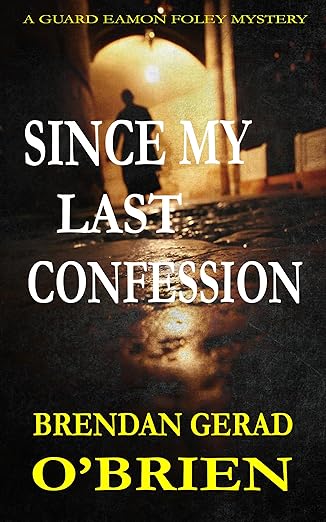
Tralee, Ireland. September 1948.
An arrogant, and highly agitated, priest arrives home after 40 years.
Days later he's dead. Suicide? Or did his past catch up with him?
Dublin 1941. A brutal murder. Mistaken identity. And barman Eamon Foley is running for his life.
Nine months later Foley is in a crowded pub, and his brother-in-law is shot dead.




I like 'the characters took over and began telling the story on their own.'
They do, don't they.
Never stop writing
m
Ron