The following story is the personal account of two FEMA volunteers working in Punta Gorda, Florida after Hurricane Charley destroyed much
of the community on August 13, 2004.
“It felt like an out of body experience. We were in total shock.”
That was how my friend Jeannine Stanford described her initial reaction, when she and husband Alfred arrived in devastated Punta Gorda FL. The Stanfords are longtime residents of the Tampa Bay area in Central Florida, where Hurricane Charley was originally expected to make landfall on August 13, 2004. After the storm passed, Alfred and fellow members of the Clearwater Jaycees immediately contacted FEMA (Federal Emergency Management Agency) to obtain necessary credentials to assist those who weren’t so lucky.
However, nothing could mentally prepare them for what they found there.
“As soon as we got off the interstate, we saw a lot of toppled trees,” Jeannine reported.
Not long after that, their eyes began wandering over a virtual sea of destruction.
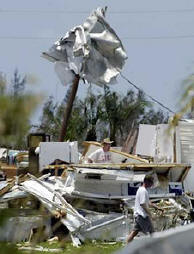
“It looked like a nuclear bomb had gone off. House after house, building after building was completely obliterated. Alfred and I wept uncontrollably. I snapped some photos to show our friends at home what Tampa Bay could have expected if Charley had come our way. But I realized after shooting a single roll of film, that there wasn’t much to distinguish one pile of rubble from another. A single photograph could have told the whole story.”
Most disturbing was witnessing dazed residents sorting through the vestiges of their lives, contemplating the loss of all that was once familiar, and trying to make sense of what was left.
And Mother Nature had seen to it that those responding to their needs didn’t have an easy time of it.
Street signs were gone. With few remaining landmarks to guide them, FEMA representatives, news media, and volunteer law enforcement from other Florida counties were having difficulty getting where they were going, as most were unfamiliar with the area. Jeannine and Alfred had the same problem.
“If one road looked clear, we’d inevitably come to a pile of rubble blocking the way. If we turned around, it was easy to forget what direction we came from, and we’d end up on another blocked road. If we weren’t careful, we’d find ourselves trapped in a hellish maze.”
Even summer thunderstorms posed a threat to wind-weakened structures, according to Alfred.
“We were driving along, when lightening struck a power pole beside the road. It fell onto the adjacent pole which caused five more to fall against each other like dominos.”
The Stanfords discovered another frustrating wrinkle in rendering aid to victims. While passing through one rural neighborhood, they found a Hispanic family camping in a tent in front of their collapsed home. Emergency personnel had not yet visited them. Their car was destroyed during the storm, so they lacked transportation to seek out assistance. Jeannine related their story.
“The parents didn’t speak English, so their 5-year-old daughter translated for us. We gave them ice and orange juice, along with whatever else we had in the van that might be of use. But we couldn’t tell them how to obtain additional help because of the language barrier, as well as a 5-year-old child’s limited capacity to translate the information. FEMA had no foreign language brochures for us to hand out during the early days of the rescue. So we did the best we could for them at the time, and hoped we could find our way back to bring more help.”
The one positive amidst so much tragedy was the immense generosity of the American people. Huge caravans of semi trucks soon began arriving, loaded with water, batteries, food, diapers, as well as personal hygiene, and feminine products, etc. One 18-wheeler displayed a huge sign on both sides of its trailer that read “From Louisiana to Florida with love”.
The outpouring of help stunned many Punta Gorda residents.
“There was no electricity, so there weren’t any links to the outside world. Other than the President’s initial visit, people couldn’t be certain that anyone else knew what happened to them until the relief trucks started rolling in.,” says Jeannine.
The losses affecting children were particularly heart breaking.
“One disappointed little boy was facing his sixth birthday without a present, until he was given a Beanie Baby from someone’s Happy Meal. His face lit up like a Christmas tree. It’s amazing how one little toy can bring happiness to a child who has nothing left.” Jeannine explained. “I saw another two year old boy with both hands wrapped in thick bandages. His mother explained that during the worst part of the storm, they’d sought shelter in a closet. Suddenly the roof blew off, and the wind began pulling her son out of her arms. She held onto his legs for dear life, as he reached out to grab something to hold onto. Unfortunately what he reached for was a broken mirror that nearly severed both of his hands.”
Keeping a stiff upper lip in the face of tremendous loss was hard for Alfred and Jeannine. Both reported having difficulty sleeping during their stay in Punta Gorda despite their extreme exhaustion.
“Every time we closed our eyes, all we could see was suffering. The first night I didn’t get to sleep until about 6 am. I kept thinking how Charley was supposed to be our storm,” said Jeannine.
That’s a comment that many residents of Tampa Bay could relate to. A lot of folks I’ve spoken to have suffered a profound sense of survivor’s guilt after Charley. Like me, they grieve for those who took a blow that seemed intended for us. And I am in awe of those in the trenches aiding the victims like Jeannine and Alfred, relief soldiers in a meteorological war zone.
No one knows when Mother Nature will strike at any of us with tornadoes, floods, or hurricanes that possess the power to level our communities, and destroy lives. However if the worst happens, it’s a comfort to know that there are compassionate people like the Stanfords who are ready and willing to put us back together again.
Michelle Close Mills ©




One thing I've observed, coast to coast, when a disaster strikes we're all one family. We stick together and help. Thanks for sharing an intimate reflection of your friend's observations.
Cynthia
God Bless
Michelle~
Love Tinka
Thanks for posting this appeal..and the graphic pictures of Hurricane Charley's devastion in Florida...
Makes you think deeply about a lot of things ...
Peter