AuthorsDen.com  Join | Login 

 
Where Authors and Readers come together!

Authors | Books | Audiobooks | eBooks | Signed Bookstore | Stories | Articles | Poetry | Blogs | News | Events | Reviews | Videos | Success | Gold Members | Testimonials

Featured Authors:  Teresa Walker, iJames Harvey, iCharlene Proctor, iPamela Ackerson, iSergio Serrano, Ph.D., iTerry Vinson, iMargaret Mullings, iTichaona Chinyelu, iGracie McKeever, iTracey Morait, i

  Home > Psychology > Articles
Popular: Books, Stories, Articles, Poetry      Authors: A B C D E F G H I J K L M N O P Q R S T U V W X Y Z     

Sam Vaknin

 Follow Me  

· 477 titles
· 125 Reviews
· Share with Friends!
· Save to My Library
·
Member Since: Jul, 2000

   Sitemap
   Contact Author
   Message Board
   Read Reviews


Books
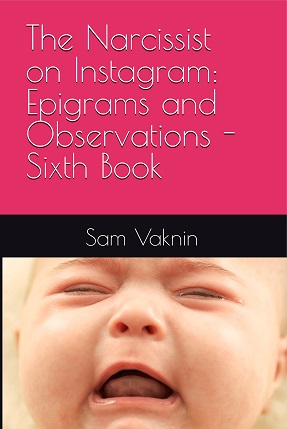
· FREE The Narcissist on Instagram: Epigrams and Observations - Sixth Book

· FREE The Narcissist on Instagram: Epigrams and Observations - Sixth Book

· The Narcissist on Instagram: Epigrams and Observations - Fifth Book

· Poetry of Healing and Abuse

· World in Conflict, Mind in Transition: Sam Vaknin Interviews

· FREE The Narcissist on Instagram: Epigrams and Observations - Fourth Book

· FREE The Narcissist on Instagram: Epigrams and Observations - Third Book

· FREE The Narcissist on Instagram: Epigrams and Observations - Second Book

· FREE The Narcissist on Instagram: Epigrams and Observations - First Book

· FREE A Critique of Piketty's Capital in the Twenty-first Century [


Short Stories
· Hunting Bambi

· Ned’s Short Life

· Sexsomnia

· Fugue

· The Galatea of Cotard

· Live Burial

· Lucid Dreams

· A Dream Come True

· Anton's Trap

· The Elephant's Call


Articles
· Triggering Cascade, Trauma Imprinting, and Total Reactance

· Lessons of My Life

· FILM REVIEW The Place (2017)

· Teen Suicide and Social Media

· The Best Offer

· Cryptoassets (such as cryptocurrencies): Pyramid Schemes or Public Goods?

· 2017 Encyclopedia Britannica Ultimate Knowledge Pack

· Narcissists HATE Christmas, Holidays, and Birthdays

· A Cerebral Narcissist on His Sexuality

· Narcissist's Frustrating, Negativistic, and Passive-Aggressive Behaviors


Poetry
· Her Birthday

· Hebrew Love

· My Putrid Lover

· Twinkle Star

· Synthetic Joy

· Our Love Alivid

· The Miracle of the Kisses

· Selfdream

· In Moist Propinquity

· A Hundred Children

         More poetry...
News
· FREE E-BOOK Abuse, Trauma, and Torture - Their Consequences and Effects

· FREE E-BOOK Narcissistic and Psychopathic Leaders

· FREE EBOOK The Hitler File (Excerpts)

· NEW eBOOK Excerpts from the Archives and Case Studies

· EIGHTH EDITION - Malignant Self Love - Narcissism Revisited

· NEW BOOK - After the Rain - How the West Lost the East

· NEW EBOOK Personality Disorders Revisited

Sam Vaknin, click here to update your web pages on AuthorsDen.

Books by
Sam Vaknin


See all Books
by Sam Vaknin


Classification (Taxonomy) of Psychological Theories
by Sam Vaknin
Last edited: Sunday, September 4, 2016
Posted: Sunday, September 4, 2016


All psychological theories can be classified by one or more of these dichotomies (pairs).

By Sam Vaknin
Author of "Malignant Self-love: Narcissism Revisited"

All psychological theories can be classified by one or more of these dichotomies (pairs):

Dualism vs. Monism

The belief that the mind and the body are two separate entities (though in constant interaction via various mechanisms and pathways); OR

The belief that the mind is nothing but an emergent phenomenon or a manifestation of and emanation from or a mislabelling physiological processes and qualities and, therefore, that psychology should be a branch of neuroscience or medicine (medicalization of psychology).

Innate vs. Stimuli-driven

The belief that all psychological traits and processes are innate and autonomous; OR

The belief that psychological processes are triggered by and psychological traits are shaped and conditioned by stimuli emanating from the environment.

Nature vs. Nurture

The belief that genes and, more comprehensively, evolution determine one’s psychological make-up and modus operandi; OR

The belief that one’s psychology is decided by one’s upbringing, human milieu, and personal history.

Reductionist vs. Holistic

The belief that psychology can be analytically reduced to a set of interacting, distinct, atom-like components or constructs; OR

The belief that one’s psychology is the complex, irreducible outcome of shape-shifting network of ceaseless interactions and the synergy of extensive and intensive qualities, parameters of action and boundary conditions.

Fixed vs. Plastic (Childhood vs. Lifespan or Determined vs. Mutable)

The belief that, at a certain age, one’s psychology becomes an immutable fixture, subject only to minor, almost imperceptible modifications; OR

The belief that one’s brain is plastic and reprogrammable from cradle to grave and that, therefore, one’s psychological settings and proceedings are constantly evolving and changing throughout the lifespan.

Static vs. Dynamic (Objective vs. Subjective)

The belief that psychological reactions and processes are rigid and set, allowing for well-demarcated diagnoses based on sharply-delineated clinical entities which are subject to the scientific method; OR

The belief that psychology is a narrative, fuzzy, impressionistic, ever-evolving, and somewhat “artistic”. Diagnosis and treatment require human contact and interaction, mostly subjective and emotional.

Process vs. Behavior

The belief that psychological processes constantly occur in the mind and underlie behaviors, cognitions, and choices and that they can be subject to meaningful and informed introspection; OR

The belief that, since we can never, in principle observe or measure inner processes in the mind (the intersubjective agreement is not falsifiable), we should only monitor, observe, and analyze behaviors.

Categorical vs. Dimensional

The belief that human behaviors, both normal and pathological (aberrant), can be categorized, distinguished, and demarcated with a minimum of ambiguity and overlap; OR

The belief that human behaviors constitute a spectrum and can be described only using interacting multi-purpose dimensions.

Statistical-Normal vs. Descriptive-Spectrum

The belief that human behaviors cluster around a mean or average which constitutes “normalcy”; OR

The belief that all human behaviors, preferences, drives, urges, traits, and orientations are “normal” (though they may be socially unacceptable or even illegal) and are part of a spectrum, even when there is only anecdotal evidence for their existence.

Analogous vs. Standalone

The belief that modelling human psychology by using analogies to various technologies provides real, testable insights into the human mind; OR

The belief that the human mind and its products are sui generis and cannot be studied by analogy. Getting to know the mind requires its own models and theories, independent of models and theories in other fields of science and knowledge.

Occult (Multipartite) vs. Overt (Monolithic)

The belief that the human mind is comprised of several interacting parts, some of which are accessible trivially while the awareness to and knowledge of other parts require special efforts and knowledge; OR

The belief that the mind is a monolithic, indivisible “black box”, which can be observed and analysed only via its effects on the world and interactions with reality.

Mechanical vs. Stochastic/Emergent

The belief that the mind is a machine which, like other machines, is subject to the laws of Nature and can be deciphered and contextualized objectively and even mathematically; OR

The belief that the mind is a cloud, the emergent outcome of numerous intertwined and fuzzy processes in constantly self-assembling and redundant networks and that the underlying math is stochastic rather than deterministic.

Theoretical vs. Experimental

The belief that psychology is a philosophy of the mind, not a rigorous science and that, consequently, it cannot be falsified and the results of its experiments cannot be repeated or replicated.

The belief that psychology is a science whose theories can yield falsifiable predictions and whose experiments are repeatable and replicable.

Web Site: Malignant Self-love: Narcissism Revisited


Want to review or comment on this article?


Need a FREE Reader Membership?

Reviewed by Ronald Hull
Reviewed on September 4, 2016
You certainly have raised more dichotomies than I have been aware of. Each one of these can result in arguments among psychologists who favor one pole over the other in an endless cycle of argument. In defense of the experimental, I would say that it is only through experiments that any meaningful results can be obtained in determining any kind of psychological result or prediction.

Ron

Reviewed by m j hollingshead
Reviewed on September 4, 2016

thought provoking read


New Articles by Sam Vaknin
article Image
The Narcissistic Personality Disorder and Pathological Narcissism - a Primer.
Pathological Narcissism and the Narcissistic Personality Disorder (NPD)
article Image
The psychology and sociology of art, artists, and the creative process.
Art, Artists, and the Creative Process
article Image
Economics affects every aspect of our lives. Hence the importance of studying the ethical, moral, and philosophical question it provokes.
The Philosophy of Economics - Part II
article Image
Economics affects every aspect of our lives. Hence the importance of studying the ethical, moral, and philosophical question it provokes.
The Philosophy of Economics - Part I
article Image
Detailed studies of five terrorist organizations in the Balkan.
Terrorists and Freedom Fighters - Part II
article Image
Detailed studies of five terrorist organizations in the Balkan.
Terrorists and Freedom Fighters - Part I
article Image
The role of women in the post communist countries in transition.
Women in Transition
article Image
Articles about mental health issues and Personality Disorders
Mental Health Articles by Sam Vaknin
article Image
Essays about various topics in current philosophy. <br>
Philosophy Articles by Sam Vaknin - Part I
article Image
These seven movies deal with moral and ethical dilemmas. "The Matrix" - with the nature of reality, "Titanic" - tackles the moral obligation versus se
Moral Deliberations in Films
article Image
Diplomats and Non Government Organizations (NGOs) thrive in trouble spots.
Diplomats and NGOs
article Image
Can religious communities co-existence? A study of the Balkan case.
Religions and Co-Existence
article Image
Language and media play decisive roles in political and economic conflicts.
Language and Media Articles
article Image
Issues in microeconomics and macroeconomics studied through the prism of economies in transition.
Economics Articles - Part II
article Image
Issues in microeconomics and macroeconomics studied through the prism of economies in transition.
Economics Articles - Part I
article Image
Articles and essays regarding the societies, politics, economics, geopolitics and history of countries in Central Eastern Europe and South Eastern Eur
International Affairs Articles - Part II
article Image
Articles and essays regarding the societies, politics, economics, geopolitics and history of countries in Central Eastern Europe and South Eastern Eur
International Affairs Articles - Part I