"Humanity's plastic footprint is probably more dangerous than its carbon footprint."
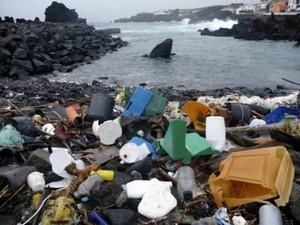
Researchers are now warning of a humongous new blight at sea: a swirl of confetti-like plastic debris stretching over a vast expanse of the Atlantic Ocean.
This floating garbage — hard to spot from the surface and spun together by a vortex of currents — was documented by two groups of scientists who recently trawled the sea between scenic Bermuda and Portugal's mid-Atlantic Azores islands.
The new studies describe 'a soup of micro-particles' similar to the so-called Great Pacific Garbage Patch, a phenomenon discovered a decade ago between Hawaii and California, that researchers say is very likely to exist in other places around the globe.
"Now, we've found The Great Atlantic Garbage Patch," says Anna Cummins, who collected plastic samples on a sailing voyage in February.
This ever increasing debris is extremely harmful to fish and to sea mammals — and at the top of the food chain, potentially to humans.
Since there is no realistic way of cleaning up Earth’s oceans, advocates say the key is to keep more plastic out of them by raising awareness and, wherever possible, challenging a modern day, throw-away culture that uses non-biodegradable materials for disposable products.
The research teams presented their findings recently at the 2010 Oceans Sciences Meeting in Portland, Oregon. While scientists have reported finding plastic in parts of the Atlantic since the 1970s, the researchers say they have now taken important steps toward mapping the extent of our human pollution.
Cummins and her husband, Marcus Eriksen, of Santa Monica, California, sailed across the Atlantic for their research project. They plan similar studies in the South Atlantic in November, and in the South Pacific next spring.
On the voyage from Bermuda to the Azores, they crossed the Sargasso Sea, an area bounded by ocean currents including the Gulf Stream. They took samples every 100 miles (160 kilometers) with one interruption caused by a major storm. Each time they pulled up the trawl, it was loaded with plastic.
A separate study by undergraduates with the Woods Hole, Massachusetts-based Sea Education Association collected more than 6,000 samples on trips between Canada and the Caribbean over the last two decades. The lead investigator, Kara Lavendar Law, said they found the highest concentrations of plastics between 22 and 38 degrees north latitude, an offshore patch equivalent to the area between roughly Cuba and Washington, D.C.
Long trails of seaweed, mixed with bottles, crates, and other flotsam, drift in the still waters of the area, known as the North Atlantic Subtropical Convergence Zone. Cummins' team even netted a Trigger fish trapped alive inside a plastic bucket.
But the most nettlesome trash is nearly invisible: countless specks of plastic, often smaller than pencil erasers, suspended near the surface of the deep blue Atlantic.
Still more data are needed to assess the dimensions of the newly discovered North Atlantic patch.
Charles Moore, an ocean researcher credited with discovering the Pacific Garbage Patch in 1997, said the Atlantic undoubtedly has comparable amounts of plastic. The east coast of the United States has more people and more rivers to funnel garbage into the sea. But since the Atlantic is stormier, debris there likely is more diffuse, he said.
Whatever the difference between the two regions, plastics are now devastating the environment across the entire world, said Moore, whose Algalita Marine Research Foundation based in Long Beach, California, was among the sponsors for Cummins and Eriksen.
Plastics have entangled and killed birds and turned up in the bellies of fish: A paper cited by the U.S. National Oceanic and Atmospheric Administration says as many as 100,000 marine mammals could die trash-related deaths each coming year.
The plastic bits, which can be impossible for fish to distinguish from plankton, are dangerous in part because they sponge up potentially harmful chemicals that are also circulating in the ocean, said Jacqueline Savitz, a marine scientist at Oceana, an ocean conservation group based in Washington.
As much as 80 percent of marine debris comes from land, according to the United Nations Environmental Program.
The U.S. government is now concerned the increasing plastic pollution could hurt its vital interests.
DiPinto said the federal agency is co-sponsoring a new voyage this summer by the Sea Education Association to measure plastic pollution southeast of Bermuda. NOAA is also involved in research on the Pacific patch.
"Unfortunately, the kinds of things we use plastic for are the kinds of things we don't dispose of carefully," Savitz said. "We've got to use less of it, and if we're going to use it, we have to make sure we dispose of it well."




















Right now, am watching a discussion by 'experts' - pundits - 'talking heads' - on FACE THE NATION. While they are talking about the banks and recent financial crisis, an interesting phenomenum is observed.
One fellow spoke at length about the 'how' and 'why' it occurred - by repeated explaining
two 'theories' that were prevalent at the time - 'IBG' and 'YBG.'
IBG = I'LL BE GONE and YBG = YOU'LL BE GONE.
In simple terms, it meant that the big 'PLAYERS' - having 'a priori' knowledge of probable
negative consequences of their acts, simply DID NOT CARE! When the 'SHIT HIT THE FAN' -
so to speak - either - "I'll Be Gone - OR - You'll Be Gone" - so, who 'gives a shit?'
Now, apply those same 'theories' to the: PLASTIC PROBLEM - the CO2 PROBLEM - the ENDANGERED SPECIES PROBLEM - the FINANCIAL PROBLEM, the GLOBAL WARMING PROBLEM - et al - ad ifinitum ...
In my humble opinion, WE ARE ALL GUILTY - Prior and Current Administrations, Prior and Current Congresses, Prior and Current Politicians at Every Level, Prior and Current Corporate CEO's and their Boards of Directors, and Last but not Least - Prior and Current
Majority Members of 'WE THE PEOPLE' - due to MASS APATHY!
"I'LL BE GONE ... OR ... YOU'LL BE GONE" - SO, WHO CARES? WHO GIVES A SHIT?
Our Kids? Our Grand-Kids? Their Kids? - IT'S THEIR PROBLEMS!
"I'M TOO BUSY - YOU'RE TOO BUSY - WE'RE TOO BUSY - THEY'RE TOO BUSY ...
SO ... FUG-GIT!"
HUMANITY IS BUT A BLIGHT - A GERM - A BACTERIA -
A SICKNESS ON THE FACE OF THE EARTH!
And, when we are ALL GONE -
GOD and MOTHER EARTH WILL CONTINUE - IN SPITE OF US!
Peace - Tom.
And that's the worst thing and why I've decried the "killing of our oceans by ourselves" - At some point it will boomerang and have its revenge on us, but it will be too late to save its beauty and value.
I've been screaming that even small bits of plastic are the worst offendors. I believe a law should say that the tops of recycled bottles also must remain attached and be recycled with the bottle. My last walk on the beach showed it was littered with these bottle tops and fragments (they didn't get there by beach walkers or boaters alone!) Currents! Sadly these particles will choke the food chain off and then also prevent natural gases like CO2 from being able to be sinked. Along with man's destruction of forests and vegetation it can't be long before we also pay the high price. But before we do all this wonderful wildlife and pristine beauty is destroyed for 'convenience sake(!?)' Appalling, but maybe if it does strike at the heart of U.S. vital interests we will finally do something! But yesterday, what were 'they' doing in Jacksonville, FL? Having a clandenstine public hearing (short notice) on Offshore Drilling and using deep-water sonics to test for drilling spots!
This is a 'wrong headed' culture headed the wrong way. All I can do is try to recycle everything and put the caps back on the empty bottle before I throw then in the recycle bin. But do they get recycled properly?'
I am very depressed about the state of our oceans...
Hope your day is better, MIKE
Georg