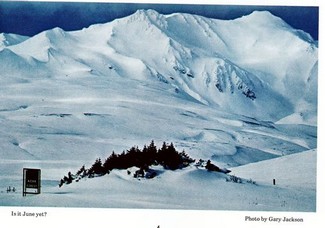
I lived on Adak from September 1972 to June 1976, and again from 1980 to 1981. It was a special place at a special time, now lost to those of us who dream of returning.
Everyone has their own cherished memories of Christmases past. They may be of a certain time, a special person, or in my case, a favorite place; and as memories of times and people are triggered by mistletoe and holly, so, too, are those of places.
Of my first twenty years, my father did two tours of duty on a little island near the end of Alaska's Aleutian Chain called Adak. The vast majority of “Adakians” were military personnel, which gave us our common link in the community. Those that weren't military were civil service contractors, thus the link was actually one of government employment. But whether contractor or active duty, it was of little consequence alongside the dependence we had on one another.
Adak is a wild little island with frequently overcast skies and rarely calm winds. Trees do not grow naturally there though a small stunted stand of Sitka spruce planted by GIs decades ago do make up what is affectionately known as the Adak National Forest. The landscape is carpeted with rugged tundra broken by cold running streams before rising sharply into jagged volcanic peaks. Every year we would watch the approach of winter as the snowline crept down the sides of Mt. Moffet until it covered the ground around us. White Christmases were a promise every year.
Purchasing holiday gifts took much forethought, and no small amount of money. They could be found at the base Exchange (PX to some) or through the ubiquitous Sears or JC Penney catalogs. If items were ordered then they had to be ordered far ahead of the holidays as shipping often took longer than anticipated and arriving in time wasn't always possible. I usually received a least one gift for New Years!
There were two armed forces radio stations (AM and FM) and one TV station that broadcast vintage television series and movies for four hours each day. As a result residents would take advantage of other means of entertainment and personal development by visiting the swimming pools, the bowling alleys, or the “hobby shops,” where they could learn and hone skills ranging from ceramics to lapidary to auto mechanics.
Our school was small yet supported both a men's and a women's basketball team whose primary opponents were teams made up of personnel from public works, the P-3 squadrons, the Marine barracks, and other such groups. At the end of the regular season they would travel off island to play in the state tournaments.
Church and school programs drew generous crowds with some coming to watch the children perform and others simply to socialize. At Christmastime, little ones would quickly learn that Santa Claus was not only fat and jolly but also multi-racial, for at the Exchange he could be black or white and at the school program a Filipino.
Classic Christmas broadcasts included A Wonderful Life and Miracle on 34th Street, as well a A Charlie Brown Christmas. On Christmas Eve, families would watch while safely inside and away from the bitter howling winds, their multi-colored lights flashing and twinkling on the inside of their snow sprayed windows. Sporadic groups of men and women from the barracks would brave the cold to roam from house to house, lending their voices in the rich tradition of caroling. Often their efforts were rewarded with a hot drink but sometimes a snowball or two erupted into a laughing free for all.
Christmas would dawn with a new layer of snow and soon an open-bedded truck would carry the combined choirs from the different faiths that worshiped in the island's small, historic chapel. The sounds of carols would bounce off the sounds of houses, drawing those inside, out. Behind them, sometimes on a fire truck and sometimes in a sleigh on wheels, would come Santa, ho, ho, hoeing and pitching candy-filled canes to everyone standing along the street.
Christmas was special in the tiny community of Adak. Its residents were thousands of miles from home and most couldn't afford the expense of flying home for the holidays. Everyone, but particularly those who were single, felt the homesickness not uncommon to those in the military. But despite this, the community would rally around one another and find joy in their own brand of fellowship. For this reason many have never forgotten the unique warmth shared by all who were fortunate to call the island home.
Photo by Gary Jackson via www.pinterest.com
|








Ron