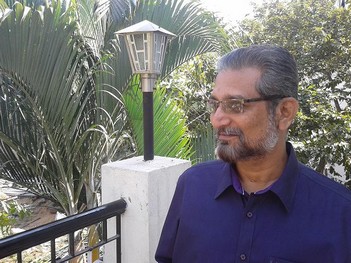
I never dreamt
of becoming a writer. In fact I used be brandishing the opinion that those who land
up with writing as a profession are generally the failures in other types of
verbal and nonverbal communication, the innate choices of expression among all
forms of life. Writing never comes to us as you would expect, whenever we feel
strongly about something, the natural response always is to express, share or
to tell someone. When that becomes an impossibility, either due to our failure
in conveying well or due to our lack of success in finding someone to listen to
what we say, we will be forced to resort to unnatural paths of release, writing
being one such path. The most likely
causes are unpopularity, seclusion and other undesirable elements of life. Naturally,
the more such elements are associated with someone; the greater are the chances
of achieving success as a writer!
During
my student days onwards I used to enjoy lengthy and protracted discussions on
many topics of mutual interest. I have noticed that whenever the topic of
discussion seemed to veer around caste, a strange transition took place in our circle.
Almost all of them started losing their steam, some of them instantly coming up
with an excuse to withdraw from the conversation with a few among them
detaching completely from all future discourses! It was only their earnest
desire to continue the friendship that made the few which continued their
involvement with this ‘intellectual exchange’, do so.
Not able to muster a minimum quorum for initiating
even the semblance of a discussion, I resorted to books. The ideas presented, in
all the books I happen to read for the next 30-35 years dealing with the issue
of caste, can be summarized in one sentence. Caste is an apparition instituted
by certain group to suppress the remaining, the plethora of rules and
observances aimed to keep them under leash against their desire. Any worthwhile
exception to this could be found only in Mahatma Gandhi, whose writings
exhorted those lower in caste to release themselves from the yoke they are
under and to surpass the upper caste brethren by freely competing with them.
As luck would
have it, I found myself in hospital for the next one year, with books as the
main companions, the complete works of Mahatma Gandhi adorning the hospital
bookshelf invitingly. And I went through the collection in full to find myself
completely at variance with the popular opinion on almost all social issues. I
ended up collating my skewed thoughts, which could find itself at ease with a substantially
different view of caste. And the result is my first book, Caste: The Unexplored
Territories.
But trouble
didn’t leave me. For every answer that I did conjure up, my book in fact posed many
new questions. How come we naturally adapted to such a system like caste, which
has the potential to bring down the capabilities of Indians lower with each
passing day when compared to those inhabiting the rest of the world? Further
reflection on similar issues affecting other societies led me to this maxim; Man
will choose the most complex or contorted one, among all available solutions to
a given problem and caste happened to be one such solution. Now I am faced with a bigger question, what
makes us choose thus, going always for the input intensive?
At this
juncture, some images of animal behavior that were lying dormant in me for
long, came to fore. I had been observing discernible differences between the
ways male and female of the animals reacted to events and occurrences of
living. As usual, no male or female could be found willing to listen to me.
Mulling over, as equivalents for the comparable particularities found
among men and women could easily be identified among all forms of life, it was
only a matter of time that I could publish my new theory; these peculiarities originate
from a single source, the one that is intended to give each species, a reason
to evolve. And the result is my second book, Why Evolve?