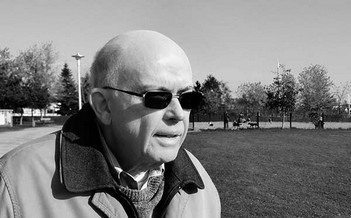
Richard French, click
here to update your pages on AuthorsDen.
Blogs by Richard French
Art at the Edge of the Pacific 4/12/2016 7:30:03 AM
At the beginning of January,, I flew to Del Mar, California, just north of San Diego, to visit a friend. I stopped in at the Del Mar Art Center, a cooperative of local artists, to have a look at their latest exhibit. A large painting near the front door on the left hand wall caught my eye. "Magical Places in My Mind" by Rosemary Valente had such an impact that it influenced my thinking about the other works in the gallery.
What kinds of ideas come to an artist? How does Artist A or Artist B think? It didn't take me long to suspect that those were the wrong questions and that they encouraged me to view the exhibit backwards. It was to miss the point to try to get beyond the paintings and sculptures and handcrafts to what I couldn't possibly know, since I had no information on the artists, not to mention the data and interpretation that make up biographies.
I went back the next day with a fresh brain for another look. I saw nature pictures, seascapes, flowers, animals, especially running horses, a few carrying jockeys, since Del Mar's race track draws numerous summer visitors. I saw woodblocks with fanciful designs, handmade jewelry, ceramic wall-hangings of fish and other sea creatures, photos in vivid black and white.
I decided to focus on the abstract work that was placed here and there around the gallery. I went back to :"Magical Places", where I gazed at a sea at of reds and yellows (sunset?), a white sky with whispers of pastel tints. Idling near the top left was a ghostly-looking ship with blue masts that a rumpled sea gave back as four blue fingers.
Across the room was a smaller painting of hands -- a father's and mothers and a baby's -- one in front of another, palms outward toward the viewer, giving an impression of leaves. The picture, by Darlene Katz, is called "The Tree of Life".
Next to "Magical Places", was another good-sized, rectangular abstract painting called "Champagne" by Asta Sutton: swirls and streams of color -- brown, red -- on a mostly white and yellow background. The effect isn't garish or aggressive, but delicate with each curve and squiggle carefully placed. Two smaller works of hers, similar in concept, were also on display: "Happy Morning" and "Inferno of Colors", richer in tone with bold, decisive gestures.
Another of Asta Sutton's works was across the gallery: "Wood Folks": a dark, blue background, with a loose, lighter-colored spiral running from bottom to top.
Now, a little curiosity can take a person a long way. The exhibition notebook said that Asta Sutton is from Finland, where my mother's parents were born, grew up, and married. She studied in northern Ontario, where I lived and worked for 18 years, and recently received a Ph,D. from the University of California at San Diego. The title of her dissertation is "A Narrative Case Study of the Unconscious in Visual Art".
Now, we shouldn't dwell on personal preferences forever, so I moved on to the work of Pamela Fox Linton. Four abstract works in acrylic and mixed media that featured blocks of color the artist's skill put together carefully: bright in one, dark like a city at night in another, and earth tones for paintings called "Insight" and "Evolve".
I moved along to a double-sided stand-alone panel filled with black and white photos, mostly abstract. I have no idea how the photographers created their images, but I found them striking and imaginative,
The gallery had too many appealing works to mention them all, but I want to include a reference to the woodblocks of Malsu Lee Paparisto, an artist from South Korea with an Albanian husband. She was on duty during my last of five visits to the gallery. She had two large works and smaller ones on display. She showed me a portfolio of photos of her work. Each woodblock, she said, had three elements: water, nature, and something man-made, such as city buildings.
She also showed me a woodcarving she was working on now that features the Golden Gate Bridge in San Francisco. I watched her at work with her chisels as she carved out a representation of water in front of the famous landmark.
I left the gallery, walked a few steps across a terrace, and saw the vast expanse of the Pacific Ocean, partly obscured by green trees, not my usual vista. I found that the size of the ocean and the skillful creations in a one-room gallery curiously balanced each other, that my experience of life would be poorer without either one, and that my brain was working the way it should.