MAN ON THE STREET
Miami Beach. Florida 33139
March 24, 2009
Barrack Hussein Obama
President of the United States
The White House
1600 Pennsylvania Avenue
Washington
, D.C.20500
Re: Interest on Capital
Dear Mr. President:
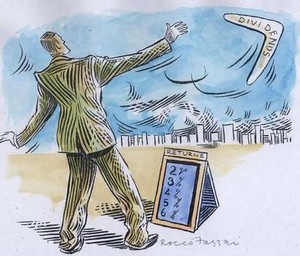
I am glad to hear that you have finally stopped campaigning against your predecessors for the office you have already won, and have started to go long on the country for the great opportunities it offers instead of persuading your audience to sell it short because doom seems to impend. For the man on the street knows too well what is wrong, and he wants to know about the right things to invest in so that he might act accordingly and enjoy the dividends.
Alas, however, that “dividend”, a term sacred to democratic capitalism because dividends liquidate the division of profits, has become a dirty word lately, signifying something almost as obscene as the gargantuan bonuses paid to purportedly greedy and incompetent executives. Ironically, the federal leviathan has done its best to stigmatize the payment of dividends to small shareholders while demanding preference over such commoners for itself, crowding them out for its 5% dividends on its preferred stock, a rate set to rise to 9% after five years. But of course the preferred dividends are tantamount to interest on loans, instead of real dividends for sharing in risk, the loans being called preferred stock so the loans can be added to the definition of capital instead of being seen as the expensive indebtedness that it really is.
During your campaign for presidency, you were closely monitoring the Bush Administration’s handling of the credit crisis. You must recall very well that Richard M. Kovacevich, Chairman of Wells Fargo Bank, protested against the arm-twisting by Government Sach’s esteemed leader, Henry M Paulson, at the infamous meeting with nine bankers on October 10, 2008 in a gilded conference room at the Treasury Department. Chairman Kovacevich said that his bank had not participated in the toxic-assets buying spree, and did not need expensive government loans disguised as capital, which he claimed would cost his shareholders dearly. And most recently he had said that the so-called bailout plan unwanted by his bank had driven private capital away and forced a drastic dividend cut. A New York Times article responded to his protest by implying that he is a greedy man interested only in his bonuses, options, and retirement plan. Nevertheless, as you know, charging 5% to 9% on faux capital that a bank does not need or want, coupled with the fearful uncertainty that an ex-post-facto, bill-of-attainder attitude on the part of an overpowering lender is bound to instill, is not the best way to attract private capital.
The bulk of common dividends, which aided banks have been pressured by Uncle Sam to cut and are absolutely prohibited from raising without express permission while he has his hands in the till, are paid to small investors who have confidence in capitalism, and not to card-reading probability players and speculating sharpsters for whom life is just a game, gamblers who could care less about which way markets go or what is produced as long as they can turn a buck for themselves on the swings.
Due to my confidence in your guidance and America’s future, I bought a few shares in Wells Fargo. That bank literally saved me from starving on the streets of San Francisco when I was a kid, during the Hippie migration to California. The bank gave me a job in the basement, where I ran discarded envelopes through rollers to make sure they had been completed emptied of returned credit cards and other mail. My bonus was in my share of the stamps the post office’s canceling machine had missed, which we soaked off the envelopes and sold to a dealer for one-third of their face value.
Indeed, it is about time for small investors to take advantage of bargain basement stock prices, to take the country’s economic future away from the professional market gamers who are presently churning and milking the market for short term gains, bragging that volatility i.e. instability is their best friend. Why should fundamental investors allow a few gamblers who liken themselves to bears and bulls and sharks determine the value of the entire nation’s portfolio? Many small investors courageously bought some of the bank shares being dumped by erstwhile strong hands, only to watch the value of their patriotic holdings plummet much further as bankers were stigmatized and dividends were cut. I have been financially poor by choice, finding my happiness in knowing something or the other and expressing it from time to time, but I can still imagine how pained retirees feel when they are so doubly damned, by less income from rapidly depreciating capital. Most dividend recipients are not wealthy executives with multimillion-dollar bonuses. I believe your statisticians will find that around 75% of taxpayers directly receiving dividends earn less than $80,000 in wage and salary income, and that around half of the total dividends paid out go to retirement funds and nonprofit institutions that their respective beneficiaries depend upon for support when their earning capacity is diminished.
Mr. President, common dividends are good for democratic-republican enterprise and welfare capitalism – capitalism that takes the welfare of all its stakeholders to heart. Successful firms must pay dividends. If successful firms did not pay dividends they would become bloated with cash, and their managers would hoard that cash to the detriment of the community or otherwise waste it on inopportune, ill-timed speculation and on an unproductive, unprofitable kind of growth that would cause bloated organizations to eventually collapse under their own weight. A firm’s very reason for existence is to serve as a mode of action whereby the factors of production, especially human resources, can be brought into a more rewarding relationship than might otherwise be achieved. Those rewards are actually realized by capitalists including small investors when liquidated in the form of cash dividends. To remain healthy and successful, a firm must bleed itself of its retained earnings when those retentions of earned equity are excessive in comparison to its total assets, thus distributing the right portion of its profits to investors for immediate consumption and/or reinvestment by numerous hands in a broad myriad of enterprises.
The great American logician, Charles Sanders Peirce, who was also a pioneering fallibilist, said that what makes America great is that every American believes he has an opportunity to get rich – Mr. Peirce was a proponent of tychism: he believed in the reality of chance no matter how slight our chances might be. There is a bit of a capitalist in us all, and what the capitalist ultimately wants from his capital is a useful return from his contributed factor of production, the return formally called interest on capital advanced, whether that interest be returned in the form of interest or dividends – if he is a Muslim, his return may not be called interest, but a portion of growth or capital gain distributions will do nicely, since there are several ways to skin a cat.
May we recognize again the secular sanctity of dividends, Mr. President, Instead of stigmatizing dividends and pressuring banks to curb dividends, we should be encouraging all big corporations to pay them. Indeed, payment of dividends from of a certain portion of accumulated earnings should be mandatory under certain conditions. To distinguish this special interest in perpetual capital from dividends as we presently consider them, we might call them “interest on capital,’ as they are called in Brazil, i.e. juros sobre capital proprio.
To further our good end, we should replace the 15% tax on qualified dividends with a 10% tax on same received by taxpayers with an adjusted gross income over $250,000, exempt incomes below that from the dividend tax, and make such “interest on capital” fully deductible by qualified corporations, just as the corporation can deduct interest on lent capital. Retirement savings plans should then be required to distribute without penalty any such dividends received, and endowments would have to immediately expend them to beneficiaries.
Mandatory payment of tax-free dividends paid out of accumulated profits, fully deductible by corporations, would attract capital to business and help conjoin the interests of corporate America and Americans at large. It would be far better to stimulate America with money already earned but hoarded in corporate coffers than to saddle taxpayers with further indebtedness and the “hidden tax” of inflation, especially when indebtedness and con-money expansion is an economic disease. Furthermore, since dividends can only be paid out of real profits, the cultivation of dividends would allow investors to identify businesses that are actually adding value to the American enterprise, separating them from the fakirs that hazarders are so fond of speculating on.
I could go on and on about the advantages of paying out deductible dividends and receiving them tax-free, Mr. President, but I realize you have a great team of so-called rivals to rely upon, and do not have a whole lot of time to listen at length to suggestions from the man on the street. Yet I know his opinions are still important to you because he is not always on the same page as your team, so I have invested some time in this opinion and look forward to the dividends.
Sincerely,
David Arthur Walters


 Share
Share Save
Save