R.K.Singh about his poetry in an interview with Dr A.K.Choudhary
PROFESSOR R.K.SINGH TALKS ABOUT HIS POETRY IN AN INTERVIEW WITH Dr. ARBIND KUMAR CHOUDHARY, Rangachahi College, Majuli, JORHAT (ASSAM)
AKC: 1. Why do you write?
RKS: Basically I am a poet and I write when I am moved by certain thought, idea, feeling, emotion, or experience. Any sensory, intellectual or spiritual experience may arouse me to articulate a lived or experienced moment. I write because I want to feel lighter, liberated or refreshed within. I write to seek a release from myself as much as from others; to feel free by unburdening myself in verses; to experience an inner balance, feeling, probing, sensing, recalling, or whatever. If it turns out to be a good poem, it has beauty and meaning created out of a pressing sense of inner emptiness or purposelessness of existence.
2. Will you please tell us something about your childhood memories? How was your parentage and bringing up all about? Was there conditions conducive to flower your genius?
I come from a humble family of Varanasi. For generations my forefathers had lived in the narrow lanes of Kashi, partaking of a culture which flourished on the bank of the Ganges that still attracts everyone, though the uniqueness I experienced in the 1950s and 1960s is gone. I was born, brought up and educated there, beginning from the School nearest to our residence, to high school, intermediate, and graduation (1970) from Harish Chandra Degree College, to M.A. (1972) from BHU, and Ph.D. (1981) from Kashi Vidyapith.
As my grandfather was a freedom fighter, frequently imprisoned along with other Congress leaders in Banaras, my father could not have formal education. He learnt to survive by himself, and learnt to read and write and did petty jobs before he could settle down in life, as he told me once. I am the eldest of his eight children who are all postgraduates and/or doctorates and fiercely independent in their views and thinking. I am proud to say that we all grew up in a secular environment with freedom to think, read and express our views.
3. How would you define a good poem?
A good poem generates some physical, emotional or psychosexual sensation, stimulates some sensuous, spiritual or exalted pleasure, or provokes some ideas.
I have no taste for didacticism in poetry. I love brevity, rhythm, and “colouring of human passion”; personal, lyrical, honest and free expression, with seriousness in reflection and interpretation. Poetry lies in creating the image (like the painter who celebrates sensuality), and in capturing momentness of a moment, which stirs the mind.
4. How have your writings been received?
Perhaps, with a sense of difference, or maybe, indifference? The established academia and the media have ignored me, as I have been writing from the margin, from a small city, where creativity in English is simply not bothered. A handful of friends and readers have, however, been very encouraging and enthusiastic about my poetry, book reviews, and articles.
5. Who did help and inspire you the most in writings?
: Help? I doubt anybody helped me in my writings. But I did learn the art of editing (my poetry) from my poet-professor friend, Lyle Glazier (USA). He helped me edit my first two collections, My Silence (1985) and Music Must Sound (1990). He was a very positive reader of my verses and he inspired me most in the 1970s with his liberal comments and/or suggestions.
6. What is your masterpiece?
It is difficult to say which of my twelve collections is a masterpiece. Perhaps the best is yet to come out. However, the first collection, My Silence (1985), is a significant volume just as my latest collection, The River Returns (2006), should be a milestone in my poetic career.
7. Tell something about your masterpiece.
'My Silence' may be treated as a mini-epic, with ‘silence’ as the common thread. The 80 poems in the volume bear no titles; titles tell too much. But here one may discover my formal taste, personal vision, and sexual orientation rooted in Purush-Prakriti union. It is significant for open eroticism, seriousness, candor, and exaltation of Rati “to a plane where the apparent glamour of the flesh merges into a universal principle of creation,” to quote R.S. Tiwary.
8. What is your philoshopy of life?
I believe in unity of mankind and equality of sexes, and am secular and non-moral in my attitude and values. I recognize the world as one earth, one nation, one country just as I love all the races, tribes, nationalities, religious, and languages. I accept the spiritual oneness of people and my concerns cut across national boundaries. I believe in living without prejudices as man belonging to the whole world, honest to my self.
In creative writing, I trust the autonomy of readers who must read and recreate a poem’s meaning according to their own intellectual potency, taste, and sensibility without any suggestions or comments from the poet (or critic). I love my poem’s exposure to different kinds/levels of meaning.
9. Which of your poems/stories are specificially autobiographical in nature?
Though most of my poems may have one or the other personal elements to refer to, I would not like them to be explored in terms of autobiography, for facts and fiction are so fused in my brief personal lyrics/poems, haiku, senryu, and tanka, one would succeed only in distorting and reaching the wrong conclusions.
10. What, in general, are the themes of your writings--poems and stories?
I am realistic and try to present facts. Maybe, sometimes I am not palatable but I don’t think the aesthetic appeal is reduced. The themes of spiritual search, an attempt to understand myself and the world around me, social injustice and disintegration, human suffering, degradation of relationship, political corruption, fundamentalism, hollowness of urban life and its false values, prejudices, loneliness, sex, love, irony, intolerance etc are prominent. In my haiku/senryu there is a deeper understanding of the quotidian as well as things in their complex simplicity.
11. Tell some memorable instances that have moulded your writings.
My chance encounter in 1971-72 with the poetry of Lyle Glazier for writing the M.A. dissertation proved a strong effect on my poetic sensibility. It seems it matured with personal correspondence between Professor Glazier and myself on our poetry. Further, the more I suffered rejection slips, the more determined I became to prove myself, especially in poetry. I have proved my distractors wrong, whether they recognize me or reject me.
I also learnt the art of criticism in the learned company of my teacher, the late Dr B. Chakroverty, a Tagore Scholar and critic. It was during the period I was jobless that Dr Chakroverty moulded my literary and critical sense.
Later, interaction with poet friends like O.P. Bhatnagar, I.K. Sharma, I.H. Rizvi, Krishna Srinivas, Y.S. Rajan, Niranjan Mohanty and others has also been memorable.
12. Will you tell something about your visualization of the futuristic society and ethos to emerge as portrayed in your books?
The ethos my poetry projects is characterized by mutual love and respect for others; tolerance of social, sexual, political, religious, and linguistic difference; and cultural dialogue and assimilation. I visualize a more liberal and tolerant mind; a more creative, more assimilative, more skilled, more aware, with a sense of caring and sharing, society. I see a future which is conscious of mutuality of concern and action, which is more integrated into global trends, which is more international, intercultural, nature-conscious, and internally spiritual.
13. Is it not dream would of your books in which a thought of harmonization surfaces amidst awful conflicts and competitions?
As a believer in the unity of humanity, I value the spiritual oneness of people and seek harmonious relationship. The ‘dream’ world of my poetry is very much real, exposing social attitude, morality, hypocrisy, the socio-sexual standards that determine ‘civilized’ norms, that discriminate, enchain, and debase honest aspirations as lust or vulgarity. The very exposure is an act of criticism. The lies are revealed to strike a balance and harmony in relationship.
14. Are you a satisfied person vis-à-vis your literary and academic pursuits?
RKS: No. Frankly, I feel sad that despite 32 books, including 12 poetry collections, about 150 academic articles, and more than 160 book reviews to my credit, I get little attention. The mainstream academia do not recognize my contributions as an Indian English poet nor do they explore my poetry for doctoral dissertation. No big press has published me yet.
Though there seems a peculiar apathy/indifference all around, I am happy I have not wasted my time and done whatever could be possible within the constraints of my situation. I have been supported and sustained by small press all these years, and to that extent, I am very satisfied.
15. Do you want to give any message to the readers?
It will serve the cause of Indian English Writing well if you could read the new, unknown poets/writers seriously and critically, and then, if you think so, dump them, instead or rejecting them without even looking at them. A change in academics’ attitude is essential.
And, please support the small press, ‘zines, and journals!
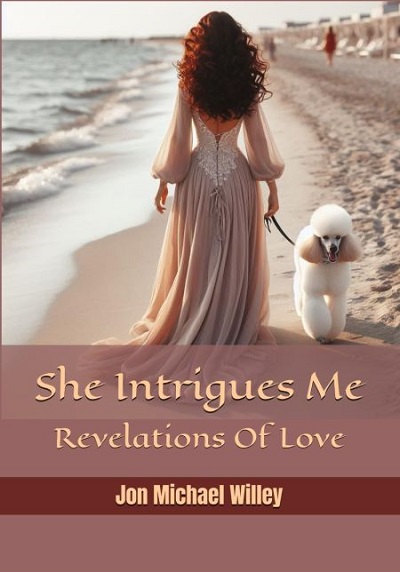
This book represents a thirty-day period of my poetry journal. Each poem addresses
the dominant thoughts occupying my mind during the early morning hours of a given
day.
If you tend to believe romantic, passionate, masculine poetry is a thing of past eras, read "She Intrigues Me," and be swept away in the beautiful craft of a contemporary poet of love.


 Share
Share Save
Save