Harley G. Brown spent days analyzing his scheme. He tore it apart looking for defects, then assembled it again. It was foolproof, he thought.
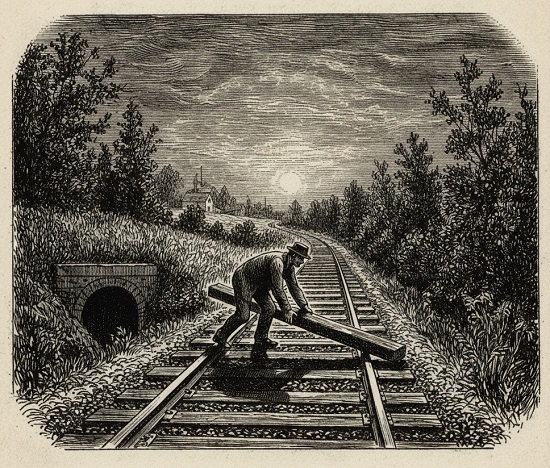
The plan was simple: wedge a railroad tie across the tracks near Claymont station, wait for the local train to stop, then run toward it waving his arms frantically. He would tell a story of discovering the obstruction and trying desperately to remove it. The Philadelphia, Wilmington & Baltimore Railroad would hail him as a hero. They would offer him his old job back—or maybe something better.
On the warm night of June 29, 1878, Brown set his plan in motion. He found an old tie in a ditch and wedged it carefully across the rails at a spot just beyond a culvert, opposite the farmhouse of J. Edward Addicks. Then he waited.
What Brown didn't know was that a fast express ran between the scheduled local services.
When an unexpected whistle pierced the night, Brown's confidence curdled into horror. The express hurtled toward him at fifty miles per hour—far too fast to stop even if the crew spotted him waving his handkerchief in the darkness. His foolproof plan had a fatal defect after all.
The locomotive struck the obstruction and toppled from the tracks "like a toy." Flames began licking at the wreckage. Engineer George Babe died in the crash, along with his son George Jr., who had been firing the locomotive, and two men who had been stealing a ride between cars. A witness described the true horror: the engineer lay between the locomotive and tender, "badly crushed and completely disemboweled."
Behind the derailed engine sat two express cars, a baggage car, two passenger cars, and two sleeping cars—all mercifully still on the rails. If they had also derailed, fire might have consumed the wooden carriages and their seventy passengers.
In the aftermath, Brown approached the conductor, Samuel Phillips, tapped him on the shoulder, and asked if the wreck was bad. Then he added, "I did all in my power to stop her." Phillips, a sixteen-year railroad veteran, grew immediately suspicious. "A man ought to be almost able to get anything off a railroad track under such circumstances," he observed. Before Phillips could question him further, Brown vanished into the darkness.
He didn't stay hidden for long. Brown confessed, and by December 1878 he sat before the New Castle Court of Oyer and Terminer, charged with first-degree murder. The Delaware Gazette reported that he was "neatly dressed in a black suit" and "walked firmly and without hesitancy." But there were signs of inner turmoil: "a slight contraction of the eyebrows, a tremor of the lips, and a nervous twisting of his pocket handkerchief around his fingers."
How had a former model employee arrived at such a deranged scheme?
Brown had worked for the P.W. & B. for over a decade before leaving in 1875. The Smyrna Times reported that during those years he was "regarded as a faithful and efficient officer, prompt and willing in the performance of his duties, and an exemplary man in all respects." He was strictly temperate, avoiding both liquor and tobacco. When he resigned, he gave proper notice and trained his replacement.
But something had gone wrong inside Harley Brown's head—literally. In 1868, he suffered a severe accident while working on the railroad. Later came a near-fatal sunstroke. After leaving Delaware for Maine, where he joined his father and brother in a farming and forestry partnership, a falling tree limb knocked him unconscious. Blood oozed from his ear. He remained senseless for ten or fifteen minutes. Afterward, his mood darkened into deep melancholy.
The forestry work proved too demanding for his injured mind. Brown decided to return to Delaware and seek reinstatement with the railroad—steady employment, familiar routine. But when he arrived in Wilmington, he discovered his years of faithful service carried no weight. Someone had taken his old position, and the P.W. & B. refused to offer him another. Master machinist Stillman A. Hodgman recalled Brown's humiliated appeals: "He asked me for a job as fireman, and if I couldn't give him that give him anything we had to do." The rejection was absolute.
Brown's timing couldn't have been worse. Just a year earlier, the Great Railroad Strike of 1877 had erupted across the country. Workers blocked trains and clashed with militia forces. Federal troops killed dozens of strikers in Pittsburgh and Baltimore. The public increasingly viewed railroads as ruthless monopolies that discarded even their most loyal workers.
Brown's case struck a nerve precisely because he embodied this dysfunction. "There is a great amount of sympathy expressed for Harley G. Brown," noted The Daily Gazette. This sentiment reflected both pity for his mental state and deep-seated anger at a system that drove even its most dedicated employees to desperation.
His cousin Adolphus, who worked in the freight department, testified that Brown "seemed discouraged and dejected and talked as though his friends did not consult him enough to do anything for him." Neighbor William Brannon called him "flighty" and "a man not possessing good common sense." A member of the coroner's jury thought Brown acted "like a ten-year-old boy."
The jury deliberated for an hour and twenty minutes. They weighed three possibilities: murder, manslaughter, or complete acquittal based on insanity. In the end, they split the difference—not guilty of murder, but guilty of manslaughter. Brown's mental state had impaired his judgment without completely absolving him. He served five years in New Castle jail instead of facing the gallows.
After his release in 1883, Brown moved to Mount Holly, New Jersey, where he built a house on his father-in-law's farm and turned to agriculture—finding in farming the stability that railroading and forestry had denied him.
But nothing could undo what happened on that warm June night when a desperate man wedged a tie across the tracks and waited for the wrong train. His actions cost four innocent men their lives and forever marked him as the hero who never was.
——————————
This post is adapted from “Delaware Behaving Badly: First State, True Crimes,” arriving January 1.
|





 Share
Share Save
Save