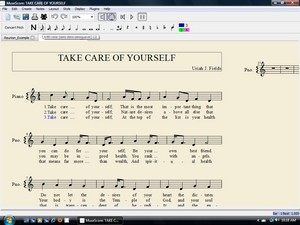
Give us, oh, give us, the man who uses music to deliver his sermons! The listener is seldom disinterested while listening to music.
"Music to deliver sermons in sound," is a mandate Martin Luther issued for sermonizers. He recognized that music is a powerful communication instrument that can be used to deliver sermons.
The sound of music is international and interplanetary just as the cry of a new born baby and as the moon, stars and sun. The earliest record declares "morning stars singing together." (Job 38.7). Music transcends language or it is its own language. Even music without words communicates spiritual messages with clarity and sometimes in ways that words cannot do.
The sermon is a Divine message attuned to what "Thus says the Lord" and proclaimed through human personality. Its content is about life and man's duty to his fellowman and to God. It is our focus on music that helps us to realize that there are various ways to deliver a sermon. We are likely to recognize, as did Martin Luther, that music can be used to effectively deliver a sermon.
Music consists of various forms that include instrumental music, singing, humming and whistling. Either or all these modes of expressions may be use to deliver a sermon. While all these forms of music can be used to deliver sermons in sound not all music can appropriately deliver sermons in sound. When I was a boy growing up on a farm I listened to my father while working, who among his other callings, were a farmer, beekeeper, carpenter and preacher, whistle to deliver sermons and was made glad.
It is likely that the Apostle Paul used music to deliver some of his sermons and had this in mind when he said, "Sing and make music in your heart unto the Lord." (Eph. 5:19). It should be noted that Paul saw all Saints, i.e., believers, as ministers, and with that in mind all believers are or can be sermonizers. As a Saint Troubadour whose forte is making music, very often I sing. Sometimes I play my harmonica and whistle. Each day I used music to deliver positive messages. Oftentimes I am aware that I am musically delivering sermons and it is not unusual for a listener to thank me for having delivered a sermon and respond similarly to people who listen to me preach a sermon in the traditional manner of delivery.
As a person who is not prone to give advice allow me to suspend my self-imposed rule and say : sing your own song; sing a new song; let your music be heard. Indeed, you are as free to make music as you are to speak. You may be surprised by joy when you hear yourself, as Martin Luther put it, using "music to deliver sermons of sound." Luther more than suggests that music can contain sermons and not just be for the conveyance used to deliver sermons. As you listen to sermonic music be aware that sermons are as much for the sermonizer as they are for the listeners of the delivered sermons.
Maybe you will begin, if you have not already begun, using music to deliver your sermons in sound.
The next time someone says to you, "Don't preach to me! you may want to deliver your next sermon musically with the anticipation of receiving from your listener a favorable response.
Like engaging in prayer and meditation, be aware that there are times when your sermons are just for yourself, nobody but yourself. After saying, for the feel of it: "Do you like your own cooking?" say to yourself and see how it feels, "Do you like your own sermon that was delivered with music?" Yes! You may like it as much as you like your cooking.
All the prophetic pieces are assembling before our eyes. It is time to prepare for Earth's final hour. There is hope for the future as you see that Day approaching.
“Vashti’s Daughter” delivers “The Whole Megillah”. The novel is rich, layered narrative that combines history, mystery, mysticism, time travel, previous lives, fact and fantasy and feminist reimagination into one compelling package.
We have been told from the pulpit that only men have been called to the leadership positions of the church. Uncovered truths and new translations have changed this perspective.








 Share
Share Print
Print Save
Save Follow