Puddle Worms
Upon the curb, in silver flood,
A pinkish coil avoids the mud.
The "Human Heart" comes walking by
With pity in its heavy eye.
A flick, a nudge, a "humane" deed,
To save the worm from watery greed.
The frontal lobe, so grand and vast,
Declares the danger surely past.
But as the Savior feels their grace,
The worm resumes its liquid pace.
It ignores the dry and grassy "good"
To seek the pool misunderstood.
It crawls back in, quite un-distressed,
By human definitions blessed.
For while we map out "worse" and "best,"
The worm is simply nature's guest.
Our logic is a clumsy tool,
To "save" a creature in its school.
How vain to think, in rain and strife,
We know the terms of such a life.
-------------------------------------------------------------
While it’s a common belief that worms surface to avoid drowning, the reality is far more interesting. Earthworms actually breathe through their skin and require moisture to do so; they can survive submerged in well-oxygenated water for several days.
Here is why they really take to the puddles and pavement during a storm:
1. The Dispersal Highway
For a worm, traveling through dense soil is slow and energy-intensive. When the ground is saturated and the surface is wet, they can move much faster and across greater distances without the risk of drying out (desiccation). A puddle isn't a trap; it’s often a rest stop on a "highway" to new territory, better food sources, or potential mates.
2. The Oxygen Exchange
When soil becomes completely waterlogged, the oxygen levels in the dirt can drop. Rainwater, however, is often highly oxygenated. Moving into a puddle or onto the surface allows the worm to breathe more easily than it could in the suffocating, stagnant mud deep underground.
3. Vibration Mimicry
Some biologists believe that the pitter-patter of raindrops on the soil creates vibrations similar to those made by a digging mole—the earthworm’s chief predator. This triggers an instinctual escape response, sending the worm upward to the surface (and into your "rescue" puddle) to flee a threat that doesn't actually exist.
4. Surface Migration
Worms are surprisingly efficient movers on wet surfaces. They use tiny bristles called setae to grip the ground. On a dry day, the friction of a sidewalk would kill them, but the rain provides the lubrication necessary for a cross-lawn migration that would otherwise be impossible.
The Acerbic Truth: When we move a worm back to the "safety" of the grass, we are often just putting it back into the "traffic jam" of the soil, forcing it to restart a journey it was already successfully completing.






 Share
Share Print
Print Save
Save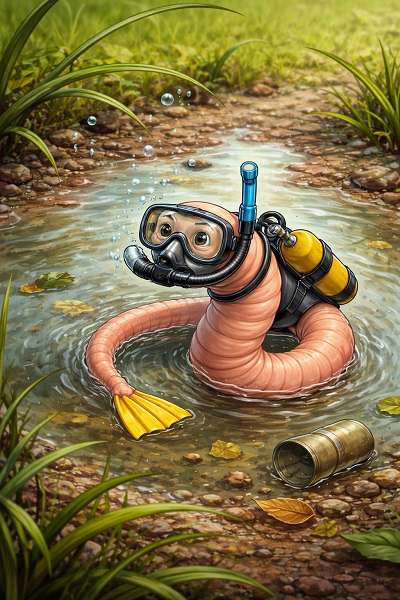















On the other hand, I always enjoyed taking an earthworm and skewering it on a hook. Then throwing it violently out into the water so that a hungry bass would get hooked and die by thinking another traveling earthworm was going to be a meal.
But I do hate it when people get trained work animals that they can't really take care of, simply for the emotional unconditional love that animals seem to have for humans.
Ron