The music of Sting's new broadway play was previewed this past weekend on PBS's Great Performances showcase. The work is called The Last Ship (not to be confused with a cable TV series of the same name) and deals with his childhood in a northern England shipbuilding town.
The music appeals to me as many of his seasongs have, notably Valpariso, and Desert Rose, too, admittedly about a sea of sand. These remind me of my own youth around shipyards. I have a toddler's memory of liberty ships being launched from a Tampa slip and I recall sitting atop my father's shoulders while the workmen around us cheered and congratulated each other.
Sting's main theme echoes them. " ... Oh, the roar of the chains/ and the cracklin' of timbers/ the noise at the end of the world in your ears/ as a mountain of steel makes it way to the sea/ and the last ship sails." The words are stirring enough and mated to a rather somber tune, a blend of chanty and durge, it has the weight of an anthem which can make any adventurer's skin prickle and heart stoke its fire.
To a child of three or four it was Christmas and New Year combined.
Conversely, when my mother and I gathered with other anxious mothers and crying children in front of the merchant mariners union hall it was a grim observation, waiting word of this or that ship and crew's fate. (The first American ship to be lost in WWII called Tampa homeport. It was sunk off the coast of Australia the day after Germany invaded Poland, lost to a mine laid by a Nazi U-boat squadron as they made their way to become part of Hitler's Indian Ocean fleet.)
But my family was linked to the sea before that.
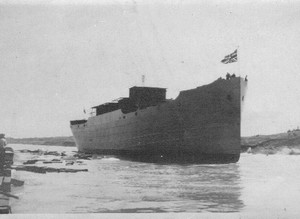
My father built freighters on the Welland Canal long before I was born. He was still into his first family then, only 28, very young to be president of a shipbuilding company.
War broke out almost immediately and like a good subject of the British king, he took a contract to build warships for the Royal Navy. Hardly sleek like battlecruisers or invisible like the new submarine menace, they were stealthy in their way. Called Q-ships, they were decidedly normal looking steamers in appearance. But in their voids and holds they carried cargo like kapok, cotton, timber and other boyant materials which would keep them afloat when torpedoed just long enough so they could lure the Kaiser's U-boats into range of their concealed 4 and 6 inch naval rifles. Since U-boats tried to preserve their store of torpedoes they most often attacked on the surface with their own deck guns and Q-ship skippers were happy to oblige them by lagging behind convoys, pretending to have engine trouble, or other ruse. Welland built eight of these ships and all of them were sunk, exactly as planned. Most of the crews were rescued and six Underseaboats were destroyed along with all of the German crewmen. That was a hundred years ago, or so.
Two families and a Great Depression later my father was thrilled to stamp steel plates in an American yard and my mother, whose predecessors had traded in China tea by clipper ship, happily welded those plates together behind her black-lensed mask. The ships were standard merchant craft called Liberty and Victory were constructed by the hundreds in a dozen ports around the country. Thousands of men and women built them, sailed them into danger, waged war and peace in their shadow.
Nearly 20 years later I was there seeking work as a mariner but the union hall was full of idle men and the floor to ceiling black boards listed row upon row of names, all lined up by seniority for exactly no berths. "Twenty thousand seamen out of work," one of them scoffed, "and you want a union card! Get out of here."
So I signed on with my brother's shrimp trawler for a dollar a day, food, cigarettes and all the back-breaking work I could hope to handle. His boat was being refitted just down the wharf. A few days later she sank in a storm.
Over the next couple of years I spent a time in nests of U. S. Navy destroyers, at Mayport and Norfolk and San Diego, all of them near shipyards and repair facilities.
I endured some weeks in a Sasebo drydock while the Pueblo crisis was going on in the Winter of '68. We'd been tasked with patroling Wonson harbor's sealanes but the Siberian winds were so cold and strong and the seas so violent for so long that the keel of John R. Craig's old hull developed a series of cracks along it and they grew more serious each day. Finally our skipper threw in the towel and we were ordered into port. There we had our wounds welded up and before we were seaworthy again the whole international incident became a diplomatic rather than military matter. We sailed south to finish mopping up the Tet Offensive.
The next year, near us in the South China Sea, a SEATO war game was going on. The Australian carrier HMAS Melbourne, on a moonlit night in a glassy sea, rammed USS Frank E. Evans DD748 cutting her in half, killing 74 sleeping sailors. They were not sleeping, of course. The sea is indifferent. There is a certain generosity in that. The stricken ship's sailors must have been wakened violently by the rending of steel and icy water which gave them a last desperate chance of survival. It also gave them a hellish awareness, acute and final.
The hull half which did not sink was towed into Subic Bay for salvage.
John R. Craig found itself there a short time later, in a drydock again, across the channel from the wreck. Every morning at quarters we could see Evans' battered shape as it was slowly stripped of armament, electronics, boilers and other useful materials. We were depressed, of course, seeing so sad an evolution. How had it happened on so clear a night in so calm a sea state? How could we keep it from happening to us?
Melbourne had already had a previous accident, under much different circumstances. Was she a cursed ship? But no, rumor persisted. The Aussie crew had warned the American several times that she was on a collision course and had even turned away to avoid the smaller ship. Inexplicably, the U.S. ship had turned into her again, as if magnetized. Radar equipment of both ships was operable and even without running lights each ship should have been clearly visible to lookouts, so bright was the moon. (A couple of years later investigations would reach conclusions and result in the courts-martial conviction of Evans' Officer-of-the-Deck, but that would be little comfort to the families and survivors).
For us, for me, it was a daily serving of too-much-imagination. Even in drydock I found myself resisting sleep. Nights drinking too many San Miguel beers in Olongapo did not make me drunk enough to really sleep. What if. Always, what if.
I could not forget the wild seas and pitch black nights off North Korea or a different winter's waters of the Mexican Gulf, or an utterly benign mishap like a night in Da Nang harbor when an air-conditioner hose blew loose and sea water began spraying in over our bunks. Nor other nights on watch when we wedged ourselves into corners so that bulkheads and decks could be interchangeable while the ship pitched and rolled in stormy seas. Sleep was not advisable then, hardly even possible.
And so we mustered every day and did not think of the ghosted crew because it could happen to us and we would have just as little chance of survival as had they.
Our repair and Evan's salvage finished about the same time. Authorities decided to get her out of sight as soon as possible. She was, after all, a drain on morale, a reminder of another U.S. Navy mishap. A training exercise was planned, perhaps a continuation of the interrupted original. Involving several 7th Fleet warships, a gunnery exercise would sink her and two needs would be satisfied at once.
A fleet tug towed the hulk to the gunnery range at dawn. We made several passes, breaking in our new gun barrels and scoring many hits on the strange craft. No mast, one funnel, almost invisible in the morning fog and gunsmoke. Newer ships followed, those with radar controlled guns, but they could not seem to score enough hits to sink the derilict. All morning and then into the afternoon the destroyers steamed back and forth firing until their magazines were empty. Still, the former Evans was afloat.
We came close alongside, counting the many holes in her hull and superstructure. Except for a slight port list she showed no sign of sinking. It was getting dark and a hazzard to navigation could not be simply abandoned on the sea. We pulled away and our weapons mates readied a torpedo. Suddenly, without warning, a huge bubble of froth and air belched from her and she vanished.
Craig herself took five hits from 8 inch cave guns a couple of years later on the DMZ, but she survived. She made it into Da Nang harbor for repairs, then back home to Portsmouth. But she did not survive the shipyard, not this time. She caught fire while under repair and in the end herself became a target for ships and fighter bombers. I was gone from her by then, but it has occurred to me that she might have gathered a certain karma in her combat with patrol boats and junks and shore batteries. Even her intention to destroy Pueblo, an 18th Century Barbary pirates plan for sure, must have counted against her. Intentions, sages and philosophers believe, mean everything.
I made it through several months in the yards at Bremerton, and homeports in Long Beach and North Island. But when the Bureau of Naval Personnel asked me where I wanted to serve my last tour, my first Navy stateside shore duty, my 'twilight' tour, I passed on Pearl Harbor and the other waterfront towns, no matter how safe they might have seemed. I chose a desert place far from port cities or big bodies of water.
It is nestled in a valley even native Americans found challenging to cross, a place of secret waterholes and delirium familiars. The ground moves occasionally, but there is no danger of drowning at sea. Nowadays I can watch a film like All is Lost, The Life of Pi, even Abyss and Titanic. But except on film or television, I have not seen a ship or smelled the ocean in more than 35 years.
Sting's musical laments the loss of his boyhood shipyard and all its fabled history. Many nations still build great ships, but they are not part of my life anymore, at least until I hear Southern Cross or Sinbad's Ship from Scheherazade ... or my wife asks, "Do you still think of yourself as a sailor?"