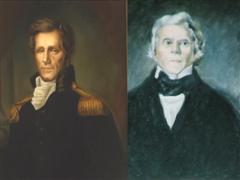
Around 1787, a young Andrew Jackson traveled from Carolina to practice frontier law in what would become Tennessee. He stayed with the Christopher Taylor family in Jonesborough while getting his feet wet in his new profession. From his home across the mountains, he’d brought with him several hunting dogs, a brace of fine dueling pistols and a superior racing steed. Jackson was a sporting and gaming man from head to toe, and had an obsession for the rich man’s sport of horse racing. He hadn’t been in the area long before he heard about Victor of All, a horse purported to be the fastest in the area. The owner, Colonel Robert Love, was a large landowner over in Greasy Cove, and among his properties was a racetrack alongside the NolichuckeyRiver. The inevitable challenge was issued by Jackson to Love, and Love took him up on it.
The date for the race was set, and word spread like wildfire of the upcoming event. While the jockeys readied the horses for the competition, settlers from as far away as Wolf Laurel (Abingdon, VA) traveled to Greasy Cove to witness the race. Over spits of roasting pigs and demijohns of hard liquor, many bets of money, land or a combination of both were placed that late summer or early fall day in 1788.
Jackson’s chosen jockey took ill not long before the event was to commence. Although considered an unfair advantage, Jackson asked for permission from Colonel Love to ride and race his own horse. The young Jackson was probably more surprised than anyone when the colonel granted his request. As the red haired Jackson mounted his steed and took his position at the starting line, Colonel Love calmly observed the spectacle.
Amidst unfathomable tension, the starting shot was finally fired. As the sound echoed off the surrounding hillsides, yelling onlookers watched while the horses vanished into a cloud of dust. As they made the corner turn, the view was clear. The horses were neck and neck. Suddenly, Victor of All sprinted ahead to take the lead, and win the race.
Amid the crowd’s uproar, an angry and defeated Jackson dismounted. The tall, wiry, and fiery tempered Jackson, a Scot-Irish descendent, was shaking with anger as he began spitting out harsh criticisms toward Colonel Love. Although Colonel Love, also of Scot-Irish descent, was also known for a gritty disposition, he listened as Jackson shouted all manner of invectives at him. However, when Jackson denounced the entire Love family as a band of land grabbing pirates, Love stood still no longer, and fierily retorted, “You are nothing but a damned, long, gangling, sorrel-topped soap stick!” Fisticuffs broke out between the two, but before too many blows were landed, friends of both parties interceded, leading both men off the grounds in different directions.
Andrew Jackson eventually left the vicinity, settling in the Nashville area of the state to again practice frontier law. He became the first man elected from Tennessee to the House of Representatives and Senate, fought in the War of 1812 and Second Seminole War, after which he became the first governor of the newly acquired United States Territory of Florida.
As for Colonel Love, he held on to much of the land he owned around Greasy Cove. He served in the North Carolina Legislature while Greasy Cove was still considered part of North Carolina. In 1792, after he had moved his family across the mountains to BuncombeCounty, he was elected to the State Senate of North Carolina. He helped form HaywoodCounty and in 1809 gave the land to build the town of Waynesville, NC. Colonel Love also helped establish the final state boundary line between North Carolina and Tennessee in 1821.
There is no record of when, where or how the two men made amends, but it happened at some point over the years. It is said that Jackson would not have won the presidency without the assistance of his one time arch rival, Colonel Love, whose influence on North Carolina voters made the difference between Jackson’s first (unsuccessful) bid in 1824 and second (successful) bid in 1828 for the presidency.
So it came to be that although defeated by Colonel Love’s Victor of All, Andrew Jackson emerged the victor of all in the most important race of his life, the triumphant pursuit of the office: Seventh President of the United States.
NOTES:
(1) Interestingly, even though both men were strangers before the race challenge, they had many things in common. Both were of Scot-Irish descent. Both were Presbyterians. Both served in the American Revolution. Both were frontiersmen. Both went on to become statesmen.
(2) Another interesting fact about Jackson is that he was the last U.S. President to have been a veteran of the American Revolution and the only President to have been a prisoner of war.
(3) Located near the site of the horse race there is a stretch of highway that runs through what is now Unicoi County, TN. It is named in honor of both men: The Jackson-Love Highway.
This is the story of the author’s great great grandparents, Edward Lewis and Sarah Crosby, who were convicts transported to Van Diemen’s Land in the 1840s. It is told from the perspective of a detective agency searching for what happened to Edward, w
325 letters my father wrote to my mother during his time in World War II.
Woven together in a timeline of events of three of his brothers, 5 brothers-in-law, and one cousin, all 10 of them were in WWII at the same time.