Most Airmen rode on the nation's fleet of rickety old passenger trains when moving from one base to another. The military aircraft alternated between time in the air and time in the maintenance shop. Civilian air travel? No way. The expense of civilian airlines precluded that option. Still, I considered myself lucky. Nobody insisted that I travel by bus. Both Greyhound and Trailways usually rumbled down the highways with quite a few empty seats.
I quickly adapted to the clickity clack of wheels on the old railroad tracks. After a few thousand miles, the noise lulled me to sleep.
The trains I rode weren't state of the art. A few diesel engines provided service for the transcontinental routes, but low ranking airmen like me failed to merit the priorities needed to board them. The Air Force scheduled us to ride on the coal-powered clunkers that dominated our railroads of that time.
Despite the noise of train wheels on the tired old tracks, I never failed to hear the call to dinner. I immediately awoke to the call to chow when it boomed over the train's crackling loud speakers.
The trains that we rode just fought for survival. However, their dining-car chefs ran superior kitchens and served excellent five star meals to our food-loving troops.
When it came to cuisine, my quality ratings might show some bias. I based them on my extensive exposure to military cooking and a minimal knowledge of gourmet cuisine. In other words, my frame of reference depended on extensive exposure to the Air Force's magnificent chow halls. During my time as an enlisted man, I still lacked extensive knowledge of the superb offerings of the world's top chefs.
Most of my time on the trains involved either sleeping or eating. Fortunately, that routine quickly changed whenever a beautiful nurse shared my seat in the coach. Needless to say, I rated all nurses beautiful after spending twenty-four hours per day and at least five days per week in the company of men.
I loved to be surrounded by flyboys and plane jocks. However, I didn't get to ride on a plane until I became a Second Lieutenant. It took me almost four years to work my way that far up the chain of command. Eventually, however, I did earn a commission.
Perhaps I shouldn't complain about my plight in the Air Force. Even as an enlisted man, I did have one advantage over civilians. Whenever I arrived at my new base, I could always call up the Officer of the Day and have him send out a command car to pick me up. During my four and a half years on active duty, I never did get stuck with a taxi.
After fighting the cold of Chanute, I considered my assignment to Dale Mabry Field in Tallahassee to be a touch of Nirvana. I no longer had to worry about blizzards or ice storms, and I now had a base that was completely functional. In addition, I was stationed in a town with over a thousand inhabitants. Being a college town similar to Champaign-Urbana, a majority of the residents were beautiful women.
Young people learn to communicate fast. Within a week or two, I mastered Northern Florida's dialect to the point of almost speaking like a tongue-tied native. I also learned to appreciate grits. However, thanks to the Air Force's diverse menu, I avoided all forms of hog jowls except on special festive occasions. Special occasions refers to those rare times when the cooks had more "cooking wine" than they could drink and they needed to get rid the surplus before their next month-end inspection.
Did I have any minor inconveniences? Yep. As an example, the base designers placed our barracks at the end of a long aircraft runway. To make matters worse, we had to work shifts. That meant tossing and turning and trying to sleep while P-47 air-cooled Thunderbolt fighter planes roared down our runway.
Day shift was a snap. The planes merely gave us a wakeup call. Nor did I mind the graveyard shift. By the time I finished breakfast and a few little errands, most of the planes had taken off and were already flying their missions. Swing shift, however, drove me bananas. It took me a couple of months before I could sleep while a flight of earth-shaking P-47 thunderbolts skimmed over our barracks.
One thing facilitated my ability to sleep through the noise of 2000 horsepower P-47's taking off. I was young. I could cope. Beside, OSHA wasn't there to play watchdog. Therefore, I acted like a good soldier and suffered through it.
Even at Tallahassee, the weather forecasters maintained a high level of independence. Although other organizations were forced to do calisthenics in order to stay fit, we dragged our heels. We based our excuses on having to do shift work. When that didn't work, we compromised by going swimming in the closest lake we could find. We might have been in alligator country but we were young and didn't know any better. Besides, the gators left us alone and we never invaded their space
Swimming had both its good and its bad points. In the first place, we had to hike a couple of miles in order to get to the lake. In the second place, we had to pass a stinky hog farm on the way.
Our response involved walking as far as we could without breathing. Then, we took short sniffs to find out if we had out-walked the smell. At one time, we tried to requisition gas masks but the quartermaster sergeant refused to cooperate. He figured that if he had to do calesthentics, we weathermen should do it too.
Another advantage of our trips to the lake was that a handful of nurses had found the same swimming hole. We were happy to commingle with them as long as we weren't wearing uniforms. Our relationships, however, were doomed from the start. We were all enlisted men. There was no way that we could meet them at the Officer's Club. The only place we could socialize with the nurses was at the old swimming hole.
How did we recover from this social tragedy? We turned to the civilian population for comfort.
Enjoyed reading this one, Henry. At least you didn't have to go by sea: my Daddy was shipped to Japan on a troop ship. In a typhoon. He said the waves were HUGE. The chaplain was heard on board asking, "Oh, Lord, why are these waves so big and we are so small?" They wanted to chuck him overboard. LOL Well done, Sir, and thanks again for your service.
(((HUGS))) and love, Karla. (USAF '83-85)
I would have loved to be stationed in Alaska, never left Texas. LOL
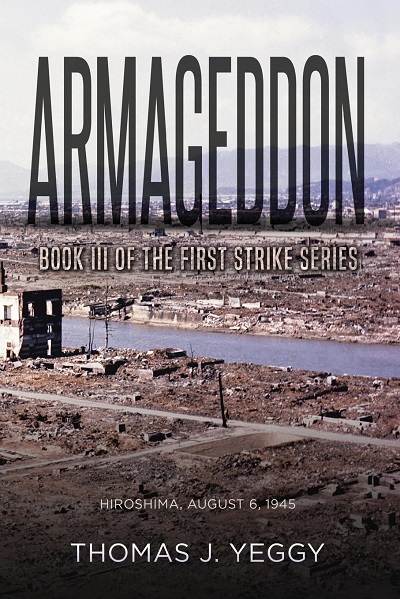
Armageddon, a fact-based historical novel, is the third book of The First Strike Trilogy: A high-stakes race against time and politics unfolds in this gripping historical account of SIOP-62, revisit the tension of a pending nuclear attack, at a time