Pacing Love’s Journey
He does not remember learning love. That is the first truth. Love arrived before memory, like breath before language. As an infant he knew it only as warmth: the dependable gravity of arms, the soft architecture of skin, the milk-sweet hush of being held. Love then was not a word but a climate. Smiles were not signals; they were seasons. Kisses were not promises; they were gravity itself.
Later, love changed its face.
As a child, he began to notice that love could tilt. That it might flicker. It was then that love learned to disguise itself as questions. Am I wanted? Am I kept? He tested affection the way one tests ice with a shoe—carefully, listening for cracks. Praise felt conditional, like sunlight filtered through blinds. Love was no longer air; it was food, rationed and timed.
Adolescence was when love caught fire—and burned.
He remembers mirrors too well. They multiplied him into distorting panels, each reflection bent toward failure. His body became an interrogation room. If he performed correctly—said the right things, stood the right way, hid the trembling—perhaps love would stay. Love felt like a prize dangling from a fraying rope. Desire throbbed like a bruised tooth. He did not know yet that the ache was not desire’s fault, but hunger confused for worth. He searched for IT the way sailors once searched for land—through fog, convinced stories were maps.
Adulthood arrived without rescue.
By then he believed he understood love. He could diagram it, explain its needs, identify its warning signs. He knew what devotion required, where tenderness failed, how attentiveness eroded. What surprised him was not love’s complexity, but its scarcity. It was everywhere in language and nowhere in practice. People promised love as though it were a destination, then complained when the roads were muddy.
Institutions rose around him like marble cliffs. Marriage wore a halo, polished to a mirror-shine that reflected only success stories. Pulpits spoke of permanence while quietly normalizing endurance as virtue. Love was traded like futures on a market floor—speculated, leveraged, insured. Clerks in tailored suits and ceremonial robes sold guarantees against loneliness, their smiles sharpened by certainty.
He watched others enter these sanctuaries with bouquets already wilting in their hands.
Here, love was often mistaken for safety. Commitment was prescribed like medicine that dulled pain but also dulled breath. Some souls were sealed into lifelong vows like birds placed gently—but irrevocably—into glass jars. The jars were blessed. The silence inside them was called faith.
And yet, there were others.
He met them quietly, usually at the margins: people who did not speak of love as possession but as encounter. Who spoke in weather and music. Who treated affection as something that moved, like fog lifting from fields at morning. They loved with the patience of gardeners who understood that flowers did not bloom on command, and that unpollinated blossoms had their own lonely, radiant beauty.
With them, love was less artifact, more atmosphere.
It was somewhere beyond adulthood that he stopped trying to define love and started listening instead. As a being, no longer a role, no longer a project, he noticed subtler things. The sound of petals opening at dawn, a faint click like a thought finally letting go. The way loud noise could soften if observed long enough. The way scent carried memory more faithfully than sight. He touched the infant still curled inside his chest, the small, unhurt place that had never stopped trusting warmth.
What if love was not something to achieve but something to notice?
He considered this while walking alone after storms. The air smelled rinsed, as if the sky had laundered itself. He wondered if romance was not the pursuit of another, but the courage to meet life without armor. Blue calm brushed against red wanting, not colliding, just acknowledging. Memory knocked from behind, but he no longer answered every knock. He began to suspect that many people mistook comfort for love the way one mistakes anesthesia for healing. Infatuation flared and vanished like matches struck in wind, leaving smoke and apologies. Minds overruled bodies, theories outpaced truth, and loneliness begged forgiveness for crimes it didn’t commit.
Still…
Life kept offering instruction.
Romance, he learned, was not scarcity or excess—it was resonance. A way of standing inside existence so that birdsong mattered, so that grief had color, so that joy did not require witnesses to be real. Romance was allowing storms to interrupt complacency. Allowing old emotions to take their proper shelves in memory instead of cluttering the present.
Love, then, was daily work, but not labor. It was tending.
Each day, he gathered what was offered: laughter light as pollen, sadness beaded like dew. Some days love required nothing more than staying. Other days it demanded pruning, cutting back habits that strangled growth, watering choices that would one day grow thorns for protection rather than harm.
He learned not to rush corners. Love was often waiting just beyond, but only for those who looked both ways, with innocence in one eye and caution in the other.
Flowers taught him this. Clouds too. Even thorns had wisdom once you stopped cursing them.
He wanted to be part of the cycle rather than its master. To be rain where needed. To drink light when it arrived. Blooming, he discovered, was not endless. Petals opened until they were heavy with their own beauty. Joy sustained itself only briefly, like a held note that trembles before release. Love did not promise permanence, only return, if respected.
And so he stopped searching for shortcuts. He stopped believing anyone who sold maps that omitted seasons.
Love remained poised, always, at the edge of beginning. Not waiting to be claimed, only waiting to be met.
Each day.


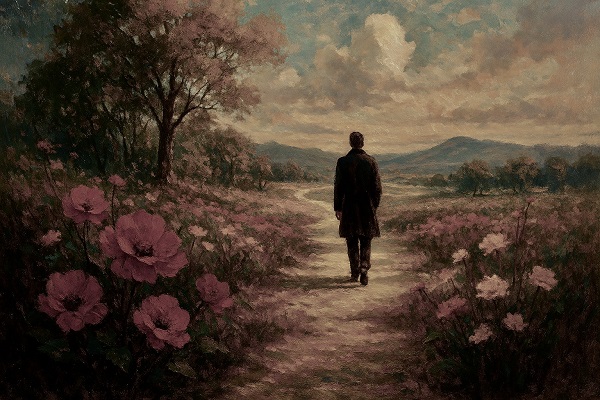 Having started this story years ago, it felt like the right time to give it room to just be. (Image by Odin AI)
Rather than a simple, "What's love got to do with it? "You have provided a richness to love that is rare in the simplistic ways that people feel of love these days.
Kudos for your insight.
Ron