I’ve never lived more than five miles away from the Gulf of Mexico.
It’s always been there; turquoise blue, mostly gentle with lapping waves and a melodic tumbling surf that’s a sharp contrast to the Atlantic, which churns and barrels onto shore like a hyperactive child diving for toys.
Of course when fickle Florida weather turns rough, the Gulf can be as formidable as any body of water on earth, with white caps and enormous swells. Many a fisherman and sailor died because they foolishly underestimated its power.
I didn’t know it at the time but I had it made. My girlfriends and I practically lived at the beach after school; deepening our tans, and parading around in teeny bikinis in an effort to see and be seen.
It was alongside the Gulf that I met my first boyfriend and realized that boys were a lot more fun than I thought.
It was alongside the Gulf that I smoked my first joint, passing it around a circle of geeky middle class kids trying to look cool. That same night I gamely slugged back my first beer - a tepid Old Milwaukee, wishing I could pour it back into the horse it came from.
Alongside the Gulf on Sand Key, my circle of friends regularly got together for parties with bonfires, weenie roasts, s'mores, and a never ending supply of laughter. One afternoon we were realized we were swimming near a pod of dolphins feeding on a school of fish.
I'll never forget the thrill.
So many memories, and so much was taken for granted. We got busy; we started believing that the beach and all its gifts are reserved for tourists.
Which is incredibly stupid.
Each time my husband and I head to the beach, I marvel afresh at the vast beauty of the Gulf of Mexico; how it stretches into the horizon like a bottomless can of spilled aqua blue paint, how the sun sizzles as it sets into an inky darkness broken by the occasional wink of lights from offshore boats. It has a way of calming me like little else can.
It represents home.
One of my favorite places in the world is the Suncoast Seabird Sanctuary, located on IndianShores. It's an avian rescue hospital and rehabilitation center that's been around since 1971. It’s also the largest facility of its kind in the country. The Sanctuary staff admits every sort of wild bird imaginable; little guys like sparrows, sandpipers and mockingbirds as well as larger ones like pelicans, herons, ibises, and egrets. No bird is too big or too small. Each year they admit roughly 8,000 patients.
They do not receive federal funding.
The Sanctuary is like a mini-zoo, where those unable to be released dwell in a habitat similar to that found in the wild; with sand, mangroves, and live oak trees. There are live fish swimming in saltwater pools which allow water birds to hunt for their meals, as they would if they were out on their own.
There's netting across the top of the larger birds' pens, to keep them in as well as keep intruders out.
And sitting on top are what I call bird buddies...those who are free to come and go as they wish but choose to hang out with those in the pens.
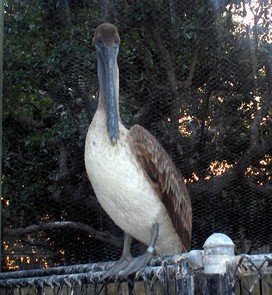
One particular bird buddy is an Eastern Brown pelican that I've nicknamed Wally. (Don't ask me why I chose the name. It just suits him.)
Wally is a juvenile, a junior pelican. Although nearly as large as his adult counterparts, the chocolate brown feathers above his face are still fluffy, and he has innocence in his eyes that the older birds no longer have.
For some reason he knows who I am. We only go out there once every week or so but he's almost always there. I can walk right up to the fence where he perches and talk to him. I’ve never tried to touch him and would presume to do so, but I suspect that if I did he’d be ok with it. There's no fear in his eyes. Once when he saw me coming and he flapped his enormous wings as though he were glad I came to visit.
After the BP oil nightmare began off the coast of Louisiana, we’ve visited our bird friends at the Sanctuary numerous times; savoring the calm before the mess hits our beaches.
As I walk by the penned birds, I assure them that they're the lucky ones. In spite of missing an eye, a leg, or a wing they're in a safe place where they won't have to worry about being poisoned, burned by toxins or drowning because they're sick, feathers coated, and can no longer swim against the muck.
But I wonder what will happen to Wally. I look into his face, so sweet and trusting and I realize that his days may be drawing to a premature close.
Wally’s world is disappearing.
And my heart breaks into a million pieces every time I think about it.
I want to open the net above one of the pens and add him to those already there. I want to protect him from the poison that’s slowly and insidiously creeping in from the central Gulf.
But I can’t.
At least for now he’s free and happy.
My husband and I wander back to the car, hand in hand and before I turn the key in the ignition I cry; for Wally, for the blameless creatures who can’t defend themselves and for those of us who live along the GulfCoast who are losing a way of life.
I grieve for all of us.
As horrifying as it sounds, the innocent lives that can’t be saved, that perish each day as a result of man’s greed may have the better end of the deal.
The start of this wonderful write reminded me of my home in NJ along the shores of the Atlantic & the same times had for the most part and the same feelings felt about "MY" home...
Then I think, what if that sludge comes our way, so not just the Gulf will be inundated by it, but the ocean along the east coast, what will it do for our beautiful beaches...yes the same that it already has done to some of the Gulf & what the hell can anyone do about it, besides complain to, quite frankly WHO!? God will listen, but can't step in where man has already tread and ruined our world, and the government is a joke...so where can we turn, what can we do, but hope and pray a little harder that Nature or maybe God is willing to help...keep finding peace as best you can, Ed
Such a soul-gripping and meaningful write, Michelle. This tragedy in the Gulf is an horrific crime against the Earth and creation. Your article reminds me of something sent to me by a friend a few days ago:
The question:
How does life deal with a part of itself that fails to discover, or subsequently loses, its sense of purpose?
The answer:
It finds some way to remove it from the equation.
The example:
Behold the dinosaurs and the duckbilled platypus.
The conclusion:
Earthians beware: your days, as a species and as individuals, are severely numbered.
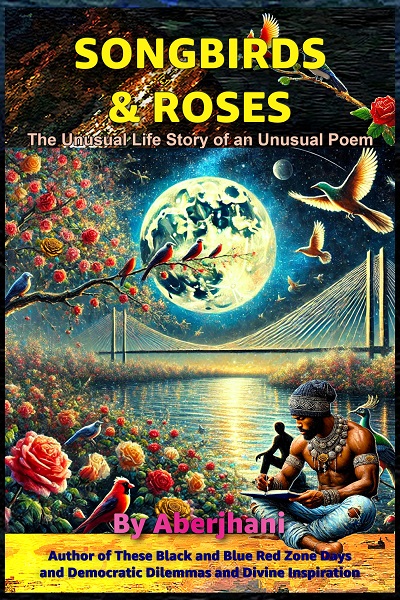
A book of nature inspired poems and essays, written from the heart and soul of a life-long nature, animal, and wilderness lover, and dedicated to today’s children - Earth's only hope for a better tomorrow.
This book won 'The Poetry Category'
Explore the mystery of how nature makes unexpected gifts of creative wonders to an unsuspecting caregiver one late night and early morning in southeastern Georgia, USA.