The title is a paraphrase of a movie from 1966 ... "Daddy What Did You Do In The War?" It was a comedy directed by Blake Edwards, the famous director of all "The Pink Panther" films.
“DADDY, WHAT DID YOU DO
IN THE MILITARY?”
Tom Hyland - 9/22/14
My "naval" experiences were quite different, and quite tamer than Jansen Estrup’s Story.
Although a member of the U.S. Army Reserves from 1960-1966, I went to Seaman's School during Advanced Training at Ft. Eustis, Va and had an MOS of 560 - Seaman. Only "action" seen was in the James River.
Stationed aboard a 176 ft Freighter, we went out and anchored while a Diver went down to take his Test. As a scrappy chap of 140 pounds then, I was sent up the mast to the Crow's Nest to keep Watch. T'was my first bout of "seasickness" as the damned ship bobbed up and down like a cork. After climbing down to the deck, I reached the Galley, where the ship’s Cook fed me some dry crackers, and told me to go hit my bunk. A couple of hours later, I was “Good to go.”
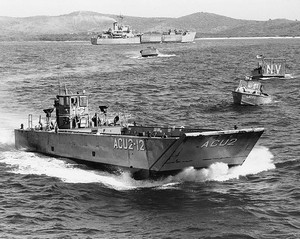
Months later, back at our Home Base, Ordnance Depot, in Curtis Bay, I learned to pilot an LCM - Landing Craft Mechanized - “Hit the Beach!” I was a Coxswain. It was a twin-prop vessel with dual Grey Marine diesel engines, a deep well-deck, and a forward ramp for loading and unloading. You could throw one throttle forward, the other aft, spin the wheel completely, and literally “walk” that sucker sideways, right up to the pier, easier than parallel parking a car!
We were in Company 1073 of the 23rd Transportation Corps. We also had a LSU - Landing Ship Utility, that had a complete machine shop aboard, and with its larger size and ramp, could load jeeps, trucks, tanks, or Troops.
We attended the base for 8 hours on Saturdays and Sundays, once a month, for 5.5 years, and with a 2-week Summer Camp every year. Because of the treaded steel-plate decks, we were allowed to wear sneakers, or ‘tennis shoes.’
Whenever the craft needed maintenance, we would cruise up the Curtis Creek a bit, beach the boat, break out the paint and brushes, crack open a few beers, and paint, while getting a nice suntan. Tough Duty? You Betcha!
When I was in Seaman’s School, I wound up helping the instructor, as I knew how to tie knots. I learned as a kid of 14, as an Explorer Scout. Also, because my Dad was a First-Class Rigger at Maryland Shipbuilding & Drydock Company in Fairfield, Maryland for several decades, he taught me how to splice both lines and wire.
Anyway, after a couple of years in the Reserves, the Big Brass up top decided to get rid of our LCM’s and LCU and swap them out for a Freight Ship. Duh?
So then, instead of remaining a Seaman 1st Class, I got more training and became a Documentation Clerk. What a Bummer! Doing ship’s inventory and filling out forms, like Bills of Lading.
The ‘upside’ of this change was that I didn’t have to do any physical labor whenever we did maneuvers of loading and unloading ‘dummy’ cargoes on the freighter. It was also much safer.
In closing this little”War Story” I just remembered what happened to me on my very last Summer Camp. Good Old Sgt. Sullivan ‘volunteered’ me to attend a week-long class on CBR - Chemical Biological Radiological Warfare.
On the very last day of class, the instructor was seated on top of a table facing us. He explained that in real combat, when someone screams out “GAS” ... two immediate steps were necessary - First, Stop Breathing and put on Gas Mask! Second, administer Atropine Injection!
After an assistant distributed a large tube to each of us students, the instructor demonstrated how to self-inject the solution. When the cap was removed from the tube, it exposed a long hollow needle, about 2 inches long. Then he commenced to explain that you had to Pound the top of you thigh muscle 3 times hard, Jab the needle in all the way, right through your fatigue pants, and use both hands to Squeeze the solution from the tube! QUICKLY!
Then, he DID IT ! Then, hollered GAS! It was scary as Hell, but I did it! When I looked around the room, about 3 guys out of 20 or so had PASSED OUT! Needless to say, they Failed the course!
Oh ... yeah, the tubes were actually filled with Glycerin, not real Atropine, the antidote for Nerve Gas!
On May 1st of 1966, my 6 years were up, and I received my Honorable Discharge at the rank of a Spec-4 - Specialist 4th Class. On the 7th of that same month, I was Married! On the 8th, we were on our Honeymoon at Penn Hills Estates in the Pocono Mountains ... a far cry from any Army Summer Camp! Hallelujah!
THAT’S WHAT DADDY DID IN THE MILITARY !
I HATED ALMOST EVERY MINUTE OF THOSE SIX YEARS!
P.S. Oh - Basic Training for the first 6 months of Active Duty was at Fort Knox, Kentucky, the Transportation Headquarters of the Army at that time.
Many more details were provided in my First & Only Book ever published ...
The last Saturday in June 1960, we drove our LCM's out Curtis Creek, to the mouth of the Patapsco River, copped a Left (portside) at the Chesapeake Bay, followed it North, through the C&D Canal to the Delaware Bay, veered right (starboard) and docked at an abandoned Air Force Base at Cape Henlopen, Delaware.
It was a 22 hour non-stop trip with 2 Grey Marine deisel engines droning
24-7. The next morning after chow, we were marched up to a theater, where the Brass addressed the troops. We were told what a terrific job we had done ...
Our voyage was equated to making the 90 mile trip from Florida to Cuba !!!
This announcement was made 9.5 months BEFORE the April 17th 1961 Fiasco ... The Bay of Pigs Invasion !!!
Glad you hated 'almost every minute of it' ... nobody should come to love the kind of work we do. Hope you were able to translate the experience into something creative and useful, surely not having to use your CBR training.
Tom.....Enjoyed very much your retelling of your adventures. I was 4F in 1966 or so. Back then I was happy. I wouldn't be attending good ol. Saigon U., and pledging Mekong Delta fraternity. In retrospct I wish things had gone differently. I was 18 going on 12 and a little military service would have grown me up some.
An illustrated developmental history of the American military chemical and biological protective respirator for use against war agents, this work provides photographs of actual respirator specimens and several useful appendices, in addition to its en


 “DADDY, WHAT DID YOU DO


