This was a book, once, and perhaps it will be again. But it is primarily a story, a story about stories, and about those who become storytellers. I recommend you save this tale to your Author's Den library, at least temporarily, not for its wisdom or insights, or clever turn of phrase. Save it because it is not a short story and even if you start and become uncomfortable or bored, you will want to revisit it. It may not haunt you, as it has me for the past 60 years, but it will tug at you, cling a little, then a lot. It already does, you know. You already know the characters and the plot. If you are a writer, you are already growing weary with the struggle because it is about you, too, and soon you will be dragged into the depths. Don't panic. You will survive, at least for a while.
I had to write it down. There was no avoiding that, so persistent and persuasive had that need become. Yet, as it carressed me this idea became uncomfortable, vaguely threatening. Then, as I began to resist, it sank its teeth in and dragged me back, way back, down the abyss of history.
For many years the whole matter was a source of embarrassment, even shame for me. The physical pain, the scars or my own doctrinaire humiliation had not been worse than that knowledge. I had been forced to prolong something barbaric, a thing odious and cruel. At least I told myself that before I mythologized and repressed the matter.
Once again I'd done something I detested. It was expected of me. It was my job. I excused myself by pointing at cruelty and bureaucracy but the fingers pointing back at me shouted ‘leadership' and continuity. I have lived with that dialogue for all of these years. They needed to earn their scars, their stripes the way I had. It was part of our heritage. Only recently had it occured to me that the key word in that narrative might be forced.
And those I'd helped victimize, for their part, had gone along because they trusted me, wished to honor me, to give me pleasure. Perhaps they loved me. No, that can't be true , can it? If not, they surely hated me. Their's was an act of hatred, wasn't it?
I have no way of knowing, really. Their actions are all I have, and only the memory of them. Perhaps my memory is faulty, or, like so many traumas, wrapped in symbols and denial.
Probably they were only bored, looking for some excitement, some symbolic retribution. Maybe it had nothing to do with me at all.
In truth, my actions had not been for them, either. And now, after so many decades, Albert Camus' warning sounds an alarm so penetrating that these secrets, like my gasping awakening dreams of drowning, dominate my sleeping, sleepless hours. "It is immoral not to tell."
I'd done it because it was ‘traditional' and besides, in addition to escorting the uninitiated into a privileged fraternity, I was educating and ennobling my peers. I helped elevate my shipmates in some way, didn't I?
It was all mythic bullshit, of course. Grandiose, arrogant, but also self-serving, and, as bullies down the centuries have pleaded, just fun - entertainment.
European Christians, very late to the ocean-seas game (feared monsters in the daytime and disease bearing mists in the night, so they knew little of cosmic chasms, either) cobbled together some pagan tales and threw in a few symbols (also pagan) like the fish and anchor. They added a drowned Englishman named Davy Jones and a series of challenges which must be endured, overcome or prayed around. Historically, Europeans (omitting the Norse and earlier, shadowy sailors) have been seafarers for something nearing five hundred years so their historians called everything before that ancient, shrouded in the mists of Avalon. But not the Avalon of Arthurian legends. Having little actual experience on the bounding seas minstrels sang nonsense of a mist shrouded lake and thought of it as something Biblical and grand, like Galilee or the Dry Bitumen (Dead) Sea. Such yarns were too well known, despite being uttered in a sing-song, extinct language. They'd become mere church-pap, even to an audience forbidden basic learning skills. The ballads rang trite and had little to do with seafaring.
No, this Avalon is truly ancient and also truly nautical.
Nearby is that place authorities suspect humankind first ventured out of Africa, across a shallow strait which joins the Red Sea and Gulf of Aden. It is dotted with a chain of islands, of stepping stones to the Arabian Peninsula and the world.
Avalon, today, is called Socotra and it is vastly different than five thousand years ago. Located slightly north and east of the Horn of Africa, at the edge of the Avalitic sea, island Avalon was widely known even before the white towers of Ava (Eve) ruled Ethiopic Africa, or Aden (Adam) lay supremely powerful and rich on the southern tip of Sheba, itself a grand land still claiming a vital Arabian river system which flowed north by east, and like the Tigris and Euphrates to empty into the Persian Gulf.
Avalon was acknowledged as a fabled home of the blessed, of gods and singing companions, leisure and pleasure; the prototype of heavenly Paradise.
In that era, those many thousand years ago, Gilgamish had already been transfixed in the night sky, locked eyeball to eyeball with his beastly brother, Enkidu. Atrahasis and Utnapishtim had long since saved the living from a worldwide flood. Egypt's creatrix, the Goddess Nu (aka Mother Night, Ma Nu, Nu'ut, she was the source of the Hebrew translation/transformation from female to male, Nu to Noah) had millenniums before ridden on the void to disgorge all of the gods, goddesses, animals and other folk upon the earth. Anus and Mukarbis had done the same for Greco-Anatolians, Mukarbis devouring his brother's ‘generations', blood and flesh in order to spit them out upon the void where they formed the soil and rivers and oceans and living things of creation. The vast overarching Baobab tree of sub-Saharan African creation still lived and its branches protected much of the equatorial world.
All of these tales were old beyond old, even then. A wondrous endeavor, travel amongst the stars and fishes had always been - seafaring. It had immediately tickled the fancy of storytellers, tugged at mystics' tattered clothing and promised riches to the bedazzled and undaunted.
Egypt's Twelfth Dynasty stalwart, the Shipwrecked Sailor, made his annual journey to ‘Punt' in these up and down waters. He found rivers in the heavens which matched and reflected the sacred Nile. Where Lake Tana collected the monsoon's bounty he rode again and again the rising and falling wonderland of the sun-bellied Cobra King, all incidents which exactly corresponded to the annual inundation and replenishment of great river's soil, soil made rich and productive for all of its people's needs, be they bread and beer, dates and game, transport or fashions or exotic energy.
Historians and archeologists shake their heads and pronounce a mystery. Where is fabled Punt. In what shrouded land flies the elusive benu bird? Where did the Shipwrecked Sailor really find landfall?
Of course, the storyteller knows the truth. He, the stargazer, knows it all and freely shares his wizard skills. One need only look to the glorious night sky.
Every year at the Summer Solstice, a time of equality, democracy and freedom in those distant days, a ‘monarch' sent forth an expedition led by a stalwart emissary, The Sailor. His task was to find and bring home silver, gold and the wondrous feathers of the benu bird. With him the sailor took 300 of Egypt's finest seafarers and a grand ship. But two months out of port the ship sank in a violent storm. All perished except The Sailor.
Suddenly an island rose out of the depths and The Sailor dragged himself ashore. Four months he wandered the island, finding no inhabitants.
Then a great serpent appeared, its length receding into the distance, his chin sporting the beard of wisdom. "I am the King of Punt," the beast announced. "You are welcome in my land."
And The Sailor noticed that many creatures had come upon the land, and growing things.
"You may travel among my people," the king said, "and get to know them. But in four months a ship will arrive to take you home, a journey lasting two months."
Just as the King of Punt promised in four months a ship arrived and The Sailor embarked, promising to tell his monarch of the greatness of Punt, and its wonders. He would return, he said, bearing great gifts.
"No," the wise serpent responded, "that will not be possible, for when you depart this land will sink once more beneath the waves and disappear. But I do send you home with gifts for your sovereign and my good will."
And so The Sailor sailed home with wonderful spices, skins of fabulous beasts, sweet fruits and rare wood.
Upon his arrival, a great celebration was made, beer and meat for everyone, even slaves. There was music and love making and joy in the land. Praises and thanks were sung and made their way to the King of Punt, wherever he resided, for his generosity. Even the heavens joined in with streaks of fire across the sky. Finally, The Sailor himself was honored above all others and took his place among the Peers, for he had indeed returned with twinkling gold stars, shimmering silver bangles and the feathery haze of the Milky Way, itself an assurance that another cycle of the heavens was about to begin. All was well and life would go on.
So the storyteller says.
This is not the version an Akkadian Stargazer would tell. He would agree that the Sun and Moon equally shared the sky and that the year began there and ended thus.
He surely would affirm that the Queen of Heaven, lying upon her frothy bed of stars, might point her finger at brave Bootes, (also known as the Vulture, the Fallen One or Fallen Angel in Hebrew texts, as Horus, the Hawk, Rama, the Archer and others, such as the biblical David) as if to order him (or later, as 'wanton' Aphrodite, beckon to him) on his way. Also, the Akkadian might note as an aside, this star formation is known as Gilgamish and the ‘corona', or crown close by is the prize prop in his quest for immortality. Corona plays the part, The Lotus of Immortality, which is swallowed by Serpens before Gilgamish can grasp it. But that is a different story.
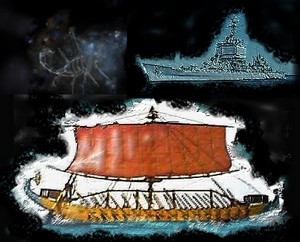
The Akkadian would say that two months later the constellation Scorpio, whose tail resembles that of an ocean going vessel and legs of a foundering ship's oars, stands forth upon the Zodiac plane. He would a also agree that four months after that the serpentine star void called Hydra appears on the horizon, and he completes the circle by joining with the monarch on her bed of stars.
Some two thousand years later, the same story elements are found in the adventures of Sinbad, except that now our sailor embarked out of Baghdad instead of On. And something else changed over those generations. Something ominous and ugly had been interjected and it gorged the muscles of seafarers with blood stolen from their reasoning faculties, a rapine drug like modern steroids. In that vacuum flourished an oxygen starved adrenal rage, the warrior's muse.
During that time between Amenemhat's troubled 12th Dynasty and the rise of Islam the world had learned war. Not simple defense of the home and granary from roving gangs of predatory, unattached men, but organized and standing armies paid by pillage, rape, enslavement and honors. Heroism had been created.
Recall how the Shipwrecked Sailor lost his ship and all 300 members of his crew, but was ‘miraculously' saved by a mysterious land which suddenly appeared (ancient Egypt had a calendar year of 12 months but only 3 seasons - Planting (4 mos.), Harvest (4 mos.) and Inundation (2 mos. rising waters, 2 mos. receeding waters - the year began at the Autumnal Equinox following peak rise of the Nile). At first he'd found no one but after meeting the King of Punt was royally welcomed and invited to ‘get to know' the inhabitants and the saved seafarer called them ‘good and fruitful'. The Sailor was filled with profound respect, even reverence. He promised the King honors and gifts and his Pharaoh's embassy of friendship. Furthermore, when the King declined, no one was offended and he suffered no loss of esteem at Egypt's court. After all, the serpentine river's rising and flooding, falling and receding left the blood red nutrients which made agriculture possible, and the great civilization which grew up there. It was the very source of everything.
Since then, a not-so-subtle difference had been introduced. Sinbad still always lost his ship and crew. But rescued many centuries later, and by 'nobles', Sinbad battled strange beasts, saved his host kingdom and returned to his homeland ever richer and more esteemed. Unlike the Shipwrecked Sailor, who pleased and brought honor to the various kings and queens of Egypt, but especially to their peoples, Sinbad sought wealth and privilege only for himself. He had become a mercenary enlisting his crews with promises of wealth and glory much like privateers and pirates of more modern times. And he does not find the inhabitants of the mystery land good and fruitful. Now, in Seventh Century telling, only those with royal blood gain his favor. The rest are hardly mentioned and the worst (these worst, conveniently, have created or possess valuables) have been demonized and fingered for execution by the roving knight. The violent hero has supplanted the generous, adoring emissary.
Has anyone ever wondered at the morality of such stories? We spend a good deal of time attempting to prove the truth, the fact, the validity, dignity and rightness of that which followed. But truth and fact have always been subject to manipulation, made plot lines of ever more complex and unfathomable stories. Contradictions and lies are conveniently pigeonholed as divine mysteries.
Year after year 300 of Egypt's finest sailors were lost (sacrificed) in a November storm. So was their ship given up to the tempest. Before that disaster, as the original telling goes, the Sailor had been commanded to bring home gold, silver, healing balms and feathers of the benu bird (original aspect of the Phoenix, thought immortal through ‘rebirth' even then). But seemingly, he brought back none of that. In fact, on the face of it, the Sailor and his quest were a disastrous failure.
Scheherazade doesn't tell us exactly what constituted Sinbad's increased wealth and notoriety, either. Presumably, it was not necessary to describe such things to a fabulous king. But we should also not forget that she was telling these (and other) stories in order to prolong her life. Failing to 'entertain' her master meant that she, like Sinbad's crew, would be doomed to Davy Jones' fate, indifference and death. And so night after night she flattered and reassured the person who, with a wave of his hand, could exterminate her.
Christian texts tell of a ‘lost' and wayward son who abandons his duties, ignores his father's holdings, wanders the world squandering his inheritance in self-indulgence. Then, weary and destitute, he is welcomed home with open arms. His brother, a loyal, industrious and devoted son, conversely, is taken for granted, given no acknowledgment or honor or birthright (even though it was he who worked to maintain, even increase the family holdings). Instead, like the 300 sailors, he might as well be dead.
Sinbad 'earned his keep' by ridding host kingdoms of those doomed to create golden eggs but not own them. Christopher Columbus sailed out for the wealth and glory, but found none. Stripped of rank and honors by his masters, he was disgraced in his time. But today we honor him with his own holy-day, even after we've been shown how brutal and ruthlessly he treated those whose land and inhabitants ‘came forth' to welcome him.
What in us that makes us believe such men worthy of acclaim and emulation? Of course, like any of us, they might be forgiven such mistakes, but why are they rewarded, made heroic, even deified for gross incompetence, dereliction of duties, abject failure and criminal genocide?
Historians want us to remember ‘explorers' who acted exactly as Columbus did. They want such men remembered favorably even though they committed the gravest crime of all - attacked their host in his/her own home.
Uninvited, St. George slew the dragon, a serpent-like "King of Punt." So did Perseus slay Medusa, whose only crime was to immortalize intruders in her own garden of stone. Beowulf invaded the lair of Grendel and killed the beast. Heracles was tasked with stealing, killing and other aggressive acts in order to become immortal. Indra sought out the slumbering sky serpent, Avritra, and decapitated her, even though he and his father, Brahma, had given their most solemn word they would not harm her. These are tales of treacherous heroes in fabled lands.
I, a very minor player on this stage, came to the storied region as part of such a campaign, a recreation of ancient mandates. We had other links to the stars as well. We possessed their fuel and fury - nuclear power.
Playing the role of Shipwrecked Sailor was a rear admiral I'll call "H" embarked with his staff in USS Enterprise. The rest of us, the attached air group and ship's company, some 5,000 strong, and the crews of Long Beach, a true cruiser and Truxtun, steamed nearby. Somewhere in the area was a fast attack submarine. She, too, was nuclear powered and equipped with super weapons, but no one was supposed to know about her. Also attached, but not in sight, was Sacramento, a fast ship carrying the stores, spares and weapons a task group might require. Altogether we numbered about seven thousand souls which Neptune would gladly accept in lieu of Egypt's paltry 300.
Under radio and radar silence, navigating strictly by man-made stars so recently placed in the heavens, these ships slipped like thieves onto the Soviet Indian Ocean naval base on the horn of Africa. We surprised them, even though they had been looking frantically for us since we left port out of Singapore a week earlier.
It was not necessary to slay them, not this time. Besting them at cat-and-mouse let them realize yet again who was cat, a cat ever widening the technological gulf between the two ‘super powers'. Humiliation saddled them once more with anguished frustration. One day in the not-too-distant future these failures and so many others over the centuries would congeal and harden as a slow drying concrete depression, a national exhaustion and surrender.
So this time, even though we could have, we did not slay the beast in his lair. We felt magnanimous and wealthy with power.
Instead we made south to celebrate, to cross the Equator and visit exotic people among the Indian Ocean islands and coastal Africa. But first we would initiate our fledglings, those who had never before sailed the Southern Hemisphere. Many were elder, highly educated men, some very senior naval officers. Others were truly young, possibly naive. All, until they achieved mythic stature, were just wiggly little freshwater things among salty, impervious giants. O, certainly we presumed such roles, such grand proportions. We were entitled, we few crusty and impossibly wise ones. We were expected to look down with disdain upon the wiggly and wobbly among us and so we did.
Pollywogs. Wannabe bullfrogs. Somehow we'd all become encrusted sea turtles by the experience.
Blacks in the crews were uneasy. Our ancestors likely felt like something more than a pollywog. Although the derogatory term ‘wog' was common enough in England's wide empire, it had not caught on in America. But the ‘wog-master' had become well known. A black pollywog might aspire to adulthood and to earn the position of foreman, but it was neither likely nor desirable that they become honkers. For all we knew, their forefathers might have sailed these seas for hundreds of thousands of years, for evidence implies that nearly a million years ago, long before our race might be rightly called homo sapiens, upright big brained cousins immigrated across deep water barriers to the islands of Indonesia, and later, to Australia.
Perhaps it is this prejudice about prehistoric beings which fuels the transition. One cannot see a cave man set upon such horizon-less wanderings. In caves there are no stars to inspire and guide such travelers. But, of course, it was mostly European predecessors who lived in ice bound caves, in a damp darkness never illuminated by the heavens.
So how is it, exactly, that clumsy, tender hatchlings so miraculously become crusty, leathery denizens of the sea? They are tested, found worthy and accepted. In ancient stories they were accepted into the dark watery depths as dead men. Nowadays, such testing invites recruits to live in sunshine and honor and privilege. That is what the official, modern story claims.
That is not the purpose of a "crossing the line" ceremony, at least not in the year the United States of America celebrated its two-hundredth birthday. In that enlightened time the rite was largely tongue-in-cheek. It was intended to advance the poor creatures from no status at all to quasi-royalty (a kind of masculine Cinderella transformation, a rebirth) if not to actual peerage then to that of one who had a cousin who knew the chauffeur of someone who once broke bread at the draw-bridge of suspected castle ruins. Naturally anyone with such exalted credentials had a perfect right to demand obedience and exact pleasures from lowly ‘'wogs'.
But, as with any lasting culture, provision must be made for the young, ambitious, the adventurous, even rebellious. In every way possible youth must challenge its leadership, its elders. And so the day before Neptune's grand appearance is always Pollywog Day. Like Halloween and April Fool's Day, Labor Day and even Independence Day, (religious folk might add the ‘New Year' and ‘Easter' breaks as well) it is a time for the commoner, the downtrodden, the underprivileged and untouchable. Hopefully, they have not stored up volatile, explosive resentments. A good skipper and his chiefs do not permit such abuses. So, in the event, they also welcome a chance for harmless fun, for blowing off of ‘steam'.
Today, if they could, they would have their way with shellbacks like me.
On the morrow we would subject them to awful humiliations. It was hot, of course, on the flat sea. Many a mariner, whether his sailing vessel was called clipper or dhow, had been becalmed in these waters. That would never happen to the modern ships, but their dark steel decks were much hotter than any wooden predecessor had been.
At high noon in the hottest place on Earth, we few would herd those many in forced homage, on their hands and knees, from bows to stern, some seven hundred feet (two hundred of it holly-stoned teak) into the awesome presence of the God of Waters. Also named Poseidon, he was greedy for land owned by Gaia, the Earth and sent floods and tsunamis to conquer it. But Gaia's women raised up their skirts and the god retreated back to the ocean depths at the sight of their genitals, or was it that they lacked the little god. So great a mystery. Was that the secret of their power? Had they mutilated themselves? Fierce and indepenedent, Gaia's women terrified the sea god. So the Greco-Roman myth tells.
Possibly such a telling is less costly in lives than the Egyptian version, which, as we have seen, appears to sacrifice 300 sailors each year to appease the heavenly/oceanic depths.
As with any passion play, surrogates take up the roles. King Neptune is always played by the shipmate who first crossed over the imaginary line we call Equator. Appropriately, in this case, it was our skipper, a rear-admiral selectee named "S", a legendary growling cigar chomper who, as a freshly graduated ensign, had crossed in an S-class submarine back in ‘39. Eventually he would raise a three-star flag over boomers and fast attacks and send them to lord over the briny depths, but not yet. Nowadays he was a stocky man, trim but not so trim that he could not make a ‘great hairy belly' smeared with number 2 bearing grease. It was this slippery hole which King Neptune was obliged to offer up as a shameful reminder of his defeat at the ‘sight' of women. And it was this greasy mess that we Golden Shellbacks would force every polliwog to kiss (and see his face rubbed in it) after crawling the length of that cruiser's blistering deck. In a few months Captain "S" would be done with sea duty, forced to break his two-star flag at some submarine base. Beyond that, who knew? But on this day he symbolized more than the power of life and death, the ancient and unquestioned law of the sea. This day he was carnival!
On the other side was a pollywog, Commander A, the Executive Officer. He was much younger, brilliant and already deeply selected for promotion. He was marked for great things in the Naval Service. Waiting in his stateroom hung a uniform newly embroidered with his fourth gold stripe and the frocking would take place whence these more important ceremonies had been concluded. "A", within only six years, would be promoted through Rear Admiral (Lower and Upper Halves), to Vice Admiral and would take over the U. S. Space Command, that other greater, more immense and fathomless sea. I would be first to congratulate him as he emerged from the slimmy depths of nautical polywogism into encrusted sunlight.
So there they were, an old salt risen up from the ocean deep and his adversarial companion representing the far reaches of the solar system. Call them Enkidu and Gilgamesh, The Twins, Zeus and Poseidon. Call them Ageless. Tradition.
The youngest, prettiest polliwogs would be dressed up as innocent, virginal girls and made to attend the defeated sea god, to salve his ego and improve his volatile temper. Others had the dubious distinction to wear heavy makeup and bright red lip paint, plus attire more suited to harlots and streetwalkers. One, a young officer in one high-heeled shoe, a bulging brazier and flaming red hair stood precariously on the Talos missile launcher. Binoculars ready, he searched the horizon for the great and awesome sea god. Around his neck he wore a conch shell trumpet with which to alert all hands. All wondered, I suppose, where so much female attire came from. Perhaps it was always there, secretly stowed in the lockers of the ship's morale officer. Miraculously, it seemed then, bras, wigs and panties, mini-skirts, corsets, garters and fishnet stockings appeared on deck and for some they constituted the uniform of the day. Nowadays it seems probable that real women, wearing their own under things, play the parts of the hapless houri. Possibly, because of the women now permitted aboard naval vessels, the rite is no longer recognizable.
Even Shellbacks were in odd, relaxed garb. Many were painted up like demons. Others wrapped phoney ‘seaweed' around themselves, blackened their teeth and assumed some aspect of piracy. The King wore a short kilt, flip-flops and, naturally, a crown. Of course he wielded his trident and sat upon a throne under a canvas canopy attended by the Master-at-Arms and other servants. The ‘pretty' ones also gathered there, singing and providing other entertainment. Those who did not please the monarch were placed in stocks. The many who did please his majesty were encouraged to throw slop and sludge and insults on these miscreants. The whole wide fantail of the cruiser was a mess, more garbage scow than warship.
My assignment was to see that none of the lowly wrigglies were mistreated or required medical assistence. I patrolled the port side, forward, in my tropical khakis, which consisted of a dun colored pith-helmet, baggy shorts and Tee-shirt.
But all that would happen the next day. They'd all crawl aft down the gentle slope of deck, swear fealty to the Realm of the Deep and its divinity. Then they would ‘kiss' the god's glistening belly button and slither through a long, narrow chute filled with several days' collection of garbage and other slime from the ship's galley - the birth canal. Reborn, at last, they'd be free to drag themselves into a makeshift canvas pool filled with seawater and the leavings of those ahead of them. A shower might remove most of the garbage, but the smell and residue of the grease would stay in their beards and hair and nostrils for days. The contempt for women in these ritual acts no doubt reflected those an actual god might have toward those female rulers of the high dry ground of myth and storyland.
You, reader who observes and thinks, will already have noted a significant difference between that oldest tale of the Shipwrecked Sailor and those which follow. The Shipwrecked Sailor killed no one. In fact, he survived the gravest elemental calamity and had the wit to see life itself as good fortune. He admired that which he saw without coveting it, pledged eternal gratitude and promised to honor the sun bellied Cobra King of Punt in his own king's realm. He offered friendship, embassy and rare gifts, all of which were declined by the Great Serpent in favor of seclusion and privacy, in favor of Punt's own independent, mythical dominion. Instead, without favors in return, the Great Serpent lavished wealth upon ancient Kmpt, as Egypt was called before the Greeks, and was the kingdom's eternal benefactor. One of the gifts he gave was, at least symbolically, the rebirth of the 300 drowned sailors (taken as a calendar, the 300 sailors might represent the approximate 300 days which remained in the year).
Call it cruel, if you wish. He would let them die over and over again, year after year, millennium after millennium, but each time they would be resurrected in the glorious night sky to attend the other Eternals.
Neptune's depths, in half a turn of the cosmos, could only do the same.
In Sinbad's version he went seeking fortune, slew monsters, stole golden eggs, etc., and seems to have been personally rewarded with earthly treasure. Most subsequent variations follow this trend and become more gory, therefore ‘heroic' with each telling. Before long, epic tales justified the pillage, rape and burning of ‘human monsters', in fact entire tribes and nations. That has been the main purpose of seafaring since the Tenth Century Before the Common Era, when Greek navies broke the Trojan stranglehold on Black Sea/Mediterranean trade and forced common merchantmen to evolve into pirates and brigands. The same thing had happened in the Persian Gulf region, and a few centuries earlier, at Avaris, which controlled the Nile/Red Sea lanes. Every seaman, thereafter, preyed upon the weaker, seeking gold and gemstones, human cargo and glory.
I apologize for the digression, yet find it useful, even necessary to explain my place in the long ‘tradition' of men gone down to the sea.
A ‘crossing the line' ceremony radically changed that. It equalized things. Suddenly, in many cases, tables were turned. We shellbacks, regardless of rank, time at sea or length of service, were separate and elevated to an arbitrary peerage, a privileged minority. They, the soft skinned majority, fell in standing like an rattling anchor. No one expected such men to accept so great an insult, even a friendly one, without a fight.
There was plotting afoot.
Mischief.
We weren't hiding, exactly. We chiefs usually stayed in our quarters, called the Goat Locker, when we weren't on duty. And no one, officer or enlisted, dared enter the CPO Mess without a formal invitation. Of course not every CPO was a shellback. But although some had not been accepted into Neptune's Realm, all had been embraced as Chief Petty Officers, so they were safe. We were all safe. We played cards and backgammon and dominoes, smoked and read books, drank gallons of coffee and told sea stories as if nothing special existed outside our little world. A chief couldn't be hiding. He belonged there ... unless he was called out for some urgent matter.
And so, about ten hundred hours, when my name was announced by the bridge and I was ordered to report to Radio Central, more than a few old salts cast an amused eye in my direction.
It was beginning.
Yet there were also the obligatory attempts to keep it under control. By the time I started climbing the six levels to the main communications department spaces, I heard the ‘attention' whistle and the Exec came on the ship's speaker system. "This is the Executive Officer. There will be no unauthorized activities aboard this ship!" he announced seriously. "That is all."
I climbed, as I had hundreds of times before.
I climbed, wondering what my men had in store for me.
I'd been razzed, hazed and initiated before. It had not been that many months since I'd undergone the Chief Petty Officer's special welcome, one which had proved embarrassingly dangerous. My sponsor had arranged to have me dressed out as a robot capable of speech only through a switch and red light with which I could flash morse code. The red light was part of an old piece of test equipment which operated on 220 volts. I carried this weight strapped on my chest and it was connected by a long power cable to an outlet in the kitchen of the CPO Club in Bremerton, Washington. The answers I gave to complex questions could not be read by most of my interrogators. One of them, not of our crew, was particularly drunk already and in a foul mood. Before anyone could stop him, he threw a full pitcher of beer on me, drenching me and the high power gear. Somebody yanked the power plug out of its socket before anything shorted, but it might have been a disaster.
There had been Boy Scout rites, and another at a 4H summer camp. And yet another summer camp, when I was sixteen, but I didn't want to think about that one, not for many years. I'd been to basic training in the Air Force and boot camp in the Navy, too.
And, of course, I had been a Pollywog myself just 18 months before. I still carried the scars of that one. It was not life threatening, just a lasting mark on the flesh, blisters I'd gotten on both knees from slowly crawling 500 feet on 200 degree non-skid. The blisters had become infected with dye and fabric of too-new dungarees and would not heal for months. Now they resembled patches of elephant skin and made my knees always look ‘dirty'. I was ‘crusty', branded .. at least my knees were. In exchange, because we had crossed Neptune's Realm at the International Date Line, I would always be entitled to the title, Golden Shellback. That, and a dime (a dollar fifty nowadays), might get me a cup of coffee somewhere.
I climbed the ladders, one after another.
The ‘Beach', as we sometimes called her affectionately (also Long Bitch and Proud Lady with the Big Box), had an elevator. Like elevators in other structures, it could be entered at various levels, but this one was for use by only one man, the ship's captain. Not even the admiral, when he was embarked, was authorized to use it. The reason for this has little to do with protocol or privilege, everything to do with responsibility. For Skippers no longer fought their ships from open, even armored bridges. At a moment, an instant's notice, the Captain more than any other crew member, had to be able to get to his battle station. It was not on the Bridge, whence he normally supervised the ship's movement, or from his stateroom just off the Bridge, where he ate and slept, hosted visiting dignitaries and held Mast, when he meted out justice. No, he fought the ship ten decks straight down, in the spidery web and comparative safety of the Combat Information Center. There he was not confined to what he or his lookouts might see on the horizon. He had sonar and radar, both active and passive, the input of other ‘nearby' warships and the great overview of circling patrol planes with sensitive, long range sensors. (This arrangement was primitive compared to the next generation of cruisers, the Aegis, and probably laughable when compared to the next leap - robotic stealth drone ships, completely unmanned, controlled via satellite and a four-striper sitting at his joy-stick, directly from a console at the National Military Command Center).
So I knew the elevator was there but I had never entertained the notion of using it.
I climbed upward and found myself standing between its sliding doors and the secure door to my offices. It was dimly lighted, as usual. I pushed the combination and heard the buzzer, the opening click. I stepped over the combing into the open area where watchstanders mustered and trained. As I'd expected, it wasn't empty.
The five of them, each one a Petty Officer First Class, stood in a rough semi-circle, ready for me. None of the lower ratings was in sight. This was between recent peers. Just months before I'd been one of them. Perhaps that was their beef, their excuse. I'd gone on and left them behind. Like a net they moved toward me and I saw the shaving cream can in Gert's hand. I raised my own open hand in a gesture which meant stop.
They stopped.
"There will be no grab-ass in the Comm spaces!" I ordered.
Without missing a beat, Jimbo, the Leading Petty Officer, replied, "Alright. Will the chief step back into the passageway?"
Both of us smiled. Technically, that was part of our ‘spaces', too, but it was not ‘operational.' This was not an authorized activity, so I could have said 'no' to that, as well.
Or I could authorize it. I could have said ‘no' and made them take it. Part of me wanted to. Part of me remembered a similar incident, long before. But I had not been ‘in charge', then. Just the opposite, in fact. And they, then, had not become men yet and had not the slightest intention of asking my cooperation. I pushed those fragmented memories out of my head.
These were men I'd worked with more than a year. I liked them. I trusted them with their jobs and to act as I would in the Skipper's name, in the Navy's name.
So I said, "Yes, I will." And backed out, pulling the steel door closed behind me. That gave me a couple of instants to select a place to make my stand and found one against a bulkhead fairly clear of obstacles like fire stations, hoses, alarm boxes and such, things like stanchions and cable runs, which tended to gouge and jab even when one was being careful. I put my back to it and faced the door. Just to my left was the elevator and so there was perhaps twenty square feet where we might scuffle without hurting each other accidentally.
The five came tumbling through the door one at a time, once they'd gotten organized enough to get it open. I imagined a Three Stooges routine on the other side and felt an adrenal rush as they advanced in a semi-circle.
I had been too passive those many years before. I'd let myself be maneuvered into a corner. There had been just three of them and I had not perceived their hostile intent, not acted soon enough to escape or attack. This time I made the first move as they crowded close.
Throwing my arms around the necks of the two nearest, Jimbo and Parks, I swung my long frame toward Gert and clamped my legs around his waist. He was surprised. They all were and suddenly we were all locked together, they bearing my weight like a six brained, ten legged creature. Shoulder to shoulder, their arms had limited mobility as well, and mine, though shortened, could move freely. I grabbed for the shaving cream, but Gert tightened his grip and the button depressed shooting white foam out in a thick spurt. Much of it collected in my hands and I smeared it on the faces, the hair of Wilson and Chambers, who were trying to loosen my belt. Except for our grunting and the occasional whispered swearing, a laugh, we struggled in silence.
A loud buzzer sounded and we stopped. At the Message Center window I could see the XO watching us. He said nothing, just watched us, assessed the situation. After a moment, he went back up the starboard ladder.
More soap sprayed out and all of us got our share. Somebody laughed, a short bark. It went on like that for another minute or so before they got my zipper open and filled my shorts up with Gillette's best. Then it was over. A symbolic circle-jerk.
We stood there, looking at each other, smiling at the mess we'd made. But nobody lit a cigarette or said anything endearing. Nobody was hurt or angry, or, I am surprised to realize now, ashamed. Gert opened the steel door and they went back inside. I returned to the Goat Locker and took a shower. None of us ever mentioned it again, not to me, anyway.
And that, after the next day's carnivale, Bosuns stowed their canvas and washed the ship's decks with high-pressure hoses, while the blisters healed and the Ship's Secretary had certificates drawn up for all the new Shellbacks, was it.
Everything went back to normal. The Earth rolled and we each went on to live happy, productive lives, right? It was no big deal.
So why, after thirty years, has this incident poked and prodded me so much that I had to write it out, to record and analyze it? Even when I pretty it up a little, tie in royal and divine analogies, Cold War anecdotes and personal secrets, it does not leave me alone.
Obviously there is more to the story.
Shortly after I began this effort, when I'd made a brave start but put it aside, a post card came from a childhood friend, one I had not seen or heard from since High School. Call him William and say that he'd gone off to college, made a successful business and public service career and a family bright with enthusiasm - the American Dream in action. As we grew up we had played baseball together sometimes on the same team. I'd known him on a more personal level in grade school, too, after the Sambo fiasco. He had always seemed very stable to me, a young man with social skills and a sense of purpose. Now he offered to renew the friendship and share photos and school records he'd come across many years before. He'd become a magnet of sorts, a repository of the history of his home town, of his place in it.
I was stunned to hear from him, from any of those names down ‘the chasm of years', as he put it. All of them had become faceless to me, as if from another life. Now a path opened up as if by New Age synchronicity, and promised to let me see, if I dared.
Wary, I felt the void staring back at me.
What would Jung say? Casual reunions had never worked out, not once. Not with family or old friends. I have plenty of interesting things to do. Why bother?
At the same time I was pleased and curious, too. Probably it was time to open this box, the span of my teen school years, which had not a single "War Story" included in my ‘memoir'. I answered and a dialogue began.
The exchange helped propel this episode, but it also brought with it a dark place. He said he had photos of me. For some reason I had none of my own. It was if my teen years had not existed. If he had not already told me that I was wearing a Spaniard's hat and fake beard, I would not have recognized myself. As it was I was tempted to deny it. I did, at first, but my wife, so good with anatomy, especially the shapes of skulls and facial features, convinced me. I did not know the others, all of them classmates and some of them friends I had not seen in nearly fifty years. I recalled the names when William supplied them, but it was hard to put faces with them, even his.
Why? I have an excellent, even outstanding memory - always have. The explanation has to be that I've known hundreds, maybe thousands of men in schools, jobs, the military more intimately, more recently. Right? Those other, earlier faces were simply pushed into my gray matter recesses, poorly lit file boxes with dusty lids and faded labels.
A different answer began to take shape when a box unexpectedly came in the mail. In it were some photos of a youth baseball team, gangly teens on a white sand beach, the pair of me in the Spaniard's hat and a program from my high school's graduation ceremonies. But the weighty item in the box was a senior year book only slightly the worse for wear. Just shy of fifty years old, William called it an unexplained ‘extra' he'd been lugging around, stashing for ‘lo these many years.
I'd handled it before, this book. My nickname was jotted next to my photo in my own hand. I wondered again why I had not bought one for myself and understood that it was part of the pattern, the forgetting ... willful forgetting.
Certainly the names and faces were somewhere in my mind, those three who'd tried to rape me fifty years ago. I've never forgotten the incident, you see. Not really. I knew them as jocks, as the privileged few, those who might have become ‘beautiful people' and ‘jet setters' later on. At the time I gave them cover names which merely hinted at their station, perhaps to the status their fathers held in our community. They were Banker (Money), Judge (Law) and Preacher (Religion) and this fit tidily with my earlier negative experiences. I encrypted it this way. It made it possible for me to walk among them, to ignore what they had tried to do. It gave me an excuse to study and despise the real-world institutions they represented, those forces which rape the world. I let the world shoulder my rage at their transgressions.
And as with Sambo and other tales, including those which dominated my family, telling was the worst response one might make. Telling made one's pain visible. Telling made the holocaust real. Telling about rape and incest made the victim, the underclass visible, but it also exposed the dirty little (and big) secrets of the ruling ellite, the unspoken ‘benefits' of what is often called ‘service' and ‘love' ... it is the stuff of secret societies, the bully's reward, the gang's authority, the ugly basis of ‘parental' (almost always meaning patriarchal) authority. Find it historically in slave owning cultures (and those which cling to Southern gentility as a cultural thing), virtually any dictatorship, a fairy-tale of kings and queens, even the boss-employee heritage which government seems so loath to acknowledge. Telling, any kind of whistle-blowing, marks a man or woman for life, even now ... perhaps especially now, as the pendulum swings so strongly back toward the ‘good ole days.'
Albert Camus is not much in favor in these post-1984 days, but I do finally value his judgement, "It is immoral not to tell."
It is immoral not to know one's enemy, those among us who rape and pillage whether it is the environment or our rights of privacy and thought and action, to that pursuit, often illusive, personal, moral satisfaction. It is immoral to diminish and dull the friendships of one's allies by pushing them aside, those who not only did no harm, who tried and succeeded in doing good ... it is wrong to see them all in a blur of forgetfulness, in the thin cruel ‘happiness' of corporate history. It is immoral and wrong.
And so I will browse through the photos of administrators and teachers. I'll see those who stood for law and tradition and order, a few who encouraged thought and love and freedom. I see those who did not care either way, who had a job and taught the same class forty times. I'll see them for what they are, these storytellers, these educators. For they are the fourth side of the structure which makes a pyramid scheme endure down the ages. Law, religion, wealth ... and education. Call it mythology, brainwashing, advertizing, flag waving. Tradition.
I see the students, my classmates, many beautiful in their radiant smiles, so many merely skilled at deceiving themselves and others. I see those who convulse on the need to tell but never will. I do not wish to see their eyes deadened by 50 years self imprisonment.
Many of them have already died, some in a long, stupid war. Others barely survive in a fog far more extensive than my few years of ‘forgetfulness' has been. They do it with drugs, legal and otherwise, or some other mind numbing obsession.
I do not blame them. We all do a bit of that. Hell, I'd done it myself for forty years. Rather I feel sad that they could not make their dreams prevail, even a little. But wasn't I, so angered and hurt, just part of the problem? Didn't that three-legged stool, those bankers and lawmakers and occulists, need a fourth leg to make their pyramid really endure? Wasn't that leg me, the historian, mythmaker, storyteller? Don't we, no matter how honest, inclusive and damning our expose, perpetuate the legends and strengthen cultural bias toward violent greed?
There is no bully so powerful as a victim. Victimized, we are all injected with the bully's fears and responses, and especially the code of silence surrounding such experiences, such traditons.
I'll know the ones who felt empowered to lay their hands on me, to assault my person, my peace of mind and trust, things so fragile and elemental in the young. I'll know them by my reaction as I study their faces from many angles, for their photos appear many times in our year book. Of course they would. They were. They did, these past forty years. They are among the leaders of our era, those who smile and betray our trust, despoil our future, my children's future. And inspite of my rage at them, I had not spoken out. Instead I had eaten my anger, calling it depression. Unwittingly, unwillingly, I had fallen into line eager to belong among those who make histories and write expectations, but somehow imagine myself among the few and chosen. Guilty as the next man or woman, I made this pledge or that, this promise, that investment.
Did those mere boys know that when they attacked me, that regardless of whether they succeded in raping me or not, I would become one of them? A victim, a bully. Did they even care that I might tell?
Might that be the real reason men are obsessed with homosexuality, vampires and mind-eating zombies? It makes Hebrew and Christian arsenals bristle with righteousness. It fuels fear of animals, dreams, people black and brown, women ... of strangers, of each other. Of ourselves.
Everyone is a storyteller because everyone has a story. So we don't need more or better storytellers. We need better stories. They ... we are the guardians of our traditions, our repository of truths, our myth-makers, those who will educate your great grand children and dominate their future. We need better stories. Our grandchildren need better stories.