The author(s) of “The Thirty-six Stratagems” were successors of the Zhou Yi’s old traditions about the Yin-Yang circular changes, expressing the Yin-Yang theory through duality of ‘hard-soft,’ ‘tangible-intangible,’ ‘attack-defence,’ ‘guest-host,’ ‘move-rest’ and other oppositions. This means that the stratagems cannot keep clear of the Daoist tradition and fail to mention the principles ‘wu-wei’ (Effortless acting), ‘zi-ran’ (Naturalness) and ‘Da Dao’ (Absolute). As to the concept of ‘wu-wei,’ it affects the whole booklet’s layout. Obviously, from time immemorial, Sun-zi’s call ‘do not fight’ has been considered as the way for reaching supreme excellence in warfare through breaking the enemy's resistance without fighting. The evidence of the ‘wu-wei’ demeanour we can find throughout all the six category guidelines. In fact, it is easy to find out that the doctrine of military strategy itself has also reflected the ‘wu-wei’ type of thinking. Especially, it concerns the first Victorious category of stratagems which requires preciseness of preliminary calculations. Hence, the true concept called ‘wei wu-wei’ 為無為 (doing things effortlessly), also known as ‘wu bu-wei’ 無不為 (leaving behind nothing undone). What does the term “wei wu-wei” literally mean? A striking example of its efficiency we find in the “Zhuang-zi,” in description of Prince Hui's cook who was once cutting up a bullock’s carcass. Every touch of his hand and every note of the movement of the chopper were in perfect harmony; it was rhythmical like the “Mulberry Grove” dance and blended like the chords of the "Jing-shou."
"Ah, admirable," exclaimed the prince, "that your skill should be so perfect!"
The cook laid down his chopper and replied, saying, "What your servant loves is to follow the way of Dao, which I have applied to the skill of carving. When I first began to cut up bullocks, what I saw was simply an entire carcass. After three years practice, I saw no more bullocks as wholes. Now I operate with my mind, not with my eyes. The functions of my senses stop; my spirit dominates instead. Following the natural markings, my chopper slips through the great cavities, slides through the great cleavages, taking advantage of the structure that is already there. My skill is now such that my chopper never touches even the smallest tendon or ligament, let alone the great bones. A good cook changes his chopper once a year, because he cuts. An ordinary cook changes his chopper once a month, because he hacks. Now my chopper has been in use for nineteen years; it has cut up several thousand bullocks; yet its edge is as sharp as if it just came from the whetstone. At the joints, there are always interstices and the edge of the chopper is without thickness. If we insert that which is without thickness into an interstice, then we may ply the chopper as we wish and there will be plenty of room. That is why, after nineteen years, the edge of my chopper is still as sharp as if it just came from the whetstone. Nevertheless, when I come to a complicated joint, and see that there will be some difficulty, I proceed with caution. I fix my internal eyes on it. I move slowly. Then, by a very gentle movement of my chopper, the part is quickly separated and yields like a clod of earth crumbling to the ground. Then I stand up straight with the chopper in my hand, and look all around, and feel a sense of triumph and satisfaction. Finally, I wipe my chopper and put it in its sheath."
"Excellent," said the prince, "I have heard the words of the cook and learned the way of cultivating life."
All the 36 Chinese stratagems reflect the essential meaning of the concept called "the topmost excellence is to win by attacking the opponent’s mind; the lowest excellence is to win by laying a siege to the enemy’s capital city” (gong xin wei shang, gong cheng wei xia). The commentaries to Stratagem 19 advise: “Undermine the enemy’s moral potential instead of attacking head-on his forceful army.” Why this is so? It’s because the force cannot be precipitated while morale can be waned. Explaining further how to eliminate the enemy’s morale, the treatise entitled “Wei Liao-zi” states: “Fight when your morale is on high, but do not fight when your morale is down.” The way to conquer the enemy’s fighting spirit is known as ‘psychological attack.’ Confucius suggests: “When you cannot look straight into your opponent’s eyes, retreat and find another opponent to beat him.” The most striking examples of this concept are the stratagems no. 31, 32 and 34. Here we have another exemplary parable about the true expression of ‘psychological attack’ derived from the truly ancient source (see “The Zhuang-zi”; Chapter 19).
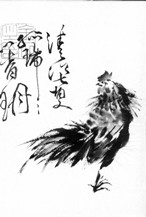
There was once a certain master named Ji Xing-zi who undertook to raise a gamecock for a ruler of a certain state.
"What about the gamecock? Is it ready for fighting?" inquired the ruler after ten days of training.
"Not yet," was the reply. "It is still blindly arrogant and relies solely on its courage."
Another ten days have passed and the ruler asked the same question.
"Not yet," he heard in reply. "It still reacts zealously upon hearing every sound and seeing every move."
In the other ten days, the trainer replied to the ruler this way, "Not at all," he said. "Its eyes still blaze with anger; it easy gets into a rage."
After another ten days, the trainer came to report, saying, "It almost becomes a true gamecock. Now, it can ignore the other gamecocks’ crowing, remaining absolutely cool and calm. Its character is ripe already, so no one dares to fight against it. Just giving it a look and the other gamecocks lose no time in taking to run at a breakneck speed.”