An excerpt from my travel article to Eastern Turkey soon to be published in my new travel book.
We had been taken to the horizon and sat on its edge to view the sublimities on the rim of the world; now it was time for yet another impromptu lunch of fabulous Turkish cuisine, standing like lost children in the kitchen, finger-pointing, or through pantomime, sign language and head-nodding by the hungry group of wayward travelers, as we fought and bickered with ourselves over the mouth-watering dishes on display. By way of brief interlude, can I now take this opportunity to sum up in one quintessential meal what the country has to offer the famished traveler in terms of culinary delights? Alex loved the variety of Kebabs and their unusual seasonings, ranging from the spicy Adana Kebab to what is called the jaw kebab, a horizontal cluster of meats (generally lamb) and fats that roast over hot natural coals in their own juices. It is a gateway to cholesterol heaven if there ever was one. Having been sizzled in its own juices and spread across a bed of white pilaf, it cannot be compared to anything in this world. Sophie savored the traditional vegetables in stew, while Evelyn enjoyed her roasted chicken leg and fretted about whether she should try the tempting salad, with red ripened tomatoes garnishing a bed of green leaves, in full dress combat with purple onions and cubes of goat cheese. “You don’t seem to be afraid to eat the salad,” the envious Evelyn inquired meaningfully. “The bacteria must like you; either that or you have grown accustomed to their insidious ways.” I had no idea as I wolfed down the fresh tomatoes, olives and cucumbers drenched in vinegar and olive oil. “Perhaps they have grown accustomed to my face,” I quipped.
Christina had sense enough to order and quietly ingest a tradi-tional Turkish dish come what may, laden with aubergine, tomatoes and garlic and garnished with tender pieces of lamb simmering in their own juices, giving rise to the designation of lamb stew that was to die for. The Turks have a name for their aubergine stuffed with ground meat and spices called Imam Bayuldi, so named because the Imam fainted when he tasted the succulent dish. I took up the rear, so to speak, by ordering chicken wings which arrived on a wooden platter, plump and grilled to perfection over hot coals and steaming in their own juices. I was the envy of the group who all vowed to sample the chicken wings at their next meal. This was my one claim to fame amid a host of travelers who could speak with confidence and style on any topic under the sun.
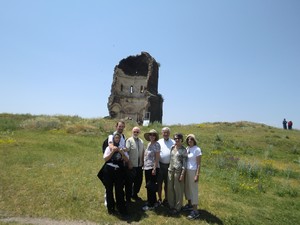
With satisfied stomachs uttering their own soulful sounds, we climbed back into the mini-van to make our way to the ancient city of Ani for an afternoon stroll through the spacious ruins. Mount Ararat overlooks the lost city of Ani like a benevolent patriarch, white-bearded, snow-peaked, and ever-watchful in the far distance, the summit of the mountain peeking out from the horizon of the silent plain with its steady, unnerving presence. In fact, over a 1,000 years ago, the medieval city of Ani was a large metropolis that once housed a population in the hundreds of thousands, now reduced to an extensive grassy knoll, surrounded by a fence beyond which lies Armenia, and interspersed at various strategic points with a church here, an ancient wall there, a crumbling palace just beyond that cluster of trees. The setting itself was as sedate as it was dramatic, set within the frame of a narrow canyon and gorge on two sides with a free flowing river sparking in the light running down the narrow passage of the gorge. We all made our way, like chickens in search of seeds, to the nearby cathedral with its fading inscriptions and vandalized artwork having survived the ravages of centuries to greet us on this sublime sunny afternoon. The domed basilica, named the Church of the Holy Mother of God, was built in 1000 at the turn of the first millennium and is one of the 1,001 churches that still remains standing today. The Church of the Holy Redeemer was completed shortly thereafter in 1035. This church had a unique design in that it was 19-sided externally, 8-asped internally with a huge central dome set upon a tall drum. The church was largely intact until 1955 when the entire eastern half tragically collapsed during a fierce thunderstorm.
Ani, a ruined and uninhabited Armenian medieval city in the Turkish province of Kars close to the border with Armenia, was once the rival of Constantinople, Baghdad, and Cairo at the height of its time and renowned for its splendor and magnificence. Once called the city of 1001 churches, it is now nothing but an eerie grassland surrounded by the ravine of the Akhurian River with the rolling hills in the distance providing a tranquil backdrop to this setting fit for the ghosts of ages past. In 1064, a large Seljuk Turkish army headed by Sultan Alp Arslan, with the help of the Caucasian Georgians headed by King Bagrat, attacked Ani. After a siege of 25 days, they captured the city and slaughtered its population. An account of the sack and massacres in Ani is given by the Arab historian Sibt ibn al-Gawzi, who quotes an eyewitness: “The army entered the city, massacred its inhabitants, pillaged and burned it, leaving it in ruins and taking prisoner all those who remained alive. The dead bodies were so many that they blocked the streets; one could not go anywhere without stepping over them. And the number of prisoners was not less than 50,000 souls. I was determined to enter city and see the destruction with my own eyes. I tried to find a street in which I would not have to walk over the corpses; but that was impossible.”
Time has washed clean any reside of the terrible deeds that were accomplished in places such as the medieval city of Ani down through history. Tombs, mausoleums, palaces, and fortification walls—these urbs dolorosa of the ancient world—have now returned mostly to dust and grasslands. The crumbling stone facades, now ruins of an ancient order, were once fragments of a vibrant and living community. To the likes of people such as our group visiting the site in the present day, they are places of dust and decay, full of memories of what once was. To earlier times, they were places of life and culture, communication and relationships, battles and sieges leading to loss of life and the end of civilizations. For the people of today, cities such as Ani are also venues of exploration to identify who their ancestors were within the global community and what they accomplished in their lives. For people of ancient times, they seem to have explored the nature of the world such as they knew it and what it meant to be human within that particular context which to us seems so alien.
By visiting these sites, we hope to capture some fragment of memory amid the dust and ruins, a fragmentary memory that may still exist within this ruined setting, as the collective lives of former people unfold once again in the form of dust devils and sage blowing in the wind. The cities appear and vanish as they speak to us through mists and time mirrors. Down through history, such lost cities were built and ravaged and destroyed and rebuilt again; appearing and disappearing and reappearing again, until they no longer became viable in a changing world. Haunted by the present as well as the past, there is no present here; there is no world rendered visible by former events and personalities that made up the narrative of history with visitors from the classical past. The camouflage of nature now hides its ancient history within the warm embrace of grasslands and wild poppies blowing in a wind. We may leave the place behind, but we take something intangible with us, some subtle form of enrichment, a vision perhaps, of what once was and may be again in some future cosmic cycle, some kernel of wisdom lying there in the dust that can shape future thinking.
WOW, MOUNT ARARAT! WHEN YOU MENTIONED THE MOUNT IT WAS A FOCAL POINT FOR ME OF COURSE, BECAUSE IT WAS THE RESTING OF THE ARK AND THE AREA WHERE GOD ORDAINED THAT A 'WASHED' HABITATION AND NEW NATION SHOULD BEGIN. YOUR DETAILS ABOUT THIS PARTICULAR AREA OUTSHINED THE FOOD AND EVERYTHING ELSE FOR ME AND DON'T YOU DARE LAUGH(SMILE)EVERYBODY'S GOT THEIR OWN 'GIST'. MUST HAVE BEEN SO INTERESTING, THOUGH, TO LOOK AT PLACES THAT WERE ONCE MAGNIFICENT BUT NOW LAY IN RUINS...THIS FACT, IN ITSELF, MAKING IT QUITE BEAUTIFUL TO BEHOLD. THANKS FOR SHARING THIS EXPERTLY, FINELY DETAILED AND MOST ENJOYABLE EXCERPT! LOVE, BLESSINGS AND FAITH...JOYCE * HIS INSPIRATIONS
"We had been taken to the horizon and sat on its edge to view the sublimities on the rim of the world;…" Is a good example of of your writing that I find quite fascinating.
On Turkish cuisine: When I was in Atlanta University I befriended a Turkish student whose father owned a holding company in Turkey among the many companies he told me about were motorcycle manufacturing and touring companies, including boat tours. He invited me to his apartment one evening where I savored kebabs, salad, feta cheese, Turkish wine and mare's milk, a very potent clear liquor that turned milky white when water was added. A little bit of Turkey without going there. I'm sure if I had visited there, his family would have put me up royally at no cost… "Your money is no good here." ;-)
I recently read about Ani in National Geographic. The city was part of the newly formed state of Armenia when it was overrun by the Turks and the exclamation and ruins at the archaeological site were mostly destroyed by Turkey in 1921. The genocide of Armenians is one major tragedies in world history. In 10th grade I wrote a paper on "Ten Cities of the Ancient World." I'm not sure if I included Ani or not.
Your travels to the lost city of Ani require an imagination to appreciate the rich culture that once existed. It is a poignant reminder how war not only takes countless lives, but ravages almost every vestige of civilization.
When people think of Madagascar, what may come to mind is a Pixar film, a lemur paradise, or the source of 80% of the world’s vanilla beans. In A Taste of Madagascar: Culinary Riches of the Red Island, Emmanuel Laroche—a Flavor Explorer and Culinary








 We had been taken to the horizon and sat on its edge to view the sublimities on the rim of the world; now it was time for yet another impromptu lunch of fabulous Turkish cuisine, standing like lost children in the kitchen, finger-pointing, or through pantomime, sign language and head-nodding by the hungry group of wayward travelers, as we fought and bickered with ourselves over the mouth-watering dishes on display. By way of brief interlude, can I now take this opportunity to sum up in one quintessential meal what the country has to offer the famished traveler in terms of culinary delights? Alex loved the variety of Kebabs and their unusual seasonings, ranging from the spicy Adana Kebab to what is called the jaw kebab, a horizontal cluster of meats (generally lamb) and fats that roast over hot natural coals in their own juices. It is a gateway to cholesterol heaven if there ever was one. Having been sizzled in its own juices and spread across a bed of white pilaf, it cannot be compared to anything in this world. Sophie savored the traditional vegetables in stew, while Evelyn enjoyed her roasted chicken leg and fretted about whether she should try the tempting salad, with red ripened tomatoes garnishing a bed of green leaves, in full dress combat with purple onions and cubes of goat cheese. “You don’t seem to be afraid to eat the salad,” the envious Evelyn inquired meaningfully. “The bacteria must like you; either that or you have grown accustomed to their insidious ways.” I had no idea as I wolfed down the fresh tomatoes, olives and cucumbers drenched in vinegar and olive oil. “Perhaps they have grown accustomed to my face,” I quipped.