Once Upon a Time in Burma
Land of a Thousand Pagodas
Exotic journeys to far distant climes begin to take shape in the realm of the imagination. We roam verdant savannas, cut our way through savage jungles, climb into eagle’s nests on mountain crags, cross parched Mongolian deserts, and ply on ancient vessels across vast oceans, all in search of new sights and sounds, new pathways into the unknown, new visions into the future, anything that will take us far from our humdrum lives. Ah, how the imagination works overtime and takes us there, takes us where we want to go, offers up an experience we would not otherwise come to know. The imagination opens doors for travelers to pack their bags and see other worlds not of their making, worlds that become a reality with the first step taken along the road of a fresh journey into the realm of the unknown.
A recent trip to Myanmar, formerly the much beloved and written about country of Burma of the 19th century, ended up fulfilling my wayward dreams of an adventure and experience that would take me out of myself and into another time and place. Indeed, the title of this adventure says it all, once upon a time in Burma, a country that once entered, will not leave us alone and will wrap the traveler up in its loving embrace. With all geo-political interests and concerns put aside for a moment, it is the people, the culture, the craftsmanship, the ancient land that we wish to know and experience, the lapping of lazy rivers, the sky-mirrored brilliance of expansive lakes, the shadowy curves of rugged mountains, the lush and verdant plains and paddy fields that fill the soul of the traveler to such exotic lands with the peace and serenity of its ancient way of life. Regimes, corruption, injustice, indeed political leaders come and go; it is the land that endures and the spirit of a people that will never die.
Whose heart will not be stirred by the name of Mandalay, immortalized by the British poet, Rudyard Kipling, whose poem, “Mandalay” still echoes resoundingly down through the corridors of time with its lush verses of charm and enchantment. It is this memory that leads me bravely onward as I plan my well-earned winter holiday in a brief respite from my duties as a writing professor at a new university on the outskirts of Kuwait, a city of sky-scraping towers wishing to be iconic and smoky oil fields wishing to be productive. I am now, in the world of Rudyard Kipling, “on the road to Mandalay // where the flyin’-fishes play // an’ the dawn comes up like thunder outer China ‘cross the bay.”
I never tire of flying into a new country that is totally unknown to me and yet soon to be less of a mystery, soon to be known. As I gaze down upon the scene below my comfortable perch on the plane, I see that we are entering a land seemingly lost to time. The blackened highlands turn to rugged mountains with nary a tree to see. The mountains themselves seem to cradle the surrounding land like a mother cradles her child, and a sense of balance and harmony prevails as I gaze upon this landscape of primordial nature, as if lifted from some remote paradise from another planet, captured out of time for the 21st century traveler such as myself to see. Already my expectant heart begins to stir as I eagerly await our arrival.
I am once again travelling with my Slovenian friend, Peter, and a better traveling companion one could never hope for. They say that if you want to really get to know people, you have only to take a trip with them to find out what they are really like. No true r words were ever spoken. My smart, brave, thoughtful, selfless friend would never let me down, brought his own unique approach to travelling with him, took delight in planning and doing background research about a place, and was able to monitor the number of steps (my three to his two giant strides) on our daily trails with his fashionable Garnett geo-watch (when it worked!).
We entered the subdued Arrivals Hall in Mandalay only to realize a half-hour time difference from Bangkok where we had met up from our different locations the night before. “That’s can’t be right,” Peter knowingly quipped. “But it is,” I quickly responded, knowing how he liked to impose his will on things. “Goa, on the west coast of the Indian Subcontinent is an hour and a half ahead of Dubai.,” I added as supporting evidence of what I said. We had easily arranged e-visas done online beforehand and quickly passed through customs control without a hitch. “Let’s change money,” I suggested. “But you get a better rate in town,” Peter countered. “We won’t get into town without local money,” I murmured, knowing he couldn’t counter-argue that. Indeed, at roughly 1,500 kyat to the dollar, after changing a mere $100, we walked away with 150,000 kyat. Hmmn, that should get us into town, I thought to myself.
I won’t belabor the point, but the exchange rate of the currency turned out to be an interesting element in our economic calculations. When you are dealing in the thousands of any currency, it can be confusing. We all know what a dollar or euro values at, but what about 150,000 kyat and how much would it buy locally. Seems like a lot, yet it is only ten dollars in value, about the price of a sandwich and a zero coke on the streets of Manhattan. Now through immigration and customs and with local money in hand, the ever intrepid researcher, Peter, marched over to the information booth to inform himself about getting into the town center where we had booked our hotel. While there were traditional taxis available for about 15,000 kyat (roughly $10), we learned that we could take a local bus outside the airport terminal that would take us directly to our hotel for about 3,000 kyat for the two of us (roughly a dollar each!). That won’t break the bank, I chirped to Peter. He agreed with a toothy grin and off we went on our great adventure.
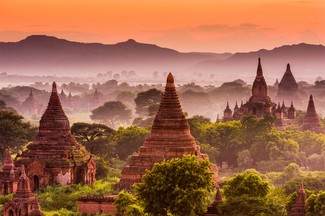
The ride into town was uneventful, but long, leisurely and fascinating. I was beginning to experience the sense of laid-back calm and serenity that would follow me throughout my days of travel through this exotic, ancient land. In the distance, through the myriad lush and wind-blown trees that lined the side of the make-shift highway into town, a rough patch of roadway if there ever was one, we could glimpse the golden spires of pagodas upon hilltops extended clear to the horizon, a vision that would become the iconic characteristic to mark the bucolic setting of this rural landscape with its timely sense of spirituality. “The trees,” I kept remarking to my friend Peter, “look at the variety and lushness of the grand, old trees. Have you ever seen the like of them?” Over an hour later in a place where time really had no meaning but that it could be filled with miracle and wonder, we were deposited at our more than adequate three-star hotel where we were greeted with timid smiles, folded hands and a humble bow.
Once unpacked and his geo-watch turned on, Peter exulted, “Let’s explore the town, the old palace isn’t far off.” I have traveled before with Peter and have come to realize that “not far off” doesn’t mean the same to him as it does to most other people. Nevertheless, I was game and still do my own 8-k run three times a week to keep fit and in the running as it were. Once outside, Peter tends to walk ahead in great strides and I follow three steps to his two; but I didn’t mind. He faced the brunt of the chaotic traffic that came up, down and toward him in every which way, including the ever-present motorbikes that never follow the rules and seem to have license to come and go as they please. “Remember Peter,” I shouted to him over the din of dust and horns, “they drive British-style here, on the other side of the road, so take care where you look to cross.” Yet Peter strode confidently onward, like a giant amid pygmies, ready to brush aside any vehicle or motorbike that may dare to come his way. Indeed, the traffic seemed to have a rhythm of its own, in spite of the noise, and flowed like a river around his colossal bulk.
Well forward at the end of the main street of the town, again lined amid the grand cacophony of shops and workshops with multiple trees blocking the pathway along the side of the road and forcing us time and again out onto the perilous danger of the streets, we beheld the inner sanctum of a walled palace surrounded by an extensive, medieval moat. Up close, when we finally arrived at the historic premises, we gazed across the extensive mote nearly a half kilometer in width at the heightened red brick wall, periodically adorned with brick latticework and towers featuring ferocious fang-filled mouths of animals out of which lotuses hung out like tongues. On the Google map, the palace walls that now house the military Myanmar government formed a perfect square. From where we stood, we could hardly see to the end of the first line of wall that we stood before. Undaunted, Peter started to walk the outside of the moat for about a kilometer until we found a little embellished wooden 19th century bridge that lead across the extensive moat up to the face of the outer wall of the former palace that now up close towered over us, even over Peter.
The Mandalay Palace itself was constructed between the years 1857 and 1859 and housed the last Burmese monarchy, in honor of King Mindon’s founding of the new royal capital city of Mandalay. The palace itself was the center of the citadel and faced East. Built of teak wood in the traditional Burmese design, it rested inside a walled fort surrounded by a moat. The complex ceased to be a royal residence and seat of government in 1885 when, during the third Anglo-Burmese War, the British entered the palace and captured the royal family. To this day, the Mandalay Palace stands as the primary symbol of the once enchanted city of Mandalay, in another time and in another place now gone by.
As we perilously neared the gate to the military enclosure, a guard slumped on a metal chair in the shade of an awning looked up at Peter towering over him as he pointed his finger in the opposite direction and shook his fist to make his point. “Oh hello, my little friend,” Peter said ingratiatingly in a sugar-sweet ironic tone that the poor fellow would never pick up, even if Peter thought he might. I cringed and headed in the direction where the soldier was pointing, so as not to offend. The guy was smiling and trying to be friendly. “But I want to go there,” Peter asserted glancing in the opposite direction, as if looking at a tidbit. “We need to go this way,” I shouted back to Peter over my shoulder, “Where the restaurants were indicated on the map.” That did the trick and at the thought of food, Peter was soon striding far in front of me, like a giant panda intent on his destination, his money (and mobile) belt tightly secured around his waste. No one was going to come near that!
Peter finally found a young, presentable fellow who looked like he knew something, especially English, to ask about a restaurant. “Yes, yes,” the fellow obliged. It turned out he was actually from India, but had lived in Myanmar many years. “Restaurant very good,” he affirmed. “I will be going there later with my family.” Indeed, I thought. What a strange coincidence. Peter soon tracked the restaurant down on the map on his mobile (I still don’t have one, I am waiting for the hand-held technology give way to something more sophisticated), a small place open to the street with tables spilling invitingly out onto the sidewalk. This promised to be our first meal in Mandalay and Peter was not taking any changes on eating unhealthy and/or getting sick with stomach trouble. “We will eat here,” he announced although I wasn’t especially impressed and it was a little early, just around sunset, to be eating to my taste. In travelling alone, one may feel lonely, but in travelling with a companion, one has to make compromises. I did the menu test and with a quick scrutiny found little that inspired me. Also, the stools at the tables had no backs. Not exactly the leisurely environment I was anticipating for evening dinner, our one main meal of the day when travelling.
I grumbled and mumbled to no avail. Peter had already ensconced himself on the tiny stool with a big grin on his face, looking forward to eating. He expected me to extract the best of the savory delights from the menu, and after some time was able to come up with various curry and vegetables dishes that seemed promising from the little photos that accompanied the text. The prices were also note-worthy, 2,000 to 3,000 kyat for the main courses (let me remind my readers that 1,500 kyat equals one dollar at the time of our visit!). We can afford that I chuckled to myself and then some. As we waited in the open-air restaurant in the dust and heat sipping our cool fruit drinks, the cars and motorcycles made their mad dashes to God knows where in such a hurry, and the mosquitoes suddenly came alive in the twilight hush! I sat there feeling tired and dreamy after the long day and the long walk around the palace walls, but Peter suddenly seemed uncomfortable and agitated. “What’s the matter, Peter,” I asked, as he swatted his hands in front of his face and slapped his naked legs. “Mosquitoes,” he cried, “they are biting me.” Welcome to the tropics, I thought, but kept quiet until I couldn’t help but launch into the story of dengue fever that some mosquitoes can transmit. Admittedly, it’s a long shot, but I couldn’t help but kid my friend who had been so insistent about eating in this restaurant at this time. From then on, we took much more care in planning our evening meals as we travelled throughout the country heading south from Mandalay to Yangon (formerly Rangoon).
The next morning, we were promptly met by out little guide whose name was Swan. We would later come to know that Burmese names were different and unique, Peter in particular always got a kick out of asking Swan questions, but always addressing him by name. “Swan, why do the women wear powder on their faces (a natural product to protect against the sun)? Swan, how many motorbikes are there in this town (far too many to my reckoning) ? Swan do you have brothers and sisters (he had a younger brother that he spoke fondly of)?” True enough, when you travel with a guide, the guide, if you are lucky, becomes a kind of father, brother, son. They are there as a font of knowledge, the shipmaster on a voyage into the unknown, a protector and a stranger turned friend in a stranger than strange land. Swan was all of those things and much more. When we came to learn that as we moved south he would be replaced by another guide, both Peter and I felt disappointed and when eventually we did say goodbye to him, knowing we would never see him again, we felt sad and at a loss. When I shook his hand, the thousands of kyat I left behind didn’t seem enough.
For now, Swan was with us at every temple, stupa and pagoda. “What’s the difference,” Peter wondered aloud, giving voice to my own question. “You can enter a temple,” Swan patiently replied, as if he had never been asked that question before. Indeed, the trick of a new guide leads the tourists in his charge to believe that everything is fresh and new, questions, statements, explanations that had never been uttered before and may never be uttered again. “The pagoda is there in commemoration and as a gift or charity that could bring merit and blessing, but it cannot be entered, a solid structure pointing heavenward. A stupa is a domed or bell-shaped monument traditionally used to store religious relics of the Buddha.” Whether temple of worship, stupa or pagoda, to enter its confines, we were required to take off our shoes and socks. In the land of a thousand pagodas/stupas, tourists end up taking off their shoes perhaps more than they would like. I kept silent, but Peter grumbled and complained as we wandered in and around these sacred places during our 10-day tour, Peter meticulously cleaning off his sizable feet with the moist wipes provided every time by the guide. I simply brushed off the sand and grit and re-socked my feet until it was time to enter the next temple, thinking that traveler dust is well earned.
After ambling through the chaotic fruit and vegetables markets of Mandalay, we made our way with our guide, Swan, to our first memorable site, the Shwenandaw Monastery, located at the foot of the Mandalay Hill overlooking the city and countryside, speckled throughout the trees with the golden domes and bell-shaped towers gleaming in the winter sunlight. The intrepid guide explained everything in great detail, and perfect English I might add. I remember asking Swan how he had learned English, but never got a satisfactory answer to account for the ease with which he spoke. The monastery was built in 1878 by King Thibaw Min, who dismantled and rebuilt the inner apartments formerly occupied by his father, King Mindon Min, believing the premises to be haunted by the spirit of his dead father. The entire structure was made of teak wood in the traditional style and heavily gilded with gold and glass mosaic work. The monastery is also known for its teak carvings of Buddhist myths, which adorn the walls and roofs in all their intricate, exquisite detail. As we roamed around the eerie premises, we came to see the commemorative preservation of a former royal way of life, particularly the colossal inner room where the king was known to have performed ritual meditation. We were even able to observe the meditation couch upon which he sat, creating in my mind dreamy reflections of a world I would never know, but had come to learn about in my travels.
By then, the time of sunset was not far off, so we made our way in the car midway up the Mandalay Hills into a parking area and from there were able to take a series of escalators to the top of the hillside that provided fabulous views in every direction of the once enchanted city of Mandalay below, now a bustling metropolis that from the distance still held its mystical lure although up close, the 21st century left its mark of noise and pollution. The rolling hills and flattened plain leading to the city below provided the perfect backdrop for the flaming sunset that soon followed, bestowing upon the fabled city below the streaming golden light of twilight.