By next morning, I came to learn that my friend Peter had slept poorly, the reason being that he had spent much of the night visiting the inner sanctum of the toilet. Alas, the revenge of the spices was finally exacting its heavy toll. While I remained free of any stomach trouble, poor Peter had fallen victim to the age-old trials and tribulations of those with no experience with the culinary delights of Asia. We had gone to “the best restaurant in town” according to our Google advisory and indeed, it had turned out to meet our expectations when compared to the mosquito-infested nightmare that Peter had experienced the night before; the swarms of mosquitoes hadn’t condescended to touch, much less bite me. For the cost of about $6 or 9,000 kyat (a tidy sum if you live on the local economy), we were wined and dined with an array of fabulous foods.
The restaurant actually employed a system that I quite liked, namely, that the diner ordered a main course, and an array of side dishes was brought to table, including soups, breads and spicy sauces. I ordered lamb casserole in a creamy, curried dahl (lentils) stew baked in a pewter pot that was utterly delicious and Peter followed my lead in figuring out the best selection from local menus letting me order for both of us. The waiter brought on a dazzling array of sides dishes and a delectable soup that we both wolfed down in various gulps, being hungry after the long day’s trek and the far distance of the hotel breakfast. We tasted everything from curried chickpeas to braised eggplant seasoned with garlic, tomatoes and pine nuts. We need more, I thought to myself as Peter and I fought for the meager remains, but there was no need. The waiter quickly refurbished the little bowls with ample tidbits to last a lifetime, much less the evening meal. Peter, of course, had ordered an extra bowl of rice, two bowls in fact, in addition to the one he had. I had warned Peter about the little sauces served up in small dishes that were intended to be added drop by precious drop to the food to enhance the flavor with a hint of hot chilly. But Peter, in his traditional style, put heaping teaspoons into his food as if he would never taste these things again and needed to remember their flavor. I noted he begrudgingly scooped up the last remaining kernels, the most fiery part of the hot pepper, on his plate at the end of the meal. Indeed, now he was remembering their exotic flavors in unexpected ways.
The next day on our busy tour, we were scheduled to visit the Mahagandayon Monastery, but first we made a quick stop to the local market to find a remedy for the gentle giant’s diarrhea and dehydration problem. “Sticky rice,” Swun immediately said when I mentioned the problem to him. These local remedies can be quite effective; I knew from my own past experience on other trips. I had recommended doses of fresh lemon juice that had worked for me; but Peter wasn’t having it. When Swun suggested the sticky rice by saying, “I know just the place where we can get it,” I thought, yes, the perfect solution. Peter trudged along behind at a reduced pace through the hectic market until we found Swan’s contact standing before a large vat of sticky rice, nearly empty at that hour of the morning. The woman dolloped out several heaping spoonfuls of the steaming mass of rice in a plastic bag sealed with an elastic band. Not exactly pharmaceutical splendor, but it promised to do the job. Swun’s smile concurred as I laughed myself content. We returned to the car and insisted that Peter swallow the heaping brew which he gulped down quickly making grimacing faces that would scare the hand-carved gargoyles we saw earlier in some of the temples.
Our first stop was the Mahagandayon Monastery where more than a thousand monks live and study. A large group of tourists had gathered under the morning sun to see hundreds of monks return from their morning trek through the village with their begging bowls seeking food for the main meal of the day. Security police and a few senior monks, curiously chubby-looking, created order of the disarray of Chinese tourists of every size, shape and color behind police barriers, clear of the roadway where the returning monks would be walking. A hush and then a rumble of whispers announced that the monks were approaching down the street from the distance of the nearby village, walking briskly single-file, holding in front of their begging bowls, now filled or filling up fast with the charity offered to them. People from the sidelines approached with fruits, packages of biscuits, and the like, and even money, a thousand khat here and there which actually represents less than a dollar, but in local terms meant something; and given the size of the crowd could add up to a reasonable hoard. I took note of the soft, youthful faces of the young monks, their heads shaved clear and wearing the traditional orange wrap-around robes that we have become familiar with in Thailand. Some of the monks were very young indeed, children, eyeing the onlookers impishly and seemingly ready for flight. My friend Peter had a clear advantage as his giant stature afforded him the luxury of towering over everyone in sight to have unimpeded views of the procession of the monks into the monastic enclosure. The monks soon disappeared into the surrounding buildings where they would have their one and only late morning meal of the day.
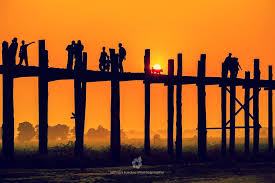
A short, pleasant drive down lush tree-lined streets soon brought Swan, Peter and I to our next destination, the more than 200-year old U Bein teak bridge, built in 1782, the oldest and longest teak-wood bridge in the world. The 1.2 kilometer bridge spans the Taungthamam Lake near the ancient royal capital not far from Mandalay to an island nearby that could service the local villagers who wanted to get to the mainland across the broad lake to sell their crops. The bridge was built from wood reclaimed from the royal palace in Inwa. It features 1,086 pillars that stretch out of the water. Though the bridge largely remains intact, there are fears that an increasing number of pillars are becoming dangerously decayed. Damage to these supports have been caused by flooding as well as a fish breeding program introduced into the lake which has caused the water to become stagnant.
Of course, the old kilometer long bridge represented a challenge to Peter who was anxious to “make tracks” across the waters in his traditional swaggering style, leaving nothing behind in the wake of his hurried footsteps but a gentle wind. I also valiantly followed in his footsteps; but soon lost him as he made his way ahead into the thickening crowd. The local Burmese, many of them villagers and many of them in groups of families who were tourists, were making their way across the bridge as they have done for hundreds of years. I was prepared to put up a brave front and make my way across without complaint under the cool winter sun, but as I tripped my way forward across the creaking wooden planks, I became increasingly more uncomfortable. A kind of phobia took hold, as one might experience in confined spaces or riding shaky elevators. The truth was the bridge looked none too stable. The wooden planks were aged, chipped and broken throughout; gaping holes yawned where planks had broken through.
I took note of the fact that the bridge itself, yes, the two hundred year old bridge, was fairly narrow, wide enough for three or four people, but there were no guard rails, just a gaping chasm on either side and a sizable drop several hundred meters down to the murky waters below. I made my way forward nearly to the halfway point, where I saw Peter up ahead towering over the crowds of people, waiting for me under a make-shift wooden structure with the traditional pointed roof that marked the halfway point. Other elderly people had the same idea as I had; time to rest and take stock. “You go on ahead and make it to the other side,” I told Peter. “You can tell me about it when you come back. I’ll wait for you here.” And my valiant companion was off without further coaxing.
I tucked myself into a shady corner of the narrow bridge, which at that point was extended a little to accommodate the wooden structure marked there as a resting point in the river crossing. It was time to rest, to be alone for a few minutes, to gather myself into my own space and reconstruct the blessings of solitude as the crowds of people made their determined way back and forth across the age-old bridge. It was a cool mid-morning with a gentle breeze under the warming light of the winter sun. At my feet sat a local Burmese women, with her jet black hair collected into a wooden hair clip and adorned with a cluster of wild flowers. Her pudgy face held an eternal smile that matched the smile she held in her eyes. At her feet were the goods she was selling to the tourists and other local travelers crossing the bridge, as women have probably done for the last several centuries since the bridge was built. She had a good business for all that, seasoned sticky rice, spicy noodles, and a variety of fruits, all sold for pennies and packed into a little plastic sack and tied with an elastic band for safe-keeping. I wished I could understand her shatter; but contended myself with the bird sounds that the Burmese language sounded to me as I listened.
A little boy, probably about one and a half years old, sat at her sandaled feet. He sucked contentedly on a tangerine rind and half dozed with heavy eyelids as if he sat on the fringes of heaven and not on the fold of the wrap-around longyi (the Malays call it sarong famed for its batik cloth) of his young mother. I watched the child as he sat in dreamy splendor without a care in the world. As if the breeze had woken him up, or perhaps the chatter of the passer-bys sounding like river stones, he now looked around as if interested in everything. It wasn’t long before his infant gaze fell upon me, an old man on a journey, lost in his own trance. Children are like cats; one doesn’t like to intrude on their space without alarming them; but leave them to their own devices and they will make their own way. I sat there contentedly; it was enough to rest my weary bones and take in the color of the local life. I do love children, especially infants, and can sit and watch them for hours, their antics, their inventiveness, their curiosity, their sweet, angelic innocence to remind me of another time and another place, from where they have come and where they might be going.
When suddenly, the infant’s random glances feel upon me as I sat there on the bridge taking rest. I pretended not to notice, not wishing to interrupt the rhythm or the intensity of his gaze. Indeed, children can come to us uninvited, as if they have known or are wanting to know. They do not bring with them all the excess baggage that we carry around as adults, who seldom look into the eyes of another, and if or when we do, we feel uncomfortable. The child looked at me with intense interest, as if he were remembering something and was still lost in thought. I smiled at him and he immediately smiled back. I scowled backed him and he immediately scowled back. We seemed to be on a wave length together, some inner harmony had struck its cord. The years dissolved and the miles between disappeared as he threw the tangerine rind aside and began to crawl on all fours. His mother was distracted by a sale and was stuffing mango cubes and their sweet juice into a plastic container, selling the pulp for pennies to the taste. The determined little fellow made his way over as I sat on a low stool. When he reached my legs, he extended his arms as if reaching for the open sky. No doubt, I looked to him like a grand patriarch with my thick mustache and bone-white beard. He soon found his way onto my lap, where he again sat content as if lost in reverie to the surrounding lake and countryside just as I was lost in sweet reverie, so unfamiliar to me, so familiar to him.
“Found a friend, did you,” my companion Peter asked with a broad smile. “Children sometimes like me,” I mumbled embarrassed. The mood was broken, the happy child returned to his mother with a longing, backward glance and this is my backward glance to him in the only way a writer knows how, in the love and beauty of words written down on the page in sweet remembrance that will never die.