After making our way back down to earth from the heights of the hilltop monastery with its clear view to Bagan, we now had a 7 to 8 hour drive through the countryside heading further south to a city called Kalaw, in the Shan State of Myanmar. When we finally arrived at the hotel after the long trek on the windy roads, we were tucked safely into our hotel, called the Royal Inle Hotel, by our faithful guide Lyme. Goodbyes are never easy, particularly when you know you will never see that person again, and we had come to know and value the kind-hearted Lyme. He will always hold a special place in my heart in the way he extended his friendship and trust by giving the true sentiments of his heart away in the telling of his tale of sorrow and woe. Lyme embraced me warmly, like a son to a grandfather, and then he was gone, another gentle breeze to be lost in the wind.
Kalaw was tourist hub at the edge of Inle Lake, with its attitude of holiday resort and its air of clean crisp quality. The native Shan people live predominantly in four main cities around the lake, including Kalaw where we were staying, in the numerous village along the lake’s shores, and on the lake itself. The last two days of our stay along the way to the former capital Rangoon gave us the opportunity to enjoy what the lake had to offer. For our two day excursions on and around the lake, we boarded a long, narrow hand-made boat of teakwood, painted black and powered by a small motor in the back. The lake itself was quite large, covering nearly 45 square miles, giving ample opportunity for long, leisure rides in the early morning and late afternoon, while in between, we spent much of the day visiting the local sights on the lake itself.
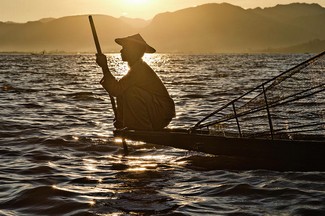
The first morning on the lake took us on an extended ride deeper into the expansive waters where much of the fishing takes places by the local fisherman who themselves live on the lake. The local Burmese fisherman are known for practicing a distinctive style of rowing. They stand on one leg on a small platform in the stern of their long fishing boat, similar to the boat we were riding in, while they wrap their other leg around the single oar as they steer and make their way along. Together with the tubular distinctive fishing nets that lay along the bow of the boat, the fisherman, dressed in their sand-colored baggy pantaloon tied at waist-level with a rope and their white cotton/linen shirts and triangular straw hats providing mercifully ample shade, offered a picturesque sight indeed as we speeded by in our own boat on our way deeper into the interior of the lake. Picturesque or not, I couldn’t help but think when I saw them again on the way back into Kalaw late in the afternoon just before sunset, that it must have been a long, tedious day indeed, alone out there on the waters, rowing in slow motion with their single foot and finding what fish they may that would provide them with a livelihood for them and their families. I was touch by the nobility, the simplicity, the hardship of the scene, a stolen glance into the lives of others that exotic travel sometimes provides.
Further glimpses into the local culture and way of life were provided us that day as we stopped around noontime at a textile factory that stood in the middle of the lake surrounded by other houses, all built of teakwood and bamboo and standing nobly out of the waters on stilts. Throughout our journey overland heading south from Mandalay on the way to Yangon, we had a number of opportunities to visit handicraft and textile shops in order to gain a deeper insight into how these handicrafts are born and worked by the local people. I would like at this point to focus on the textile industry, but before going into the details, let me make passing mention the intricate and incredibly fine and detailed work done by the local people in creating woodcarvings, lacquerware and silverware. The wood carvings are traditionally made from the softwood teak, a high quality wood found in abundance throughout the country. The unique art of this craft is handed down from father to son.
I stood in wonder before these young men and women sitting cross-legged on the floor as they meticulously and with great care carved scenes of mythical creatures, deities, fruits and flowers on panels, frames and doors as if it were second nature to them. Such focus, such patience called for these artisans to work throughout the long day from 8 until five with regular breaks for tea and lunch, as they worked such intimacy between the mind, the hand and then applied to the texture of wood. To watch these people work gave an intimate insight into how a work of art is born from such a simple person through not only sheer skill, but also the devotion and love of the craft that is handed down from father to son across the generations. Similarly, I went to a lacquerware factory where individuals sat in rows working through the various stages of production of the cups, jewelry boxes, vases and combs, all constructed from bamboo and horsehair, that come to make up the exquisite repertoire of lacquerware, all finalized in the colorful intimacy of hand-painted scenes from the sap tapped from varnished trees into works of art with all the delicacy of lace.
I am not that interested in precious stones and wear no jewelry, but if you are, then exotic Burma is the place to go. Rubies and sapphires are popular, but jade is the stone most abundantly available. One can easily pick up an exquisite bracelet or necklace for under $10. Of special interest were the beautiful parasols that are so characteristic of old Burma. Used throughout Asia, the parasol is considered a necessity when heading out onto the street to protect oneself from the sun. In Myanmar, many still favor the traditional style, made with bamboo (for the frame and handle) and cotton, which is stretched over the bamboo frame and then decorated with a hand-pained traditional Myanmar design. It is very common to see monks carrying an orange version of the parasol as they go through the streets on their morning rounds with their begging bowl in hand.
As much as I would like to describe in meticulous details all the handicraft shops I visited while in Burma, I will focus my efforts on my experience visiting those textile shops where I climb the wooden stairs from off the dangerously swaying, hand-crafted boat that led up into the inner sanctum of the textile “factory” standing on proud stilts upon the waters of the lake. I place the word factory in quotations marks because it was like no other factory ever visited or ever will visit.
You hear the looms that create these fabulous textiles before you see them. The clear, punctuated sound, the steady beat, the rhythmic sense that something is happening, something is being made. Then the door opens and I see the looms, row after row, casting thin shadows in the late afternoon winter sunlight. The wooden structures seem primitive, skeletal, and yet they are designed to perform and in performing produce minor miracles in the shapes and textures of cloths, as though hand-painted, vibrant, a living a life that is born of pure art. It took me some time to understand for I have never seen a loom up close before. The spinning wheels of fairy tales were a part of my imagination, but never a true reality. Now I stood in the midst of a mythical loom from which the fabric of the universe has been created, at least in principle, a loom that could have been in the distant halls of the Greek gods, Daedalus’ loom spinning the cloth of Aphrodite.
There was a seat before the loom and the weft and the warp were drawn by strings up and down and across, moving threads cast in colored dyes that could have been spun by black forest spiders or perhaps sea snakes from the deep blue. How I loved the whole business of it. I stood there spellbound, unconscious of Peter, the guide, the light and shadows of the room, the wayward dust motes in the air, only this vision of infinite patience. The rhythms of the multiple looms created an exotic and mesmerizing melody of perfected industry. The simplicity and skill of the crafted machine came together to produce a lasting image. There it was, the smell of the wood, the shush of the shuttle, the satisfying way that weft stacks upon weft and the waft intermingled to create this single unity of fabric.
As I said, a simple wooden seat stood before the loom and upon the seat sat a simple Burmese woman, middle-aged with a slight elegant, indeed noble bend forward as if in protection of the loom. Her hair jet black and adorned with a cluster a simple white flowers cascading down through her shiny oil-sheen locks pulled together into a bun with a wooden hair clip. She took no notice of us; but I took notice of her, orchestrating the entire event, the ancient machine of the loom, the whispers and cries of the warp beam, harnesses and shafts, to create this magic of spell-work. The hands of the woman steady and sure, the mind of the woman focused and clear, the face of the woman detached and enduring. This was a labor of love in its finest moment. I stood there spell-bound, conscious of the moment that would pass, but to be forever etched in my mind as a lasting memory, not built of air but a light that will never blow away. Later, we saw the finished products, filled with color and light, as though cast down from the rainbows of heaven to shine of glory in their own right. I took away with me a piece of fruit of the loom, in the form of a lotus scarf, made from the thread-like sap drawn from the stem of a lotus flower, a valued treasure that I will keep until my end of days.