Hua Hin Railway Hotel Topiary
When I got back to Bangkok, Vitoon picked me up in a different car—a rear engined Renault. Unlike the firm ride and high revving engine, tight steering and suspension of the Italian Fiat, the French made Renault floated on unsure suspension with low power acceleration and cheap plastic interior ready to fail.
He also had hired a Laotian woman for something like $25 a month with room and board. She made my breakfast and cleaned my very dirty clothes from three weeks of travel. I was embarrassed they were so bad, but thankful. With so many Cambodian and Laotian refugees in the country, the Thai people were taking advantage and living quite wealthy as a result.
We left the next morning for Vitoon's birthplace in the upcountry eighty miles northeast of the city to visit more of his relatives. We drove through dry rice fields populated with grazing water buffalo for many, many clicks. Vitoon told me, “In the rainy season the fields will flood and they would be full of fish. In Thailand, where there is water there is fish." I believed.
About noon, we came to a village that was hidden in an island of trees and palms amid a sea of rice fields. When we got out of the car, we were faced with a pack of about thirty small, viciously barking dogs that seemed to announce that they ate white intruders. Somehow, we eluded the dogs and arrived in Vitoon's uncle's office. The walls of the office were covered with pictures of his uncle's exploits as a major participant in helping the Allies rid the area of Japanese during World War II. At 76, he had a 350-acre farm and was the patriarch of the village. Recently, he had become the head of the whole region. Politics ran in the family. He immediately announced that I had known Vitoon in another life—a great compliment.
(Note: Recently I have learned that the Thai government collaborated with the Japanese and those accolades on the wall that I saw were probably awards he got from the Japanese. I should have known because the original Bridge Over the River Kwai, made famous in a novel in 1952 and two movies, is located in Thailand. I hope I can be forgiven for my lack of knowledge of the matter in my autobiography.)
About ten miles further, we arrived at Vitoon's birth village and visited Vitoon's 85-year-old mother and two of his sisters. The sisters' families shared the house. We brought canned goods and they gave us rice. As Vitoon chatted with his mother and a sister sitting on the wood floor, Samboon told me that she could not understand the dialect that Vitoon was speaking to the two beetle nut-chewing women. Their teeth were blackened by the mildly sedative nuts.
Life was very primitive there. Except for the electric wiring Vitoon's nephew had tacked to the poles that held up the building's thatched roof, the house was ancient and traditional, open to the outside air. Samboon was concerned about the open well right next to the house where they got their water. Sent to a Buddhist monastery as a child while his father was dying of Malaria, Vitoon was evidence of how far one can come in one generation.
But Vitoon had bad, crooked teeth. They bothered him while we traveled. When we came to a village that fronted the main road, the practitioners in the storefronts lived upstairs in the fashion of the early United States. He sought out dentists about three or four times during our travels. I waited in the car while he went inside and got his cavities stuffed with that numbing agent, I could smell it, that I was given sometimes as a child.
Then, we went to a park in a waterfall area. It was obvious that winter was the off-season because few people were there. The paths leading up river were lined with abandoned refreshment stands for the throngs of summer. I was surprised by the amount of litter, but litter was one of the legacies of Thai involvement with Americans during the Vietnam War. In the evening we met his younger brother, a doctor, in a recreational club in a park at Nakorn Nayak. That whole area was quite parklike and very clean. Upper-middle-class American.
After we arrived back in Bangkok, Vitoon took me to see the Siamese Crocodiles. All ten thousand remaining of the species are said to be confined to one farm in the Bangkok area. Crocodile feeding is a spectacle not to be missed. But we got caught in one of Bangkok's infamous traffic jams, and had to return home without seeing the crocs after we were stalled for over an hour without moving.
The streets were often clogged with trucks, many of them logging trucks coming down from the mountain forests of the North. Ancient teak logs that would take hundreds of years to regrow. I read later that that practice of unlimited logging was stopped and the elephants that did much of the work ended up in Bangkok giving tourist rides.
The next day, Vitoon drove me to the Oriental Hotel and dropped me off early for a guided tour to the Ancient City. My brief trip through the hotel revealed its luxury located in its ideal spot on the river. We left the hotel on the Empress of the Orient, a two hundred-passenger excursion boat that plied the Pra Cha River. Only about twenty tourists enjoyed all that space as we cruised up river past the city center, Royal Palace and Royal Barge, dining on a lavish buffet and enjoying the sights.
As we left the dock, we were seated on the open bow to get a good view of where we were going. An unusually tall and beautiful waitress brought me a cool drink and then engaged me in conversation for about 15 minutes. It left me a little sad when she left and started to engage with other passengers. So glad I had some time with her.
A short distance out of Bangkok we came upon a rookery of white egrets making their own home on the shoreline of the river. Our guide made a big point of it, proclaiming, "Plenty birds."
About eighty miles up river, we disembarked and took a bus to the Summer Palace and the Ancient City at Ayutthaya. The Summer Palace was the old vacation home for the King of Siam. Inside, furnishings from China represented the riches of Dynasties in ways modern China can't. The Ancient City thrived in the 1700s, but invasion by the Burmese in 1765 left it in ruin. Our guide warned us about hawkers, beggars, and thieves at the site.
As we tried to view the site's ruins, men who offered to sell us gems and ancient idols harassed us like our guide had predicted. I held onto my wallet as they circled around us and offered relics that were probably fake.
On the bus as we started back, a school teacher from Australia discovered that the star sapphire she had hung around her neck was missing. She had recently bought it during her tour in India. To this day, I don't understand why she wore it on the tour. Perhaps she was afraid to leave it in the hotel. Some passengers wanted to go back and get the guy who stole it, but our guide suddenly seemed to have trouble with English. He had warned us.
During the week,Vitoon drove me around to various locations and then let me walk around while he went inside to do various business. I remember stopping in a military compound where I stayed in the car and he went in to talk to the commander. From what I gather he was involved in intelligence because of his knowledge of upland dialects and his contacts along the border with Laos and Cambodian borders.
One morning I was by a canal watching a group of men using a fire brigade relay to load bricks one by one, hand over hand into a boat. While I was watching, a mailman came through and picked up a couple of rocks as he passed me. Up ahead, a dog lying in a doorway was waiting and came alive, viciously barking as the mailman skirted widely around him and threw a couple of rocks. As soon as the mailman was out of sight, the dog returned to dozing in front of the doorway ignoring everyone else on the street including me.
Nearly all of our eating was outdoors. Some of the meat like the pink veined sausages, appeared inedible to me. The meats were doused with something similar to my aftershave, mints that made them less tasty. And the salads were doused with the family dressing that made them like eating liquid fire, probably to kill bad bacteria on the leafy vegetables. In the process, burning my mouth and killing my desire to eat them. The fish was quite good and so was fried rice and vegetables like miniature corn stir-fried in soy sauce. There was one snack with a small stick covered with a strip of beef (?) doused in soy sauce and broiled on charcoal that was quite good. I didn't go hungry, but my stomach was upset much of the time.
One evening we stopped at a restaurant next door to an ancient boxing stadium. While we ate, we could hear the roars of the crowd as some kickboxing match was underway. Every once in a while a boxer would come through and go upstairs or come downstairs. Vitoon never mentioned taking me to a match there. It was very old and completely round like the Colosseum. It was highly tiered, probably to steep for me to climb into the seats. The replacement stadiums much less colorful and modern.
Vitoon wanted to take me to Chang Mai for a weekend. We would take the bus because he was fearful of driving on those dangerous mountain roads. When he went to book the hotel he learned that there was a match between a Thai kickboxer and an American black boxer and all of the hotels were full because it was a big event. I regretted not going because I’d heard much about that resort town in the cooler north and seen movies made there.
One evening in front of the house I was pleasantly serenaded by Vitoon's eldest son, whose name escapes me but was 29 at the time and a lawyer. He sang familiar country songs that I didn't quite connect until later I learned that they were by Slim Whitman, a British country singer who gained a lot of fame singing like Hank Williams.
Later, Vitoon's favorite son, Kik and his girlfriend came. He got out his guitar, played and sang many rock 'n' roll favorites for me like the Beatles in a way that was almost indistinguishable from the original. Apparently, Vitoon was not in good standing with the elder son, perhaps for something he did while Vitoon was away to Canada and US getting his degrees. Kik was clearly his favorite. I never asked and never learned if he had any daughters. He certainly had a lot of sisters.
One day while Vitoon was otherwise engaged in business, I found myself in the care of Samboon. She didn't tell me exactly what, but she had something in mind for us to do. It was close to noon, so she took me downtown to a large building where we found a large ballroom type room on the second floor set for lunch.
The room was filled with well-dressed women and a few men that was more like a hotel ballroom/dining room than a traditional Thai place of eating that I had been exposed to under Vitoon's careful introduction to his country. About halfway through lunch that was more American than Thai, as I recall. A man got up and started singing.
Although the songs were in Thai they were very familiar and had that smooth delivery that was unmistakably a crooner like Frank Sinatra. The man was very good at working the tables and went around many to approach the women who were very excited to have him singing at their table. He didn't approach ours because we were far away from the center, that I was entertained, fed and enjoy this slice of more normal professional Thai life.
Later, when we met Vitoon, he seemed very upset that she had taken me to that luncheon at what appeared to be a woman's club. I always wondered why. It is only thanks to the Internet that I just found out what the problem may have been…
The man singing was a famous Thai singer named Suthep Wongkamhaeng. He was often referred to as, "The Frank Sinatra of Thailand." During the tense political period that I visited, a coup had shut down the Thai Parliament. Wongkamhaen was running for office under the New Force Party when the Parliament reopened in 1979 from his home province.
For all I know, Vitoon may have been from another party or his rival in the military since was an honored member of the Thai Air Force. He failed to be elected in 1979, but was a member of Parliament in 1988. Clearly from his extensive Wikipedia page, a very famous person in his home country.
The last weekend I was there, Samboon joined us and we drove south to Hoa Inn, an British old railroad hotel on the way to Malaysia. On the way to Hoa Inn, we stopped at some mystical mountains that jutted up sharply from the flat fertile plain like daggers.
A Buddhist wat occupied the wooded area at the base of one of the mountains. There was a large door on the side of the mountain and we entered. Inside, the mountain was nearly hollow, creating a huge cavern and there was a large reclining Buddha in front of us. There was also splattered bat dung and an eerie feeling in the place, filled with intricate passages and high up openings to the sky.
We came out and Vitoon told me that there was a sitting Buddha up on the other nearby mountain and pointed out a trail. As usual, he declined going with me, so I set out alone. The trail started with steps and was not too difficult except for a few steep places. It wound up the mountain until it reached the high point of a saddle between the two mountains.
Now high above the plain, I could see both ways for many miles. I kept thinking of monkeys that Vitoon had warned of and what I'd do to avoid an encounter if I ran into them. When I reached the mountain on the other side of the saddle, the trail entered a hole in this mountain. Far below, I could see a black sitting Buddha. I was looking down on its head like a bird flying over. The trail was too steep for me to enter the mountain, so I returned.
On the way about noon, we came to where a river joined the Gulf of Siam. Overlooking the river was a restaurant. We were served a seafood soup containing fish, shrimp, squid and mussels in a battered aluminum ring container that was nicely heated by a candle. The soup was incredibly delicious and the ingredients placed on rice were equally yummy.
As I sat in the restaurant, I looked out at the beach far below. There, the ingenious Thai were using bamboo and cloth windmills to raise tidal seawater into shallow basins to evaporate into salt. I didn't see a single human out there while the wind in the little windmills was doing most of the work and the sun was doing the rest.
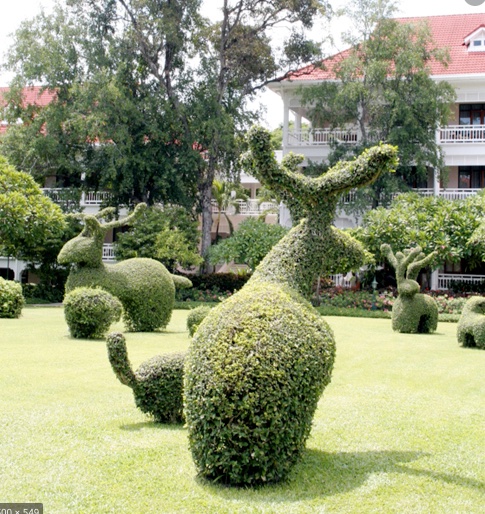
When we reached Hoa Inn, the grounds of the hotel featured trees carved in the shape of animals-topiary. We stayed, instead, in a beach bungalow near the hotel. It was Saturday, but when we stopped at a little beach restaurant in the center of the little town, the beach and restaurant were deserted. January was the off-season. As we left the restaurant we came upon hundreds of sticks about 2 feet high stuck in the sand, each with a little 3 or 4 inch fish speared on it, drying in the sun. The whole area stunk of drying fish.
Squatters on the beach in front of our bungalow brought us everything we needed, including a large fish that Vitoon had them go to the village on their bicycle and buy for us. They also cooked it to perfection on the beach for us for a small share.
In the morning, I rose early to see the sunrise over the Gulf of Siam, just as I'd seen the sun set at Chol Buri two weeks before. It was very foggy at dawn, and all I could hear was the shrieks of children and the roar of small outboards. Five buses with campers had pulled up before I got up, shattering my thought of a peaceful time watching the sun float up from a peaceful sea. It was too foggy anyway, and I could barely make out the kids making all the noise.
Again, we drove to more temples, shining from small mountains like images from a movie. I climbed steps to see them all. Vitoon and Samboon waited in the car each time as I explored, dutifully awaiting my return, giving me all the time I wanted. It was a strain to do all that climbing, but my curiosity could not be dampened by exertion. I gritted my teeth and pushed on, always hoping to see something, learn something, I had not seen or known before. My thirst for knowledge of Buddhism was insatiable, but without a guide, it was purely visual.
Most temples were dirty and run down. But one was different. Almost new, it had a fountain, pools with fish, and beautifully crafted paintings in the temple walls inside. The paintings covered the usual ancient themes, but also depicted cars, houses, and clothes of modern living. From a distance that mountain was particularly striking, with many temples, chedis, and Buddha images rising from it.
After we returned, Vitoon ask me if it annoyed me that he and Samboon had argued the entire weekend. It may have been over his other girlfriends. I don't know. To me they were just talking amicably in Thai. Not understanding a single word, I got no indication that they were arguing.
It was time to leave for home. Vitoon took me to the airport and I boarded Philippine Airlines for the first leg of my trip home.
The rest of the story…
I never saw Vitoon again. We communicated occasionally by letters, his favorite way. One time I called him and he told me to hang up and write, apparently thinking it was costing me too much to make the call. It wasn't, but I wrote him instead.
In spite of their arguments, Vitoon married Samboon. He continued intelligence work in the upcountry and established a technology school. I was never able to contact him at the school, even after they got email.
Vitoon worked with the United Nations and traveled to many countries. One time he called me while he was visiting a niece in New Jersey while at a UN event in New York City. His wish was to fly on the Concorde and he may have had it during those many diplomatic excursions. My way wish was to have him visit me in Houston, but he didn't have the time. He didn't inquire about our mutual doctoral advisor, Dr. DeVore, and I gave him address and telephone more than once.
Tragically, about two years after I left, Kik and his girlfriend were killed while driving the 190 Mercedes two door sedan. Vitoon never got over it. And then, sometime around 2005, he and Samboon were both involved in an accident and hospitalized. Vitoon recovered but Samboon was bedridden for some years until she died. After about 2010 I did not hear from him. He was at least in his nineties and also still suffering from those injuries.
Copyright 2021 © Ronald W. Hull
1/27/21