As parents reach the "Golden Years," how do their children come to accept responsibilty, and still maintain their parents' dignity?
As a parent ages . . . sometimes the roles seem to reverse. Who has the final word? Seventy-nine is a lot of years for a human body, just the sheer number of years of enduring what one faces on a daily basis. And the battle scars of life experiences, environment, heredity, the roads taken (rather than not), that led to other roads, and other decisions, end up making a lifetime.
My mother has led a full and varied life, and recently I've felt a change in her attitude, the way she is, or the way I feel she is. I worry. But what can I say?
We have a couple of daily phone conversations, though sometimes she doesn't understand me, or what I'm talking about, and I don't understand her. Her priorities and life move at a much slower pace than mine do, and than her's did previously. Her life perspective is something I can't reproduce in my own head. I'm not her age, and I've only been around for part of her life experiences.
I try to be attentive without inflicting too much of my attitude on her. I'm trying REAL HARD not to tell her what to do, unless she asks me for an opinion. There were years I was an overprotected child, though I rebelled more than enough to make up for that in later years. Lord knows that through the years she's endured more of my attitude than just the pleasant side. All in all, she's probably gotten the worst of the worst, because my father died over 25 years ago. She had to be the disciplinarian, and parental guide until I reached the "grown up years."
But in all fairness, I believe my bipolar disorder came from her side of the family. It doesn't really matter where it came from, except I see bipolar symptoms in the larger sense of her behavior sometimes. I couldn't even mention heredity in bipolar disorder. I tried once, and she told me I didn't know my father before I was born. What can I say?
That's a discussion that could go on forever and she wouldn't understand. There are some conversations not worth having because I know where they would go, and I know I'm perfectly capable of losing it (usually in the fashion of loud verbal frenzied, cussing behavior, and she HATES cursing!).
I know, sometimes, I just want to be argumentative with her. I don't know why. Maybe, because in some way it feels comfortable. I know what my role is in that situation. It's not right, but it's comfortable, usual.
It's not that I make the discussion disgustingly abrasive. We just have different opinions, and I just need to let some things ride. We need to agree, in advance, to disagree. If I don't start a conversation on a "forbidden subject," it doesn't become a source of conflict. So there are things we don't talk about. What can I say?
It's kind of like an unstated (but obvious) generation gap, like when I was sixteen, and she was 49. She set the rules for skirt length and dating policy. I didn't like the rules. My friends' parents were more lenient, and I was living, am living, the only child syndrome. She set the rules for everything until I developed my own set of rules.
I'm still developing my own set of rules for living. I guess they're called morals. There will always be a generation gap between mother and child. The mother always expects to care for, and do for, her child. I know when I do for her, she does feel happiness, but she also feels hurt because there are things she'd rather do by, and for, herself. Age and health conditions prohibit that. So we don't dwell on that either, though it's a source of mild (?) emotional trauma for me. But, what can I say?
The generation gap is still there, except now it the roles often feel reversed. She is the one who stays out in the car without reporting in often enough. I worry. She has cataracts. But what can I say?
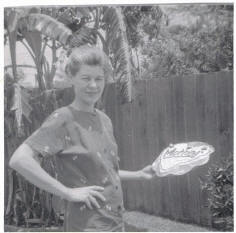
We go places together, or meet somewhere, a couple of times a week, and we're always identified as mother and daughter, by appearance. I hope I age as well as she has, for she looks much younger than her 80 years. But then, who's to say what 80 is supposed to look like?
Her routine, despite her always-on-the-go attitude, has slowed to a stream of doctor appointments, trips to the cafeteria, and jigsaw puzzles. The doctors have told her to slow down and take it easy, but she's never been that type of person. She wants to always be busy doing something, and if the task is physical, she ends up "over doing " it.
Age is wearing away at her--the things she wants to do, but is not able. She doesn't like that part of her life, the "not being able to anymore." Independence is important to her. Sometimes, I think it's the most important thing to her. I know I value my independence. They say, "like mother, like daughter." It's true . What can I say?
But it's the small changes about her I notice that make me view our relationship differently. Always her life has been filled with people. She enjoyed many secretarial type jobs through the years, and has always been active in the church, and the church office. Now, mostly, she stays at home with her dog. Since her second husband died she's lost her desire to socialize. She's been to many funerals. Lots of her friends aren't around to socialize with.
It is sad when you get older, and all your family and friends have already passed. We believe they're waiting there for us. It's some consolation. Now she plans her outings around doctor visits, and her meals (usually from the cafeteria) by what she thinks her stomach can digest without causing pain. I feel that she's been dilly-dallying about getting a colonoscopy because she thinks the doctor might find something wrong. Her cousin died of colon cancer.
She makes doctor appointments (many different types of doctors), and then she gets to feeling better, and she cancels the appointment. What can I say?
Does it really matter? If I say anything, I know I'm instigating an unpleasant discussion. It's her life, her decision, right? What "magic words" would make her think my way? Why should I be so bold as to think my way is best? It is her life.
Most decisions are in God's hands anyhow. But how much does one intervene in nature, with SO MUCH medical technology? It's a very personal decision. I have her medical power of attorney, and I know what she DOESN'T want, when the time comes. No extreme measures are to be taken to sustain a life state that is vegetative, or full of only pain and human suffering. Just knowing the words won't make anything much easier--when the time comes.
I hope God takes care of the situation without legal papers being necessary. It's in His hands anyhow, and I know I worry too much over things of which I have no control. I need to "let go" of lots of things. I try. What can I say?
There is a way in which mother and daughter are connected that no one outside the two of them can understand. It's experiential. How does one behave as a good daughter?
I've always strived to be the best at everything I do, and I drive myself overly-compulsively! Plus, this particular mother and daughter are codependent, and I'm trying to work on my end of that. She deals with that concept in her own way, in her own world. We don't talk about something she could help me with. But she's not as healthy as she's been; these past two years her health has been deteriorating, her physical body wearing out.
The past two months her heart condition (need for bypass surgery and a mitral valve replacement), and digestion (she won't keep an appointment with the colon doctor) seem to be causing her horrible pain. She's never experienced much physical pain in her life--not headaches, broken bones--just mostly allergy annoyances. Now she has pain, but sometimes it goes away for a bit. I listen. I'm usually very up-to-date on the movement of her bowels--an important and privately distasteful matter, about which I've begrudgingly adjusted to including in EVERY conversation.
I've heard this line of conversation goes with the age--hers, not mine. What can I say? But what is my responsibility for her pain as a daughter who can really only listen, and what is my obligation to repect the dignity she has developed from a lifetime of experiences? It has to be a combination of the two. I'm having a real problem with the alegbra in this equation.Life isn't math.
Often the phone has rung in the middle of the night, to be followed by a trip to the Baylor emergency room for some immedialtely necessary care. It's hard on her, but it's hard on me, too. She knows it's hard on me, and acknowledges it. then I feel guilty and self-centered for the subject coming up at all. What can I say?
Everything that cracks or creaks or leaks can be repaired, and there's a contractor or technician, somewhere, who can fix it. But it's different with humans. We have to trust God. What else can I say?
What can I do to find more faith in God in this aging situation I face daily with my mother? How do I best support her in her quest to maintain the human dignity she has alwys known? What can I say to God?
Mother's emotions, her state of being, her concept of life and what she can do with it is changing, daily. So is her health. I have to be the one to be "up," and keep the conversation light. What can I say this time, and what shall I say tomorrow??
good write about unanswered questions all must face when dealing with an aging parent. your mother is a very pretty woman, and so are you. god bless you both, and may he give you both the strength to go on! love, your friend, karen lynn in texas. (((HUGS))) :)