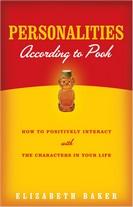
If you feel like your living in a zoo, cheer up! You probably are! Knowing how to identify and relate to the characters can be an adventure!
In her new book, PERSONALITIES ACCORDING TO POOH, Dr. Elizabeth Baker provides a lighthearted approach to understanding personality as well as insights for dealing with characters when they complicate your world. If Tigger tends to bounce all over you, and Rabbit wants to be the project manager of your life, Owl won’t stop talking, and Eeyore’s negative attitude has you climbing the wall, expect solutions and a reason to smile from this refreshing new book.
Writing both from the prospective of Christian faith and her background as a Professional Counselor, Elizabeth states, “God has a plan for every variety of personality; a wondrous plan that involves you and me and the rest of the characters in the human zoo. It’s a plan of hope and personal change and fascinating tomorrows.” Realizing those changes is what Personality According to Pooh is all about.
Most personality typing systems use letters, colors or even various animals to divide people into four categories. Elizabeth, however, has chosen six characters from A. A Milne’s original works for children: Rabbit, Kanga, Eeyore, Tigger, Owl and Piglet. Each character comes alive with specific identity markers, unique strengths and an honest look at the growth points most frequently found in that personality style. This specificity and the many real-life examples in each chapter make it easy to guess your own personality mix or identify that of co-workers, friends and family members. A process that is not only fun, but enlightening as the good qualities of each type are celebrated and growth points are encouraged toward change.
Each chapter ends with a brief bible study and discussion questions, and readers are provided with the tools for study, reflection, prayer, and change. Regardless of what your own “pooh-sonality” may be, you will discover help for dealing with all the characters in your life and better understanding your own.
Excerpt
Chapter 1
“Here is [Winnie-the-Pooh], coming downstairs, bump, bump, bump, on the back of his head behind Christopher Robin. That is, as far as he knows, the only way of coming downstairs, but sometimes he feels there really is another way, if only he could stop bumping for a moment and think about it.“
I sympathize with Pooh. Stopping the bumps of life long enough to think is never easy. In fact, it may be impossible because the thing we are often bumping into is one another! So, unless we are willing to live as a hermit in some desert cave, the bouncing and jiggling and banging is likely to go on whether we want it to or not.
Perhaps that’s why it’s so refreshing to remind ourselves that all those bumps are not random acts of nature. God has a plan. A wondrous plan that involves you and me and the rest of the characters in the human zoo. It’s a plan of hope and personal change and fascinating tomorrows.
I like that idea.
But, I’ll also be the first to admit that I have never liked the bumps and if I can find a way to smooth things out a bit, I’ll take it. That is probably one reason I became a counselor. It was sort of a perverted effort at self-defense.
Yet, I can’t say that learning to counsel helped smooth the way much in my own life. If it had, I don’t believe I would possess so many bruises.
We will never be free of all the bumps in life. Indeed, we should not even seek total tranquility, for as stated earlier, God is creating something through all those jolts and bangs. However, I have discovered a few ways to smooth out a wrinkle or two and the opportunity to share one of my best wrinkle-removers is what inspired this book.
My particular odyssey began a few years ago when still another move had Mom and me looking for a house. Since we are only fifteen years apart and both widows, we live together and most of the time, make a pretty good team. This was not one of those times.
We had been roaming the streets for what seemed like hours with husband/wife real estate agents. The Texas sun was brutal, the air thick, the houses smelly and time was growing short.
Mom and I may be a good team, but we are also about as different as two personalities can get and as the temperature continued to climb so did the tension in the backseat of the car. Mom was fixated on why none of the houses would be right for us and I was busy arguing a solution to every problem she identified. Exasperated, I finally threatened, “One of these days I am going to write a book about what it is like to live with Eeyore!”
“I’ll buy the first copy!” the female half of the real estate team shouted from the front seat. “I’ve lived with Eeyore for fifteen years!”
Our mutual Donkeys responded by comparing us with some equally unsavory characters and suggesting if we didn’t have them to keep us from running off the edge of the nearest cliff, we would have met our Maker long ago. Only a well timed sense of humor, and a sudden summer shower cooled things off and, eventually, we were able to agree on a place to live.
Once we settled in the new surroundings, I opened a counseling practice in the large, front office of our new home. But, as with any new business, things were slow at first and I found myself with a good many empty hours. I filled them by returning to my on-again-off-again writing career and that was when I remembered my threat.
The more I thought about it, a book on Eeyore didn’t sound half bad. So, after a trip to the local library, I came home loaded with both the original works and the newer Disney offerings as well.
To my surprise, they were rich with personality insights that rivaled anything I had learned in graduate school. Most theorist divide humanity into four groups, but A. A. Milne chose six stuffed animals. Using a Rabbit, Kangaroo, Donkey, Tiger, Owl, and Pig, who lived with a stuffed bear, he produced a view of human nature that was fresh and hauntingly accurate. Not only that, he made me laugh.
After my book came to print, [1] there was the fun of radio and television interviews, doing book signings and generally meeting the public at every opportunity. It was during those events that three things took me by surprise. The first was the fact a few people on earth still had no idea who Eeyore might be. The second was how frequently I was asked which of Milne’s characters fit my personality. And the third was how beneficial the study of the characters had become to my own relationships.
I suppose out there somewhere there are those who find relationships easy. Social mavens who connect easily, communicate with skill and are always willing to share their own life at appropriate times and to appropriate degrees.
I’m not one of them.
As a counselor, I had worked for years helping families relate more fully and communicate across natural barriers. I had taught professionals how to teach communication to their patients and trained Christian workers in the subject. But, Eeyore and his friends helped me, personally, more than a master’s degree in the subject and twenty years of experience.
For example: Just this morning I asked my mother a simple question. “How long since you’ve had a new pair of walking shoes?” She replied, “Listen, girl, you are talking to someone who wore the same pair of shoes to school all year and all the next summer and even longer if they didn’t fall apart.”
That was not an answer to the question I had asked. When I ask a simple question, I want a simple answer and I want it now! I know she lived through the Depression. I was not trying to force her to purchase new shoes if she didn’t think she needed them. It was just a question.
But, I had learned my Mom was an Eeyore. She needs time and space to think and will most often provide negative information before she gets around to an answer. As I gave her that space, several more sentences passed between us (none on the subject of shoes) and two brief stretches of silence. Then, out of the blue she said, “April. I got these shoes when Kathy was here. Wasn’t that April?”
If I had I not been viewing our conversation through the caricature of Eeyore, I would have been upset when my question appeared to go unanswered and I doubt I would have handled the situation with grace. As it was, I found no tension inside myself and no pressure to fix the situation. I knew my Eeyore needed space.
Giving space is not my style, but I also knew that “my style” was not the only game in town and this new perspective made the “bumping” of relationship less jarring. All of this, thanks to a book written for children about Bears and Donkeys and Owls and other assorted creatures trying to live together in a Hundred-Acre-Wood.
If you sometimes get the feeling that your Hundred-Acre-Wood is filled with characters from a zoo, take heart. Most humans feel that way at times. It’s often a feeling that is both mutual and justified. We all look at each other then slap our forehead and lament, “Why do you insist on doing it that way?” or “How in the world could you draw such a strange conclusion?” or “Why do you feel like that?” Not to mention the communication glitches, defense mechanisms, self-justifications and outright sins that beset us.
The truth is, unraveling the knot of human relations can be a very formidable task.
Humans have been trying to organize the many variations of homo sapiens since the birth of the scientific method. Their efforts have never been very successful, but they keep trying anyway. We’ve grouped folks under letters, newly invented words and according to scores on written tests. The process is so common that it now filters naturally through our language. We casually remark that Martha is classic Type-A, or Harold is an introvert, or Josh is a high D on the DISC or Susan is a Golden Retriever and feel that we have said something significant. Perhaps we have.
As long as we remember that personality types are caricatures, not photographs, a great deal of information can be communicated with a few words and no harm done.
If you have ever been to the fair or had a street artist quickly sketch your portrait, you understand about caricatures. These quick drawings look like you, but then they don’t. The artist makes a caricature by exaggerating certain features. Usually bad ones. Celebrities of every sort—especially political ones—are often portrayed in caricature by the press. It is the exaggerated features of these drawings that make the individual instantly recognized around the world. Bob Hope’s pointed, turned up nose comes to mind, as well as Ross Perot’s big ears or President Clinton’s huge jaw. Of course, a photograph is more realistic and carries more information, but these quick exaggerated sketches also carry information and may draw our attention to things we missed. I never knew Clinton had a big jaw until the press let me in on the secret.
This book, like the Hundred-Acre Wood, contains six caricatures of human personality. The work is not scientifically accurate and you won’t find a body of research backing up the data. What you will find is a lot of common sense, a touch of humor and a fresh look at the human zoo. I like that combination and hope it will do as much for you as has for me.
As you read, you’ll probably find yourself identifying with one or more of the characters and I know you will find glimpses of those who work around you, share your home, call you “family” and sit beside you on the pew at church.
Characters in the Church
This book is also about the local church. There are two reasons for that: In the first place, I can’t think of anywhere that a sense of humor is more needed. Second, this book is about character growth and the church has been designed by God as a place of character growth and change. [2] We knock off the rough edges as we rattle around in families, but we also get shaped and formed by the church.
Mom started bringing me to church around the age of five and I have attended most every Sunday for the past sixty years. I was baptized in one church, married in another church, raised my children in nine different churches, served as paid staff in a big city Mega-church, been through a small town church split, had my husband’s funeral in a church and served as volunteer in church libraries, church Sunday schools, church choirs, church vacation Bible schools and church nurseries. I have also been a church janitor and one of my college degrees is in church administration. Yet, in all that church-stuff, one thing stands clear. Churches can be painful places and finding a spot where you personally feel you belong is a challenge unfit for the timid soul.
It is in the church that we often meet some of our most jarring bumps as children of the earth try to fit themselves into this heavenly organization. You can’t be a part of a local congregation long before wondering how God ever gets anywhere with such a disorganized army of misfits!
Bump! What do you mean by “Church”?
I don’t presume to understand all Jesus had in mind when He said, “Upon this rock I will build my church,” [3] but, regardless of whatever else He may have meant, there can be little doubt that He included the sometimes painful, often stumbling, supportive & lonely, kind & cruel, wise & stupid, bumbling organization that frequently meets in a building with a steeple on top. Jesus is building His church.
Church (as herein defined) is not scattered individuals who love the Lord reading their Bible alone. It is not an accountability group of pastors who meet over coffee. It is not a family on vacation gathered around a well worn devotional guide. Church is not a television program or an interactive electronic chat room. No matter how theologically strong or necessary or entertaining some of these things might be, they are not what this book means by “church.”
For the purpose of this study, a church is a group of Christians who have banded together to follow the relational and functional guidelines outlined in the New Testament. This kind of church may be fifteen senior citizens holding the doors open to a dilapidated building while being served by a ministerial student who can’t wait to go someplace else. It may be a mega-church featuring a rock band and state of the art video / sound systems with a pastor who publishes a new book every time he completes a sermon series. Church may involve worship services filled with liturgy, ritual and written prayers or be spontaneous and highly emotional. It may be a 501-3c with its own tax number and incorporation papers or a home Bible study meeting informally on the first and third Thursday of each month. As long as there is general agreement among those present that they have arranged themselves in an organized fashion and are relating to each other within the basics of the Christian faith, that’s church.
This kind of church has two main problems. The first problem is that the organization is led by humans. The second is that humans make up the rank and file.
Bump! Human Leaders
Occasionally, you may get knocked by someone “up there” in the ranks of ecclesiastical leadership—a pastor with a national profile, the head of your district, the preacher of a mega-church where you attend but whom you don’t really know—however, most often the bump will be of a more personal kind and involve someone much “lower” on the scale of religious leadership: The song leader who demands too much from the choir. The Sunday school teacher who talks above your head (or doesn’t know a thing!) The home elder who insulted you and never even realized it. Etc., etc., etc.
When a leader who is “high” on the ecclesiastical scale is the problem, it will likely have limited impact on your personal life. If you don’t agree with what they have said or if their sins become public, the worst thing that is likely to happen is that you will be embarrassed and perhaps move to another church group. But, those at the “low” levels will set your teeth on edge, tempt you to gossip, be a challenge to your communication style, and otherwise mess with your world.
Bump! Human Followers
It is not only the leadership that will likely stretch you; it is the follow-ship as well. When you become part of a church, somewhere along the way someone is going to want something from you. It might be bringing a pot roast to a church dinner, or giving an offering to a visiting missionary, or opening your home to a youth meeting, or becoming a teacher for the fifth grade girls’ class, or just showing up for yet another meeting. But, if you are connected to a church at all, you will eventually end up giving and relating to peers whether you really want to or not.
Along the way, you will bump into people whom you don’t like, people who can’t do things as well as you do them, people who are ungrateful, people whose personality rub you the wrong way and a general array of sinners.
You will also find some within the follow-ship who are as comfortable to be around as an old pair of house shoes. You will have those who look up to you when you can’t for the life of you understand why and those who will walk beside you in tragedy and joy alike. And, you will probably bleed a little when you have to part with these folks; a reality that happens all too frequently in our mobile society.
The Church, The Zoo, and You
A lot of years and a lot of churches have touched my life. They have spread across two states, two countries, a couple of Interdenominational groups and most every stripe of Baptist known to man. Along the way I have found dear and lasting friendships as well as plenty of experiences that stretched both my faith and my patience. When I hit one of those stretches while employed full time on church staff, my boss said, “Elizabeth, just consider it a personal growth issue and don’t worry about fixing it.”
How right he was! Personal growth. That is what church involvement is all about. It is also what life is about. Through our bumps and struggles, God takes on the project of leading us to become more and better and stronger than we have ever been.
e amazing enough, but the truly astounding point is that as we become more like Him, we also become more uniquely more ourselves. Our personalities become more distinct. Our uniqueness more open and freely expressed. Our differences more celebrated. Our relationships richer. We are destined to be made more like Him without becoming less of the unique person He made us to be.
I trust you’ll stay with me as we will explore this phenomenon together. I think you’ll enjoy the trip and you may even meet yourself along the way. As you read about these characters, feel free to laugh, but hold any critical conclusions with lose fingers. If you do, you may be very pleased with the results brought about as a new perspective freshens your world.
Oh, yes. . . . one last note. Some may wonder why all of Christopher Robin’s stuffed toys were given a full chapter in this book while the most famous character of all, Winnie-the-Pooh, is seldom mentioned. Easy answer: Winnie is too well adjusted to be of interest. Just imagine him as the preacher.
Get the Point
Growing to be more like Jesus while at the same time becoming more uniquely ourselves is the goal of individual Christian progress and a major reason for involvement with the local church.
Read the Book
Read aloud I Corinthians 12:28--
Who is given credit for determining church leadership and structure?
This scripture lists several different kinds of authority and other gifted individuals. How many have you personally known?
Consider I Corinthians 12:31 & 13: 1-13--
When Paul was confronted with the fragmented, prideful church at Corinth, he reminded them of the best way to relate in all situations. What was it?
Choose one of the elements of love listed in Chapter 13 and tell why you think it is important within the context of all relationships.
Look up I Thessalonians 5:14-15 in at least three different translations
Three types of people are mentioned in verse 14. Who are they?
How might you “pursue good” (v.15) for each of these three?
Tell the Truth
The author has defined church as a group of Christians who have banded together to follow the relationship and functional guidelines as outlined in the New Testament. What would you add or delete?
Elizabeth states that personal growth is the central issue involved in being part of a local church. Do you agree or disagree? Support your answer with scripture and/or logic.
Tell about a time you were forced to relate to a personality who was very different than yourself. How did your Christian faith impact that situation?
Describe the largest benefit you feel you have received by being part of a local church.
Want to review or comment on this book?
Need a FREE Reader Membership?
Reviews for "Personalities According to Pooh"
Reviewed by p duckworth
5/30/2011
The true beauty of reading...
The author's fine work and
the reader's enjoyment.
“If you are not using Huna, you are working too hard.”
Max Freedom Long, author of “The secret Science Behind Miracles.”
A modern application of ancient Hawaiian mysticism (i.e., Huna) with many practical exercises to understand the st
Do you want a Godly marriage?
Here is a guide for couples to be able to get their marriages on track with God's will and keep it there. This is accomplished by looking at every aspect of the marriage relationship and showing by using numero