Kindle Edition
Download to your Nook (eBook)
Download from Apple iTunes (eBook)
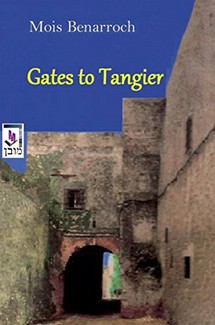
GATES TO TANGIER
KOBO
SCRIBD
Category:
Literary Fiction
Price: $5.99 (eBook)
When the father of the Benzimra family dies, he leaves a will informing his family of an illegitimate son he fathered with a Muslim woman in Morocco. To receive the inheritance, the family is instructed do everything possible to find that son.
When the father of the Benzimra family dies, he leaves a will informing his family of an illegitimate son he fathered with a Muslim woman in Morocco. To receive the inheritance, the family is instructed do everything possible to find that son. They embark on a journey to Tetouan, Morocco, from places as far-flung as Jerusalem, Madrid, New York and Paris. They are in search of their lost brother; a journey that will bring them face-to-face with their Moroccan roots and with their Judaism, a journey that will force them to think about their identities. After this experience they will no longer be the same. The novel reveals the Sephardi-Ashkenazi conflicts that exist in Israeli society as well as the ties and tensions between the Arab world and Europe, and between Middle Eastern and Western cultures. This is a world of complexities and nuances that are often blurred in the versions shown to you by the media.
This is a novel about the little-known world of the Jews of Northern Morocco, full of intrigue, humor, and eroticism. But there is also the possibility of a homecoming.
Published by Destino in Spain in 2008 in Spanish, Arabic, and Hebrew, and now being translated to Portuguese, French and Italian, Gates to Tangier is recognized as a literary treasure cherished both by the critics, the academic world and the public.
"Gates to Tangier is not primarily a critique of the marginalization of the Sephardim in Israel, but rather and exploration of the Moroccan component of Sephardic identity. The Benzimras' pilgrimage to Tangiers, however, is not suggesting that this Moroccan component is the essence of Sephardic identity. Benarroch follows Khatibi's bilingual paradigm in suggesting that identity is expressed in the intersection of languages." Adolfo Campoy-Cubillo, Memories of the Maghreb: Transnational Identities in Spanish Cultural Production (Palgrave Macmillan, 2012)
Excerpt
"The son of a bitch!" she shouted, surprising herself with her own words.
An absolute silence fell in the office of lawyer Ilan Oz, at 7 Ben Yehuda, Jerusalem. The kind of silence that follows a terrorist attack. Everyone was seated around a large table and seemed to be in a state of shock, five adults trying to understand what was happening, what had befallen them.
"So that’s it. He has dropped a bomb on us." continued Estrella, the mother. "After his death."
"And if we don’t look for him? What happens if we don’t look for him?"
"According to the will, the money will remain in a locked account for five years. After this time, you can access it. The will just says that you should do everything in your power to find him."
The youngest of the children, Israel, swirled his black yarmulke, which he wore from time to time.
"It’s just that—I don’t understand. He really wants us to look for his son?"
"That bastard," said Messod, the oldest. "What does all this mean? He never told anyone about this?"
The mother looked at the lawyer. "He couldn’t have taken this secret to the grave?"
The lawyer became impatient.
"I don’t have any other information, this is what is written in the will. I can only speak to the legal parts, nothing more. I believe that at this point, the provisions are pretty clear. You can try to nullify the will, but I don't think it will be that simple.
"We should do everything we can to find his son," said David.
"Who should? Everyone? Or is one of us enough? Do five people have to put their lives on hold to look for his son?"
"I'm not going, I'm definitely not going to Morocco to look for my husband's bastard son. No way."
"Fine," said Silvia, "I don't think we're going to resolve this sitting around an office. I think we should go home and think, and if we have questions, we will call you, Mr. Oz. Thank you." She gestured to the others that they should leave.
"One more question," said Albert. "An important question. How much money are we talking about?"
"I have account numbers," said the lawyer. "But I don't know how much money they have. There is an account in Switzerland."
"There isn't much left," said our mother, "some six -hundred thousand dollars, a bit less, that's all that is left."
"That's all that is left of the legendary fortune of the Benzimra family, less than one hundred thousand dollars each? That's all that is left of the fortune that could buy princes, ministers, and kings? Get any Jew out of jail?"
"That's how it is," said Israel. "The Ashkenazim got rich here, and we got poor. A generation more and we won't have anything left.
"That's already begun," said Albert. "It has already begun."
"Well, now is not the time. Thank you very much Mr. Oz. We will call you if we need you."
*
"Where are you going, son?"
"I'm going alone."
"Do you see anyone?"
"I see you all, but you are very far away."
"And will you return?"
"I've already returned, I always return."
"Where do you return to?"
"The sea."
"Do you like it?"
"The waves don't leave holes."
"A rock is always waiting."
"I am the rock."
Madrid
FORTU/MESSOD
I'm always waiting for something to happen, I'm always waiting for something. And when something happens, I hope for more. I have spent thirty years far away from Tétouan and haven't gone back. It is always there, eternally there, a there that never ends, a word from the past, a word from oblivion, a word from memory. Thirty years I fled from that journey.
Alberto told me that he was there, that things were going well, that every minute was a wonder. But others, many others, spoke of the trash, how dirty everything is, that the whole city is garbage, that it is full of moros, as if the Moors had never lived there before. And maybe they weren't there, maybe they weren't part of our lives, despite the fact that they lived with us, by our side, always in tangential circles that did not penetrate our lives, they were in parallel universes, bringing us our necessities, Fátima who did the housework, bought oranges and fish. And we were always the same for them, the ones that moved the economy, the ones that provided employment. They miss us, they ask why we left, if we had felt bad, and I don't believe that's the case.
We didn't all feel badly, but some did, like Mamá and our grandmother; the women felt uncomfortable in the city, they spoke of Israel as something obligatory, always the women, the women are the ones that decided to go to Israel, the men, like myself, preferred something more known, Madrid, Paris. Who was right? I don't know, but when I came to visit Israel in 1977, I felt like it was too late for me, too late to change my life and leave Madrid, leave the smell of squid, the chatting over tapas, it was too late, I told my father, I told my mother. He understood, she didn't. She wanted me at her side, he would have preferred to be elsewhere in Palma de Mallorca; where my cousin wanted him to go to run or buy a hotel, or in Canada.
"This is not for us," she told me a thousand times.
"I understand, but at the least it can be for the next gen-eration,"
"The nephews and nieces, yes, it could be better for them, but I see your brothers, and your sister, and none of them really feel at home, none are really doing very well, not even your brother Isaque, who was never very conventional. He's better in New York."
I don't believe we would have been better in New York, I think. I think that we would be better off in Madrid, or Paris, or in Jerusalem, but New York – is that far? Not really. For someone born in Morocco, Jerusalem is much further. Don't you think so?
I said that last bit out loud, seated next to my dear sister Silvia.
"What?" she said. "What am I supposed to think?"
"I don't know, I can't stop thinking about it, I can't stop thinking about what this trip is for. What are we looking for, a brother? A brother we know nothing about. Maybe we're looking for a dead man. Maybe he is already dead, people do die young, you know. Thirty years is a long time. And in Morocco, with all the drugs, you know how many get killed.
"I can't stop thinking about it either."
I asked the flight attendant for a whiskey, a full bottle and glasses with ice. I offered some to everyone. J&B isn't our favorite whiskey but we all like whiskey, and it was a good excuse to try to reduce the tension.
1974. The family dispersed: some went to Jerusalem, and I stayed in Madrid to finish my medical studies. After the dream subsided, the distance between us widened, languages began to change, his language, mine, the language of my brothers and sister. We spoke about things we didn't understand, that we couldn't understand, didn't want to understand, discrimination, racism, oppression....but my mother did not want to even hear about emigrating to another country, or anywhere outside of Jerusalem, although I proposed they move to Madrid many times.
"We are managing just fine here, money is not a problem," she said.
But a year passed and then another
|