A landmark collection of previously uncollected prose from Rebecca West, one of the most celebrated writers of modern times.
A landmark collection of previously uncollected prose from Rebecca West, one of the most celebrated writers of modern times. West's wit, wisdom and vivid prose tackles love, war, pride and politics, and offers insights into great minds from Aldous Huxley to Bertrand Russell and legendary leaders from Winston Churchill to Richard Nixon -- as well as personal revelations on the role of women to a fascination with cats. In all, a vivid reminder of the timelessness of the writing of a woman who has been called the finest of her generation.
Excerpt
Those who are easily shocked had better leave Mr. Aldous Huxley’s new fantasy, Brave New World, on one side; noting, as they pass, that since this is a free country they are not compelled to read it, this is all they need do about it. Those who are not easily shocked can settle down to enjoy what is not only the most accomplished novel Mr. Huxley has yet written, but also the most serious religious work written for some years. His tendency in his other novels has been to select subject matter which might fairly be described as a fuss about nothing. Even though the characters in Point Counterpoint were carefully docketted as interesting individuals, they were, in relation to the depicted imbroglio, as lacking in allure as sexually-maladjusted cockroaches. But the argument in Brave New World is of major importance. One could sanely ask for nothing more than it gives.
One would say that the book was about a Utopia, if it were not that a line of dreamers have given that originally non-committal term a sense of imagined perfection; for it describes the world as Mr. Huxley sees it may become if certain modern tendencies became dominant, and its character is rather that of deduced abomination. If one has a complaint to make against him it is that he does not explain to the reader in a preface or footnotes how much solid justification he has for his horrid visions.
It would add to the reader’s interest if he knew that when Mr. Huxley depicts the human race as abandoning its viviparous habits and propagating by means of germ cells surgically removed from the body and fertilised in laboratories, so that the embryo develops in a bottle and is decanted instead of born, he is writing of a possibility that biologists are seeing not more remotely than, let us say, Leonardo da Vinci saw the aeroplane. And it would add to the reader’s sympathetic horror if he realised that the society which Mr. Huxley represents as being founded on this basis is actually the kind of society that various living people, notably in America and Russia, and in connection with the Bolshevist and Behaviourist movements, have expressed a desire to establish; and that this is true even of the least pleasing details.
Professional Reviews
THE ESSENTIAL REBECCA WEST - Review by Dennis Drabelle
I once interviewed a well-known writer who confessed that, when he turned a good phrase, he would pump his fist in the air. It's safe to say that this was not a habit of Rebecca West's - otherwise she would have suffered from a chronically sore arm.
Consider the opening of her review of a book called "Patriarchal Attitudes:" "There is, of course, no reason for the existence of the male sex except that one sometimes needs help in moving the piano." Such a bravura start seems impossible to sustain, but West does just that in the following three-and-a-half pages. She had a gift for - and an impish delight in - smashing icons. Here she is, for example, poking fun at Winston Churchill's vaunted style: "His rhetorical passages seem, like the first English automobiles, to be preceded by a man carrying a red flag."
Both quotations can be found in "The Essential Rebecca West: Uncollected Prose," which should be essential reading for anyone enamored of insight, wit, and English prose that scintillates. Some of the book reviews - written for London papers over a period of more than half-a-century - will deliver the shock of the new to American readers. Others are historic documents, among them West on Aldous Huxley's "Brave New World" on its first publication in 1932.
"The Essential Rebecca West" also contains essays, reminiscences, and an excerpt from an unfinished project of West's, a book that would have used the assassination of Leon Trotsky in Mexico as an instrument for examining that country's bloody history. For all its range and zest, this collection has one shortcoming: to adapt a phrase from another brilliantly impudent writer, Ambrose Bierce, its covers are too close together.
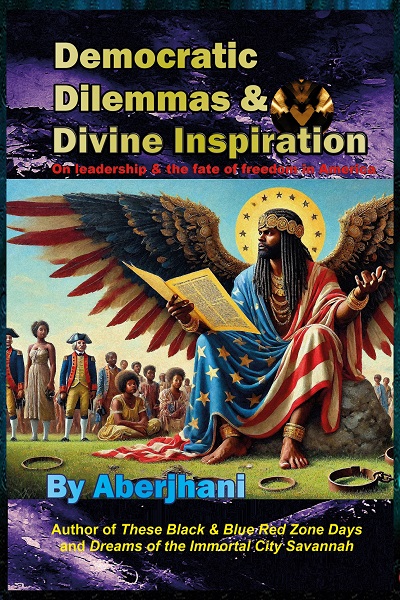
Democratic Dilemmas and Divine Inspiration examines the significance or relevance of the idea that the U.S. Constitution was, as many believe, divinely inspired. How much did that belief matter to founders of the nation and how much does it matter no
Democratic Dilemmas and Divine Inspiration examines the significance or relevance of the idea that the U.S. Constitution was, as many believe, divinely inspired. How much did that belief matter to founders of the nation and how much does it matter no