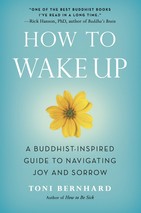
"How to Wake Up" sets forth the Buddha's path to peace and well-being in the midst of life's ups and downs. This is a path that all of us can follow regardless of our backgrounds or circumstances.
“Toni Bernhard's beautiful book is a new invitation to investigate the Buddha's teachings in the laboratories of our own lives. How to Wake Up will be greatly appreciated by readers new to the Buddhist path, as well as by seasoned practitioners.”—Sharon Salzberg, author of Real Happiness
“Toni Bernhard has done it again—sharing wisdom teachings in a way that makes them mightily accessible and helpful without any sacrifice of depth. I love this book!”—Tara Brach, Ph.D., author of Radical Acceptance
“This remarkable, warm, encouraging, and crystal-clear book expresses the ancient wisdom of the Buddha in universal, twenty-first-century terms. I honestly think it is one of the best Buddhist books I've read in a long time.”—Rick Hanson, Ph.D., author of Buddha's Brain
How to Wake Up: A Buddhist-Inspired Guide to Navigating Joy and Sorrow describes the path to peace in the midst of life’s ups and downs. Using step-by-step instructions, I illustrate how to be fully present in the moment by actively engaging your life, just as it is. Doing so opens the door to awakening to a peace and well-being that are not dependent on whether a particular experience is joyful or sorrowful.
Like my first book, How to Be Sick, this is a practical book, containing dozens of exercises and practices, all of which are illustrated with easy-to-relate-to personal stories based on the my experience as a Buddhist practitioner of over twenty years. Because the book focuses on integrating the Buddha’s teachings into everyday life, it is intended for both experienced practitioners and those with no background in Buddhism.
Professional Reviews
Publisher's Weekly
Drawing inspiration from the Buddha's awakening, Bernhard addresses this ancient tradition's core ideas in a wise, gentle guide to reducing suffering. Her previous book (How to Be Sick) described her efforts to adapt skillfully to a chronic, life-changing illness. Here she explores Buddhism's heart to show how we have the potential to awaken to a peace and well-being that are not dependent on whether a particular experience is joyful or sorrowful. With assurance the author blends clear explanations, examples, and easy practices (such as the tracing exercise to identify the source of dissatisfaction) from her circumscribed life to explore how wisdom, mindfulness, and open-heartedness can improve well-being. The relevance of classic topics such as the three marks of existence (impermanence, no fixed self, and suffering) is deftly investigated. Her discussion of tanha (desire) teases out the difference between wholesome aspirations and harmful craving, a sometimes thorny topic for students of Buddhism. While the market is saturated with good introductions to Buddhism, Bernhard excels at demonstrating from personal knowledge that the Buddha's promises to ease suffering aren't just empty words. (Sept.)
Booklish
How to Wake Up: A Buddhist-Inspired Guide to Navigating Joy and Sorrow.
Bernhard, Toni (Author)
Sep 2013. 240 p. Wisdom, paperback, $16.95. (9781614290568). 294.3.
Expanding on the lessons of mindfulness and meditation found in her well-received How to Be Sick (2010), Bernhard switches gears to focus on the venerable and often intimidating idea of “awakening.” The author begins with the core idea that life is a string of experiences engendered by and producing suffering. From here Bernhard walks her readers through the concepts used in Buddhism to accept and engage this state of being and, in doing so, hopefully become more “awake” to the reality of life. The book is organized around three fundamental tenets of the Buddha’s teachings—wisdom, mindfulness, and open-heartedness—with each section broken into chapters that examine these ideas and offer practices that help incorporate them into daily life. Bernhard presents all of this in an easy, straightforward manner that will reassure readers who are less familiar with Buddhist tradition. While this is an ideal book for people beginning to explore Buddhism or alternative methods to handling life’s difficulties, this is also a useful book for the more experienced Buddhist or spiritual practitioner looking to revisit fundamental concepts of their practice. — Taina Lagodzinski
A guide and challenge to Christians who want to live a life of true discipleship. It explains why worship is fundamental and how a life of true worship transforms one to Christ-likeness.
The world calls us to improve and promote ourselves. Is this
Finally, the commentary that adds even more to the diagramed version of The Easy Study Bible. Follow the diagramed verses of this new clear translation with a verse by verse commentary. Understand even better the New Testament book of Philippians.
<