Kindle Edition
Amazon
Category:
Memoir
Publisher: Ogun's Fire
Type: Non-Fiction
Pages: 112
Copyright: March 2016
ISBN-13: 9781326612733
Price: $2.99 (eBook)
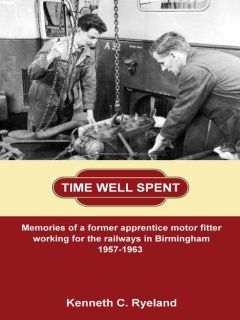
Memories of a former apprentice motor fitter working for the railways in Birmingham 1957-1963.
Time Well Spent is a personal account of Ken Ryeland’s training as a motor fitter in Birmingham, where he served his apprenticeship with British Railways (London Midland Region) from 1957 to 1963. Birmingham, the veritable “Workshop of the World”, could offer a limitless variety of industrial and clerical jobs during the 1950s. Work was so plentiful in those days that it was possible to resign from one company in the morning and start work at another by lunch time on the same day. Many skilled men took advantage of this happy situation by changing jobs if they could secure an extra few pennies an hour over their current rate. Any young man wanting a job could find one easily, so when Ken Ryeland was about to leave school at the age of fifteen to venture into the world of work for the first time, he had plenty of scope. However, rather than allow his son to settle for any old job, Ken’s father was determined to guide him into something worthwhile. Young Ryeland was told by his father that he could aim for any job he liked, provided he agreed to serve a proper apprenticeship. Little did Ken realise at the time how much of an influence this wise fatherly advice would have on his future life.
Excerpt
When Mr Goodman told me I had finished in the battery cage and was to report to the tyre cage, I was both relieved and puzzled. How long does it take to learn about big black round things with a hole in the middle? I wondered. Not three months, surely? I was to be surprised.
When I reported for duty on the Monday morning, Danny, who was in charge of the tyre cage, was squatting on top of the workbench eating an apple. He acknowledged me and said he would be with me in a moment. I stood looking at him with some amazement. As he clambered off the bench to throw the apple core into the waste bin, I could see that he was of average height with long arms and a barrel chest. The surprising thing about him was the amount of hair on his head, arms and chest, all of which were exposed because his sleeves were rolled up, the front of his overalls were open to just below his waist and he wore no shirt underneath. His hair was black, but turning to grey and it reminded me of the famous photograph of Albert Einstein, it was so frizzed up. His chest was a carpet of black/grey hairs making it impossible to see any sign of skin. Danny looked like the wild man of Borneo without the facial hair and he moved around with amazing simian-like agility. I reckoned he was in his early 40s, but he could have been older.
It was January and quite cold; the workshop where the cages were situated was heated by hot water pipes feeding large radiators fixed to the roof girders. The radiators had fans to blow hot air down upon us. Despite these numerous heating units, the workshop could still be quite cool because of the vehicle access doors opening and closing all day long. Consequently, most people wore a jumper or similar garment under their overalls to keep warm in the winter. Not Danny, he stripped down to his underpants every morning and just wore his overalls, but open all the way down his front. He was forever complaining about the heat, even in the depths of winter. When he changed to go home, he only ever wore a shirt, trousers and a light linen jacket, no matter how cold it was.
I found out that Danny was a Welshman from Swansea and that he was incredibly strong, able to move huge wheels and tyres around with no effort. His easy going manner and willingness to teach all he knew about inner tubes, tyres and tyre valves made him an extremely likable bloke, despite his quirky ways. He was a vegetarian and he told me once that he had never knowingly eaten meat. In fact, he always used to make some comment or other when we settled down at the back of the cage to eat our lunch. He would first watch me take out a ham or corned beef sandwich and then say in his sing-song Welsh accent, “That bloody stuff will kill you if you keep eating it, Boyo. Poisoning your body you are, see.”
I would always reply, “Yes, Danny, but it’s ever so nice,” and laugh.
The other thing about Danny was that I never saw him drink anything other than plain tap water. What dedication.
I soon realised that there was more to tyres and tubes than meets the eye, as Danny set about showing me how to deal with them safely and correctly. From huge mobile crane wheels with locking rings to retain the massive balloon tyres, right down to private car tyres that simply slipped over the rim with a bit of force and some soft soap, Danny held forth on each and made it all seem so easy. In those days there were virtually no tubeless tyres, so I was taught how to detect and repair punctures that would last the lifetime of the inner tube. We had all the appropriate machinery in the cage, most of which was operated pneumatically and you really needed to watch your fingers when removing tyres from rims using these machines. Right at the back of the cage was a huge water tank for leak testing and, on more than one occasion, especially in the hot summers, Danny was sometimes observed using it as a plunge pool to keep cool.
The other piece of important equipment was a special reinforced cage in which the really large commercial vehicle tyres could be inflated with absolute safety. Many commercial vehicle manufactures employed the locking ring method of keeping tyres on the rims. It’s like a giant circlip and has to be seated properly otherwise it can blow off the rim when inflating the tyre, with devastating consequences. It was mandatory therefore that when inflating tyres fitted for the first time on a locking ring rim, the whole assembly had to be placed in this special cage so that if the locking ring came off it would not injure or kill the person inflating the tyre.
The other thing I had really not expected were the days out in a small van, when Danny and I would be summoned to one of the many railway goods yards dotted around the city to change a wheel on a truck or crane because of a puncture. Danny was a bit of an erratic driver, but nonetheless the days out were a real tonic and I learnt how to jack and secure all makes and models, from huge Walker Brothers 10 ton mobile cranes to little Ford vans, safely and quickly to enable wheels to be changed.
Towards the end of my three months with Danny, the management had purchased a tyre tread re-cutting machine and naturally they asked Danny to test it. The machine was a hand held, electrically heated cutter with a special U-shaped blade that could cut new grooves in worn tyres to supposedly make them legal again. We both made numerous attempts to make it work properly, but to no avail. The resulting tread pattern would be erratic and vary in depth, simply because the machine was hand controlled. Danny made his report and the machine was soon taken away by one of the district managers from upstairs and we never heard anything about it again. Even if it had been successful, I couldn’t imagine that anyone would be happy to drive a heavy truck on re-cut tyre treads. In fact, Danny and I concluded that even then it was probably illegal to cut new treads in old tyres, it certainly is now.
I had never met a man like Danny before and when I left the tyre cage to go to the welding cage next door, I knew I would miss that quirky, hairy, free spirited Welshman.
|